The pain trade in bonds is real, but not if you’re a corporate pension plan
Higher yields have challenged fixed income investors, while strengthening funded status and creating new opportunities for corporate pension plans.
- Higher rates have meaningfully improved the pension landscape, but the path forward is less certain. Rising yields have lowered liability values and strengthened funded status. At the same time, rate risks are increasingly two-sided, with structural pressures that could keep yields elevated and economic and market risks that could drive them lower.
- Strong funded status creates an opportunity to reassess risk and protect progress. With corporate yields attractive, plan sponsors can revisit hedge ratios, liability-driven investing (LDI) positioning, and overall pension strategy. Rather than trying to predict the next move in rates, the focus should shift toward managing risk, not regret.
When bonds make headlines, it’s not always for favorable reasons. But in today’s market, who you are matters. Pension liability values are highly sensitive to changes in interest rates. Treasury interest rates have risen to their highest levels in roughly 25 years, following a dramatic increase from their 2020 lows. The 10-year Treasury rose 87 basis points (bps) in the third quarter, the largest quarterly increase since 1994.1
Meanwhile, the credit side of the ledger has been more contained thanks to strong fundamentals and healthy demand, which have kept corporate spreads in a tight trading range. Despite a meaningful supply overhang, with issuance up roughly 30% year over year and heavily skewed to data centers, the market has absorbed the additional supply reasonably well. Estimates from data center infrastructure buildouts continue to rise, potentially putting more pressure on spreads.
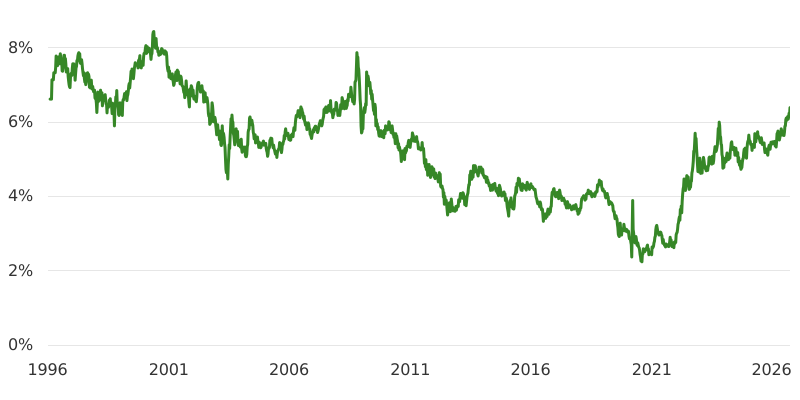
Collectively, higher Treasury yields and relatively contained spreads have pushed AA corporate yields to multi-decade highs, with long AA yields averaging 6.4%, up about 100 bps year to date (Exhibit 1). As a result, liability values are down roughly 6%–8% year to date, further improving funded status from already-strong levels of 105% to 108% at the beginning of the year.2 The magnitude of that improvement depends on each plan’s specific hedge ratio:
- Plans with lower hedge ratios (less than 90%–100%) benefited from the combination of rising rates and strong equity markets.
- Plans with higher hedge ratios (90%–100%) at the start of 2026 likely experienced more modest gains, supported by above-average equity returns, while interest rate effects remained neutral.
Exhibit 1: Long AA corporate yields have risen to levels not seen in more than two decades
Past performance is no guarantee of future results.
Data represents long-duration AA-rated corporate bond yields. Source: Bloomberg Finance L.P., as of 9/30/26.
So, what’s driving the rapid rise in global rates?
- Strong growth has tended to coincide with higher real yields. Market expectations for multiple rate hikes have pushed up the real (inflation-adjusted) cost of borrowing.
- Inflation declines have reversed course, and price pressures remain sticky. Higher energy prices and supply concerns are keeping risks elevated, placing additional pressure on central banks to raise policy rates.
- Large fiscal deficits often translate into greater government bond issuance, potentially requiring higher yields to attract sufficient demand. This dynamic has become an increasing focus for investors in 2026.
- Capital expenditures and infrastructure expansion related to artificial intelligence (AI) and data centers are driving significantly higher current and expected corporate debt issuance, with the hundreds of billions of dollars in financing adding further upward pressure on yields.
There are factors that could keep rates elevated.
- Many of the factors putting upward pressure on rates remain entrenched and are unlikely to be resolved quickly. Even if the conflict with Iran were to de-escalate, energy market participants believe some supply chain disruptions could persist for years, with some changes becoming permanent.
- Resilient economic growth and strong corporate earnings give the Fed room to weigh both growth and inflations risks when determining the appropriate path for monetary policy under its dual mandate. Any concern the Fed is falling behind the curve could keep yields elevated.
- The “higher for longer” environment represents a shift from the “lower for longer” one that dominated much of the prior decade. Economic resilience has driven real rates higher, while rising debt-to-GDP levels across the globe are receiving increased investor scrutiny after years of expansion.
There are also factors that could cause rates to fall, particularly in a shock environment.
- A sharp equity market sell-off driven by stretched valuations, a slowdown in earnings growth, or a correction in AI-related expectations could trigger a flight to quality, increasing demand for Treasuries and driving down yields.
- Elevated geopolitical risk, including uncertainty surrounding global oil supply and pricing, could increase market volatility, pressure equities, and prompt another flight to quality in Treasuries. On the other hand, a resolution to the Iran crisis could ease inflation expectations if oil supply re-opens anywhere near pre-crisis levels.
- Growing confidence in the Fed’s ability to contain inflation through measured policy actions could push long-term yields lower, particularly if investors become convinced that inflation is trending towards the preferred level.
What this means for pension strategy
Following what has felt like a one-way train ride towards higher rates from the 2020 lows, rate risk may be more symmetrical, with a meaningful move in either direction plausible.
For pension plans, this has important implications because the pain trade is not higher rates, rather lower rates that drive liability values higher.
For a plan that entered this period with a relatively low hedge ratio:
- Funded status has likely improved over these last few years, largely due to favorable market dynamics rather than market foresight. That creates an opportunity to increase the hedge ratio and lock in some of those gains, shifting the focus to managing risk, not regret. Rates could still move higher in the near term, but they could also fall, reinforcing the case for a disciplined approach to risk management.
For a plan already maintaining a full or near-full hedge:
- Funded status likely maintained or improved on the margin over this time. Maintaining that hedge and re-adjusting where appropriate leaves the plan well positioned to navigate a market environment in which the direction of rates is less obvious.
Putting it into perspective: The dramatic rise in rates has materially changed the opportunity cost formula between equities and fixed income. In 2020, with Treasury rates as low as 1%, the opportunity cost of owning bonds versus equities was significant. Today, with corporate yields above 6% and equity valuations elevated in several areas following three years of strong returns, which have tempered forward return expectations, that differential is much lower.3
Why it matters for LDI portfolio construction
- Rate volatility, heavy issuance in select sectors, and evolving credit fundamentals have introduced new sources of potential value that have not been seen in a few years, meaning there is more happening below the surface.
- Heavy data center issuance has created distinct market dynamics, at times repricing existing secondary market bonds and creating buying opportunities in other sectors. It has also increased concentration risk in the AA credit sector used for liability curve construction. However, the overall impact is a net positive, given the overall high credit quality of the hyperscaler issuance and strong earnings support relative to other periods of heavy sector issuance.
- High yields, particularly further out the curve, are generating attractive investment opportunities relative to equities, with some long corporate bonds yielding over 8%.
- Mid-cycle merger and acquisition activity may favor companies and sectors better positioned to withstand elevated financing costs—not every company can absorb the burden of higher rates.
The bottom line: Rising bond yields have created a challenging environment for many fixed income investors. But for corporate plan sponsors, it has a positive impact on liability values, providing an opportunity to re-evaluate the plan’s pension strategy, hedge ratio, and LDI composition. The question now becomes: Do you want to manage risk or manage regret?
Daniel Tremblay, CFA, is the head of Pension Solutions within Fidelity Institutional®. In this role, he engages with internal institutional distribution and consulting partners to shape our strategy, drive the business, and focus on the innovation, development, and delivery of pension solutions and strategies.
Michael Jarasitis, CFA, is a pension strategist in the Fidelity Institutional group at Fidelity Investments. In this role, Mr. Jarasitis works closely with corporate defined benefit plans to develop and execute custom de-risking solutions. He also provides capital market perspectives and represents the investment process in the marketplace.
Next steps to consider
Pension investment solutions
Take a tour of Fidelity's pension solutions, all designed to meet plan sponsors' specific goals and needs.
Learn more
Asset Allocation Strategies
Draw on unmatched resources, scale, and experience with our broad range of asset allocation strategies.
Learn more
Outsourced CIO
Explore outsourced CIO solutions tailored to your needs, powered by Fidelity's deep investment capabilities and proprietary research.
Learn more
1. Bloomberg Finance L.P., as of Sept. 30, 2026.

2. Milliman, Inc.: Milliman 100 Pension Funding Index analyzes the 100 largest U.S. corporate pension plans, as of Aug. 31, 2026. "Pension Funding Index September 2026," by Zorast Wadia, Sept. 10, 2026. https://www.milliman.com/en/insight/pension-funding-index-september-2026.
3. Bloomberg Finance L.P., as of Sept. 30, 2026.