




Navigating private markets in 2026: Q&A with StepStone and Fidelity
A discussion of global private equity trends—including valuation dynamics, distribution recovery, value creation, and secondary markets.
Ian Johnson: What are the key themes shaping global private equity markets today? What is your outlook for 2026?
Michael Elio: StepStone believes there are several key themes shaping global private equity markets today.
- Continued resilience amid macroeconomic volatility
Private equity has shown a consistent ability to withstand market volatility. Across major crises—from the dot-com downturn to Covid-19—price-to-earnings (PE) ratio has historically captured approximately 55% of public market drawdowns while exceeding 100% of public market recoveries. This underscores its long-term resilience and ability to compound value despite volatility. - Slower exits but not a market breakdown
Exit activity has slowed since 2022 due to higher rates, inflation, and buyers’ caution. However, exits continue to occur, with quality assets still finding buyers. While the tariff situation in 2025 created a pause in mergers and acquisitions activity, the rebound became more significant in the second half of 2025. General partner (GP)-led secondaries have also expanded, becoming a more meaningful liquidity channel. - Despite concerns that private equity valuations may be inflated, evidence suggests otherwise
Private assets usually trade below public peers due to size and liquidity differences. Assets continue to exit at premiums to their valuations a year earlier, validating prior marks rather than revealing overvaluation. - Value creation is driven by growth and operational execution, according to return data across more than 13,000 buyout deals
Revenue growth and margin expansion generate 3.3 times more value than multiple expansion. PE-backed companies have delivered about 7% higher annual revenue growth than public peers, demonstrating the impact of active ownership.1 - General partner-led transactions are gaining momentum
GP-led secondaries have become a structural feature of the market. Volumes rose from $71 billion in 2024 to $105 billion in 2025. Demand focuses on blue-chip assets with strong growth and stable cashflow. This reflects a broadening of liquidity options across vintage years.
2026 presents a constructive opportunity set for disciplined investors, favoring those with strong GP relationships, steady pacing strategies, and a focus on fundamental value creation. Improving exit markets will enhance liquidity and valuation discipline will continue to support portfolio credibility. In our view, operational excellence will differentiate top performers in an environment of moderate growth and higher financing costs. In addition, secondary and GP‑led activity will remain elevated, creating both liquidity and opportunity.
Ian Johnson: What is your perspective on current valuations? Within private equity markets, where might valuations be rich? Attractive?
Michael Elio: StepStone’s analysis finds no systemic overvaluation across private equity markets. Despite headlines questioning valuation integrity, the data shows:
- Private assets are marked at levels below public markets, consistent with structural differences in liquidity and company size.
- Exits continue to occur at premiums to prior marks, meaning realizations are validating reported valuations—not contradicting them.
- Alignment between active and exited valuations strengthened in 2024–25, indicating that marking discipline is intact even after a volatile macro period.
StepStone identifies several areas where valuations look compelling:
- Companies with strong earnings growth and low reliance on multiple expansion: These businesses are valued more based on fundamental performance, not market sentiment—making them comparatively attractive.
- Smaller and mid‑market companies: Private equity generally prices smaller companies at lower multiples than public peers, due to size and liquidity discounts. These persistent discounts make the lower middle market structurally more attractive on a valuation basis.
- Strategies where operational value creation dominates: Across the more than 13,000 buyout deals analyzed; revenue and margin expansion generated 3.3 times more value than multiple expansion.
Ian Johnson: Given the multi-year dearth in private equity distributions, what are your private equity distribution expectations over the next year? How are extended hold periods and the increased GP use of continuation vehicles influencing LP pacing strategies?
Michael Elio: Private equity distributions have remained significantly depressed in recent years as mature portfolios historically distributed about 20%–25% of net asset value (NAV) per year. Still, in recent years, distributions fell to just 10%–15% of NAV, levels not seen since the global financial crisis. As outlined in Exhibit 1, global PE distributions were 12% of NAV through 2025, and buyout-only distributions were 13%. Despite positive momentum, distributions as a % of NAV remain meaningfully below the long-term average of 21%.
Exhibit 1: Private equity distributions since 2000 (2000-2025)
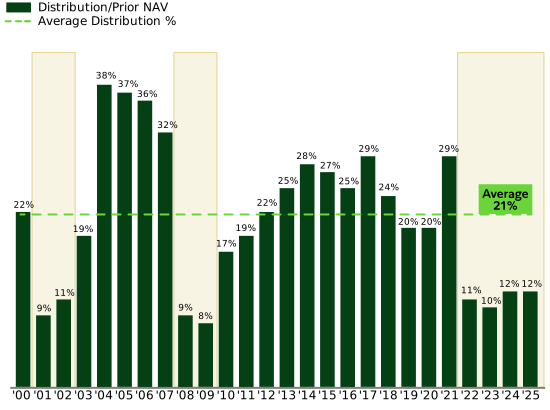
Source: SPI by StepStone. Full dataset and average annual distributions calculation cover from Q4 1999 to Q4 2025. Data set includes 3,510 Global Private Equity funds. Note: Distributions % of NAV calculated as annual global private equity distributions as a percentage of total NAV from the prior year. Year-to-date distributions are divided by the NAV at the end of the prior year. Distributions include buyouts, venture capital, and growth.
This slowdown is directly tied to a sharp decline in exit activity across 2022–2024. However, the same analysis provides evidence that exit activity is beginning to recover, supporting higher distribution expectations over the next 12–18 months. StepStone’s forward‑looking dataset identified 100+ portfolio companies where GPs have begun exit discussions. Eighty percent of these companies exhibit strong earnings growth and limited reliance on multiple expansion, making them credible near‑term exit candidates. In addition, StepStone expects a gradual improvement in distributions over the next year, supported by healthier exit pipelines and the sustained increase of GP‑led secondary transactions.
Ian Johnson: How has the secondary market evolved in recent years? What do you see as the biggest opportunities and challenges in this space? Do you expect secondary transactions to drive greater liquidity in 2026?
Michael Elio: The secondary market—particularly GP‑led transactions—has expanded rapidly and become a central part of the private‑equity liquidity ecosystem. GP‑led transaction volume increased from $32 billion in 2020 to $106 billion in 2025, almost tripling in five years. Secondary activity has helped drive distributions to paid-in capital (DPI), particularly during years when traditional exits (IPOs, corporate sales) slowed.
Secondary markets are expected to take on an even more important role in providing liquidity in 2026. GP‑led secondaries reached record levels in 2025, and the demand for these structures is structural rather than cyclical. StepStone’s forward‑looking analysis indicates that 80% of near‑term exit candidates have strong earnings growth and limited dependence on multiple expansion—making them well‑suited for GP‑led or traditional secondary processes. Sponsor‑to‑sponsor activity also strengthened in 2025, reflecting renewed buyer appetite and supporting overall market liquidity.
Michael Elio is a member of the private equity team, leading the middle- and large-market buyouts and secondary funds sector teams. He is also involved in portfolio construction for many of the firm’s largest advisory clients, SMA clients, and high-net-worth distribution platforms.
Ian Johnson is an institutional portfolio manager in the Institutional Portfolio Management team at Fidelity Institutional®. He serves as a member of the investment management team, maintaining a deep knowledge of portfolio philosophy, process, and construction; assisting portfolio managers and their CIOs in ensuring portfolios are managed in accordance with client expectations.


Next steps to consider
Endowments & Foundations
See how our tailored solutions help endowments and foundations navigate the evolving market and work toward their investment objectives in service to their mission.
Learn more
Outsourced CIO
Explore outsourced CIO solutions tailored to your needs, powered by Fidelity's deep investment capabilities and proprietary research.
Learn more
Custom investment solutions
Discover how our investment solutions can be tailored to meet your unique goals and objectives.
Learn more
Stay up-to-date on our research and insights.
1. Source: SPI by StepStone, CapIQ, as of June 2025.
This document is for informational purposes and is meant only to provide a broad overview for discussion purposes. This document does not constitute an offer to sell, a solicitation to buy, or a recommendation for any security, or as an offer to provide advisory or other services by StepStone Group LP, StepStone Group Real Assets LP, StepStone Group Real Estate LP, StepStone Group Private Wealth LLC, StepStone Group Private Debt AG, StepStone Group Europe Alternative Investments Limited and StepStone Group Private Debt LLC, their subsidiaries or affiliates (collectively, “StepStone”) in any jurisdiction in which such offer, solicitation, purchase or sale would be unlawful under the securities laws of such jurisdiction. The presentation is being made based on the understanding that each recipient has sufficient knowledge and experience to evaluate the merits and risks of investing in private market products. Information contained in this document should not be construed as financial or investment advice on any subject matter. StepStone expressly disclaims all liability in respect to actions taken based on any or all of the information in this document. This document is confidential and solely for the use of StepStone and the existing and potential investors or clients of StepStone to whom it has been delivered, where permitted. By accepting delivery of this presentation, each recipient undertakes not to reproduce or distribute this presentation in whole or in part, nor to disclose any of its contents (except to its professional advisors), without the prior written consent of StepStone.
Expressions of opinion are intended solely as general market commentary and do not constitute investment advice or a guarantee of returns. All expressions of opinion are as of the date of this document, are subject to change without notice and may differ from views held by other businesses of StepStone.
Some information used in the presentation has been obtained from third parties through various published and unpublished sources considered to be reliable. StepStone does not guarantee its accuracy or completeness and accepts no liability for any direct or consequential losses arising from its use. Thus, all such information is subject to independent verification by prospective investors.
All information provided herein is subject to change.
All valuations are based on current values calculated in accordance with StepStone’s Valuation Policies and may include both realized and unrealized investments. Due to the inherent uncertainty of valuation, the stated value may differ materially from the value that would have been used had a ready market existed for the portfolio investments or a different methodology had been used. The long-term value of these investments may be lesser or greater than the valuations provided.
StepStone Group LP, its affiliates and employees are not in the business of providing tax, legal or accounting advice. Any tax-related statements contained in these materials are provided for illustration purposes only and cannot be relied upon for the purpose of avoiding tax penalties. Any taxpayer should seek advice based on the taxpayer’s particular circumstances from an independent tax advisor.
Prospective investors should inform themselves and take appropriate advice as to any applicable legal requirements and any applicable taxation and exchange control regulations in the countries of their citizenship, residence or domicile which might be relevant to the subscription, purchase, holding, exchange, redemption or disposal of any investments. Each prospective investor is urged to discuss any prospective investment with its legal, tax and regulatory advisors in order to make an independent determination of the suitability and consequences of such an investment.
An investment involves a number of risks and there are conflicts of interest. Please refer to the risks and conflicts disclosed herein or in relevant disclosure documents associated with potential investments.
Each of StepStone Group LP, StepStone Group Real Assets LP, StepStone Group Real Estate LP, StepStone Group Private Wealth LLC and StepStone Group Private Debt LLC is an investment adviser registered with the Securities and Exchange Commission (“SEC”). StepStone Group Europe LLP is authorized and regulated by the Financial Conduct Authority, firm reference number 551580. StepStone Group Europe Alternative Investments Limited (“SGEAIL”) is an investment adviser registered with the SEC and an Alternative Investment Fund Manager authorized by the Central Bank of Ireland and StepStone Group Private Debt AG (“SPD”) is an SEC Exempt Reporting Adviser and is licensed in Switzerland as an Asset Manager for Collective Investment Schemes by the Swiss Financial Markets Authority FINMA. Such registrations do not imply a certain level of skill or training and no inference to the contrary should be made.
PAST PERFORMANCE IS NOT INDICATIVE OF FUTURE RESULTS. ACTUAL PERFORMANCE MAY VARY.
StepStone Group and Fidelity Investments are not affiliated.