




Our philosophy on investing in private markets for nonprofits
For nonprofits that can tolerate illiquidity, private assets can be a valuable source of diversification and growth. But sizing and selection are critical to success.
Fidelity's Erika Murphy discusses how private markets can help institutions with a long time horizon access a wider universe of investable companies, potentially increase returns, and support long-term spending needs.
What is your philosophy on private markets investing?
For institutions—especially capital appreciation-focused nonprofits, endowments, and foundations—private markets can be helpful in broadening the investment opportunity set and potentially enhancing portfolio returns, though private manager access and selection are critical. Even in the best case scenario, however, private investing is not a one-size-fits-all allocation. Client circumstances such as liquidity needs, investment sophistication, and operational support must be considered before making an investment in private markets.
If institutions can tolerate illiquidity risk, private markets can help to expand a nonprofit's investment opportunity set beyond public markets, especially as public markets have shrunk in recent decades. Conversely, the universe of private companies has grown meaningfully. For example, the number of private- equity-backed firms has increased from just under 5,000 companies in 2006 to 13,500 currently, according to the Wall Street Journal1. In addition, there are over 1,580 private companies each valued at over $1 billion2 (the so-called unicorns). Given the rotation away from publicly listed companies to privately listed companies in the U.S., and as the US. private equity market has matured over time, allocators may be leaving returns on the table if they limit themselves to only public markets.
Beyond just broadening allocators' investment universe, private market funds can tap a broader tool kit to create value for investors. They can do so without the noise and pressure of having to report quarterly earnings and manage short-term public market expectations. Instead private investors' governance models have more direct influence on strategic business decisions and value-creation initiatives—such as changing management or management incentives, influencing board appointments, adjusting the capital structure, or changing cost structures—to more directly affect growth, profitability, and investor returns.
If done well, private market funds may offer greater return potential compared to public markets. Unfortunately, however, history shows that many private funds disappoint, creating wide return dispersion within private asset classes. This makes manager selection absolutely critical to private market success. Without strong manager research and access to top-tier private managers, allocators may underperform public markets while giving up liquidity.
How do you determine the appropriate allocation to private markets within a portfolio?
After determining with a client that they can take on illiquidity risk, we evaluate which private market assets are best aligned with a client's return and liquidity needs. For example, private equity exposure may be more appropriate for nonprofit organizations with ambitious return objectives and spending rates, as the level of return from private equity tends to be highest among private asset classes. Private real assets tend to be effective inflation-hedges over the long-term, so these allocations can be well-suited for organizations that are perpetual in nature and wish to preserve their long-term real wealth. Private credit tends to be best suited to insurers and liability-focused pensions, as well as some health care organizations, as these organizations often benefit from a more consistent income profile that may be achieved through certain types of private credit.
While we do have strong views on which private asset classes tend to best align with client return, risk, and liquidity objectives, we do not have a one-size-fits-all recommendation for sizing private asset allocations. The size of private investments is heavily influenced by client objectives and constraints. To determine the best allocation for each client, we model several asset allocation mixes with various private market allocations to illustrate the potential range of return/risk/liquidity outcomes. We discuss these customized mixes and their tradeoffs with clients, and we compare them to our expectations for the client's existing return/risk/liquidity outcomes. These conversations are often iterative until we arrive at a private markets asset allocation target that is unique to the client.
For some of our nonprofit clients with a long-time horizon and aggressive return objectives, we do suggest private equity exposure to broaden the investment opportunity set and potentially access higher returns. Consistent with this rationale, we see that a private equity allocation is quite common across many endowments and foundations.
For fiscal year 2025, for example, the 2025 NACUBO-Commonfund Study of Endowments (NCSE)3 data shows that participating endowments are diversified across asset classes, with many institutions looking well beyond traditional public markets. U.S. colleges and universities' endowment allocations to private investments varied widely, ranging from approximately 5% to more than 30%, depending on the size of assets under management, according to the 2025 study (see Exhibit 1 ). On a dollar-weighted basis, private equity was the largest single allocation at about 16.8%, topping the dollar-weighted allocation to U.S. equities of 13.7%.
Exhibit 1: Asset allocations across endowment portfolios, fiscal year 2025
Dollar-weighted by endowment
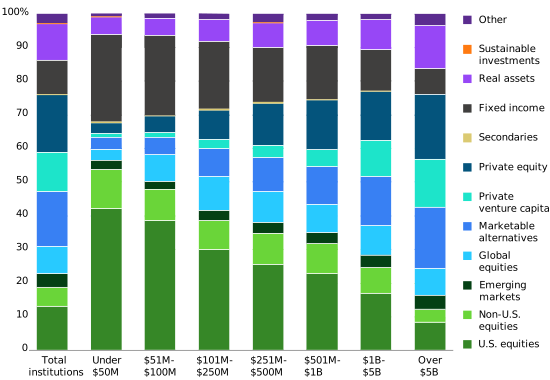
Source: 2025 NACUBO-Commonfund study of Endowments, February 2026.
While the NACUBO data shows private exposure that includes venture investing, we prefer instead to focus primarily on buyout exposure (or co-investments in more mature private companies). Philosophically, we tend to favor top-tier buyout funds as these investments are generally in more established, cash-flow positive companies, and this segment of private equity has historically offered an attractive level of return, with more consistent outcomes and distributions. This strategy stands in contrast to venture exposure, which often invests in companies that are less mature and generally do not have positive cash-flows, and as a result requires longer investment time horizons, offers less consistent returns and distributions, and generally presents significantly more downside risks.
In terms of allocation size, our private equity sizing views may differ from the NACUBO averages, depending on client liquidity needs and the private equity distribution environment. Notably, NACUBO’s 2025 allocations represent fund investments that were made in many cases 5-10 years ago, during environments in which private equity performance and distributions were strong. More recently, however, distributions from private equity funds have slowed materially. This dynamic affects our clients' overall portfolio liquidity and ability to rebalance, so we currently prefer to make smaller private equity allocations than what the NACUBO averages might otherwise suggest for nonprofits of various sizes.
Could you highlight the role of Fidelity's OCIO platform in private market investing?
Beyond evaluating the role of private markets in a portfolio, we can help our OCIO clients with private fund access, research, oversight, pacing strategies, reporting, and the operational complexities of private market investing.
As mentioned above, access to top-tier private funds matters because performance dispersion among private funds is wide. Yet capacity in these top-tier private funds is very limited because they tend to be oversubscribed by larger asset owners and investment platforms with long-established relationships with the fund managers. Moreover, many of the top-performing private funds have high minimum investment requirements, making it difficult for smaller institutions to invest in these funds directly.
OCIO providers, however, often have a private fund network and platform that can offer smaller clients access to top-tier funds, typically via commingled funds. If designed thoughtfully, these commingled private funds offered by OCIO providers can also help clients streamline the operational demands of private market investing, from capital calls and reporting to building a diversified mix of vintages and managers.

Endowments & Foundations
See how our tailored solutions help endowments and foundations navigate the evolving market and work toward their investment objectives in service to their mission.
Learn more
Outsourced CIO
Explore outsourced CIO solutions tailored to your needs, powered by Fidelity's deep investment capabilities and proprietary research.
Learn more
Alternative investment strategies
Discover a wider range of new investment opportunities with our growing lineup of alternative investments.
Learn more
Stay up-to-date on our research and insights.
Related Insights
View all


The Chartered Financial Analyst (CFA) designation is offered by the CFA Institute, To obtain the CFA char-ter. candidates must pass three exams demonstrating their competence, integrity, and extensive knowledge in accounting, ethical and professional standards, economics, portfolio management, and security analysis, and must also have at least 4,000 hours of qualifying work experience completed in a minimum of 36 months, among other requirements, CFAL is a trademark owned by CFA Institute.
Chartered Alternative Investment Analyst (CAIA) is offered by the Association of Chartered Alternative Analysts. Candidates are expected to understand the basic concepts of finance and quantitative analysis and need to pass two exams. One year of professional experience with a bachelor's degree or four of professional experience without a bachelor's degree is required. Professional experience is defined as full-time employment in a professional capacity within the regulatory, banking , financial, or related fields.Views expressed are as of the date indicated, based on the information available at that time, and may change based on market and other conditions, Unless otherwise noted, the opinions
provided are those of the author and not necessarily those of Fidelity Investments or its affiliates. Fidelity does not assume any duty to update any of the information.
- Wall Street Journal. "Private-Equity Firms Are Sitting on a Nine-Year Backlog," July 7t 2026. https://www.wsj.com/finance/investing/private-eauity-firms-are-sitting-on-a-nine-year-backlog- dbec673a
- Bloomberg L.P- "Future of IPOs 2026 Outlook," by Bloomberg Intelligence. April 2026. "https://www.bloomberg.com/companydpress/frictions-weigh-on-public-markets-capital-goes- private-finds-bloomberg-intelligence/
- 2025 NACUBO-Commonfund Study of Endowments, February 2026. Study participants included 657 U.S. colleges and universities and affiliated foundations. https://www.nacubo.prg/ Research/2026/NACUBO-Commonfund-Study-of-Endowments