You are on the Investment solutions website for advisors & wealth management firms.
Browse more Fidelity websites here.
Today’s wealth management firms face a multitude of growth options. Many of the largest firms today began as asset managers, evolved into planning, and then added services to become wealth managers. Their evolution is continuing as they enhance capabilities through mergers and acquisitions (M&A) and actively hire specialized talent. Emerging and mid-sized firms are also actively expanding services through partnerships with outside experts.
Making the right decision on how to evolve your practice can significantly influence your future competitiveness and financial health. To help you consider the best path for your firm, we asked the leaders of several high-growth businesses for their perspectives on managing complexity, adding service offerings, and keeping a strategic focus.
Since 2004, Mallouk has transformed Creative Planning from a small firm with a handful of clients into one of the largest independent financial advisory firms in the United States, managing approximately $350 billion (as of Aug. 2026) in client assets. The firm practices a holistic approach to wealth management.

Since 2003, Dekko has guided the firm’s growth from a regional advisory business managing $600 million in assets to a national Registered Investment Advisor (RIA) with over $125 billion (as of Aug. 2026) in assets under management and 1,800 employees across the country. Wealth Enhancement has completed over 100 strategic acquisitions.

Bicknell co-founded Mariner with seven partners in 2006. Mariner is committed to positively impacting the lives of many by bringing together exceptional advisors, specialized resources, and an integrated platform to build lasting client relationships. Under Bicknell’s leadership,the firm now advises $650 billion (as of Aug. 2026) in client assets.

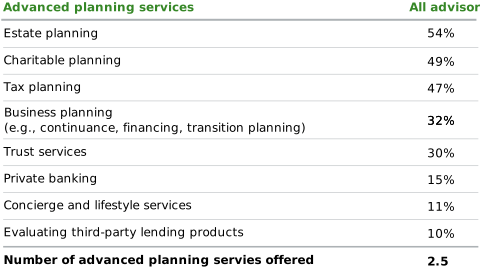
Source: Cerulli Associates, U.S. Advisor Metrics 2024
As the CEOs we interviewed can attest, the essential step before adding any service is to ask for client feedback. Jeff Dekko of Wealth Enhancement suggests that “advisory firms must constantly ask: What problems are clients trying to solve, and where are we credibly positioned to help? Our decision to add services wasn’t driven by competitive benchmarking or industry trends; it came directly from listening to clients.” “We have been a planning-led firm since our founding,” says Peter Mallouk of Creative Planning, “so naturally we mark the critical steps in our clients’ plan development, making sure each of our services helps to meet those successive steps. As the saying goes, ‘things get lost in the gaps’ and we try to make very sure there will be no gaps.”
While client preferences must be considered thoughtfully, our interviewees also stress balancing client interests by making sure that each service you add aligns with your business strategy, your ideal client profile, and your firm’s strengths.
“Our rationale has always been strategic. We were in business for 15 years before we made any acquisitions,” says Mallouk. “Our legal, retirement planning, and trust teams, for example, were all built over that time to support a long-term vision. We are trying to create a durable business and compete a decade from now.”
Dekko proposes that “the better approach is to focus on true adjacencies—services that naturally complement your core values and purpose. If comprehensive planning is at the center of your client relationships, then tax planning would make sense and may deepen engagement.”
Mariner’s Marty Bicknell notes that if it’s considered strategic, it belongs in-house, saying that “one of the most overused words in our industry is holistic planning. Everyone says it, but it is still important. To be truly holistic, I believe talent and expertise must be brought in-house. That way we can shape the culture, manage the priorities, and give our advisors access to excellence in all these areas for the benefit of clients.”
Across the industry, firms are adding services through a gradual, intentional process. We’re seeing wealth managers shift from informal referral arrangements with several accountants to more formal arrangements, followed by hiring a CPA, and later buying an accounting practice. Similarly, firms are moving away from outside estate planning firms and hiring an estate attorney in-house. Even with trust services, some opt for outsourcing, while others are starting or acquiring their own trust company.
This is the question, and it can be a challenging one to answer. Establishing a broker-dealer includes FINRA regulated net capital requirements, FOCUS reporting, audits, licensing requirements, and specialized compliance staff. While the addition may create new revenue streams by allowing the firm to offer a broader range of alternative investments and variable insurance products, will it be worth the investment? Our interviewees offer distinct perspectives.
Mallouk observes, “we’ve seen a lot of broker-dealers try to move over into the RIA space, to look more like RIAs, but now we're seeing RIAs add broker-dealers. And so, I think we're coming to the middle over time. It's getting muddy.”
The broker-dealer capability might offer a way to reduce potential points of friction when recruiting advisors with trails that they prefer not to relinquish, or when serving certain clients or transactions that may fit better in a brokerage construct, but it may also add a level of complexity. Mallouk prefers that Creative Planning stays an RIA exclusively. “We have no broker-dealer. At Creative Planning, everyone is registered as an RIA. It supports a seamless integration of service offerings across the firm.”
Dekko’s Wealth Enhancement decided to add a broker-dealer capability not too long ago. “We see that there are some situations where, at an advisor’s discretion, the client might be better served by keeping some of their assets within a brokerage construct. It may give our advisors some flexibility when navigating an individual client’s path.”
Bicknell, Dekko, and Mallouk agree that added services can accelerate growth, but adding the right people matters more than speed. Dekko points out that “often an acquired firm brings innovative ideas, and entrepreneurial vitality, and you don't want to lose that spirit in the process. These are successful professionals that we can learn from.
"Bicknell refers to Mariner’s approach as “a frontstage, backstage perspective." [When integrating a business with our firm] we don’t want to mess with the front stage, the client experience. I’m a firm believer that there’s more than one ‘right way’ to do this business. We want to allow those individuals to do what they do, what got them to where they are, and then surround them with all those other resources and elevate the client experience.”
The comments from these firm leaders underscore the importance of the ideas, energy, skill, and creativity of the team that will ultimately deliver a new client service. Their talent and professionalism is essential to powering the business forward.
Wealth management firms focused on sustainable growth exercise discipline and patience, allowing time for improvement and adjustment. It also helps to remember that adding a new service does not mean every client will immediately move their business.
“I would say be nimble and iterate,” says Bicknell. “Don’t get stuck on a certain perspective. Test the idea, evaluate it, test it again, and just keep changing with that. I think the iteration thing has worked well for us. Really figure out your client value proposition, and what advisor value proposition you’re striving for. Stay true to that piece of it, instead of it being AUM for AUM’s sake.”
Dekko believes services must be codified so that the value of an added service can be measured. “On average, our advisors heavily utilize multiple services, across many distinct functions. I think this usage underscores two things: client needs are diverse, and advisor discretion matters. The goal isn’t uniform adoption—it’s really what works best for the client.” A consumer marketer in his early career, Dekko relies on performance metrics to evaluate client impact. “We focus on three indicators: net promoter scores (NPS), employee engagement measures, and asset flows. And we can see whether certain services are strengthening relationships, improving advisor experience, and supporting long-term firm health.”
Successfully building your firm’s capabilities means navigating key decision points and arriving at solutions that delight clients and power the business forward. If your firm is looking to build, buy, or partner to achieve targeted goals, seek out expertise and explore these next steps:
Want to assess your business to see where you might leverage your strengths?
Contact your Fidelity representative today and explore the possibilities.
Discover how to transform your firm into a future-ready practice by leveraging our proprietary research, proven frameworks, and industry-leading insights.
Learn more
Make the right move for your firm with our M&A resources, which can help you compete in an increasingly consolidated industry.
Learn more
Go beyond traditional client segmentation to understand where your revenue is coming from with our tailored insights.
Learn more



1. 2026 Fidelity Investor Insights Study
The 2026 Fidelity Investor Insights Study was an online blind survey (Fidelity not identified) that was fielded during the period March 6 through April 28, 2026. It surveyed a total of 2,652 investors, including 1,245 Millionaires and 1,548 investors with advisors. The study sample was provided by an independent firm not affiliated with Fidelity. Respondents were screened for a minimum level of $50K in investable assets (excluding retirement assets and primary residence), with additional quotas by age and affluence levels.
The views expressed are as of the date indicated and may change based on market or other conditions. Unless otherwise noted, the opinions provided are those of the speaker or author, as applicable, and not necessarily those of Fidelity Investments. The experts are not employed by Fidelity but may receive compensation from Fidelity for their services. Fidelity Investments is not affiliated with any other company noted herein and doesn’t endorse or promote any of their products or services. Please determine, based on your investment objectives, risk tolerance, and financial situation, which product or service is right for you.
Third-party marks are the property of their respective owners; all other marks are the property of FMR LLC.
The third-parties referenced herein are independent companies and are not affiliated with Fidelity Investments. Listing them does not suggest a recommendation or endorsement by Fidelity Investments.