You are on the Investment solutions website for advisors & wealth management firms.
Browse more Fidelity websites here.
Here’s a frequent question we’re getting lately from advisors: What do we think about the role of bonds in a 60/40 portfolio? We think today's higher yields have created a better risk/reward trade-off: Treasury yields do not have to fall for bonds to generate a respectable return, while higher starting income may help cushion losses if rates rise further.
We are increasingly constructive on high-quality bonds, not because we have a strong conviction that Treasury yields are headed lower. Rather, today's yields provide investors more income and, therefore, a larger margin for error than they've had in years.
Investors often worry that adding duration today will backfire if rates rise from here.
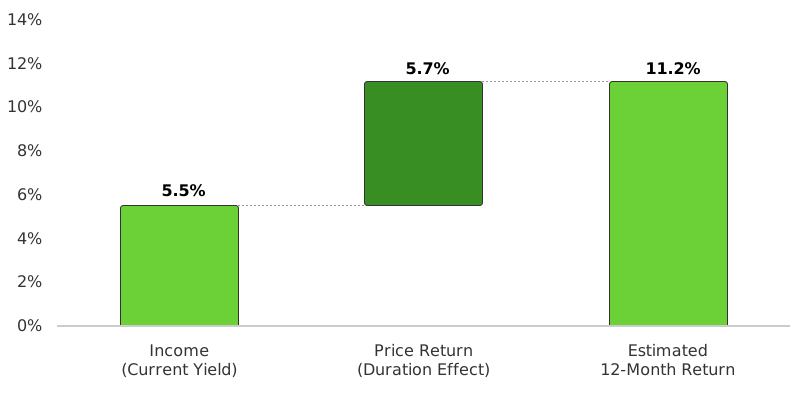
Price gains from duration add to income, resulting in a potential double-digit return.
If yields rise by 100 bps
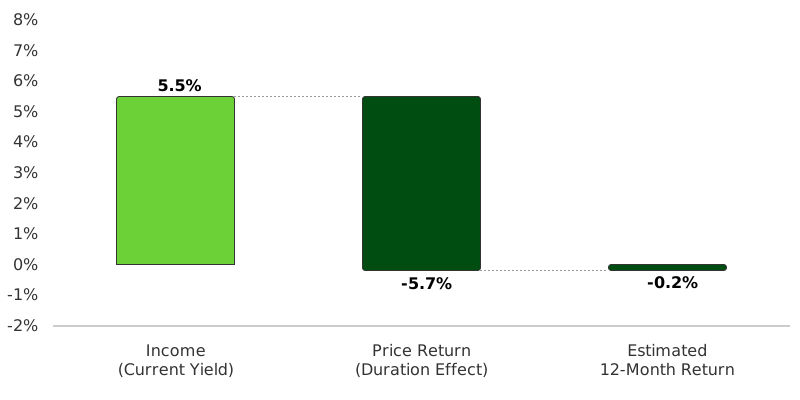
Price declines from duration are largely offset by income, resulting in a roughly flat return.
For illustrative purposes only. Past performance is no guarantee of future results. Diversification does not ensure a profit or guarantee against a loss. It is not possible to invest directly in an index. Source: Bloomberg Finance L.P., as of 9/30/26. Illustrative 12-month estimates for the Bloomberg U.S. Aggregate Bond Index: 5.5% starting yield and 5.7-year duration.
Exhibit 1 shows our view of the bond math. It assumes the Bloomberg U.S. Aggregate Bond Index starts with a yield of 5.5% and duration of 5.7 years.
In this scenario, if yields fell by 1 percentage point (100 bps), income and price appreciation would produce an estimated 12-month return of 11.2%.
Conversely, if yields instead rose by 1 percentage point (100 bps), the 5.5% income cushion would help offset most of the estimated price decline.
The point isn't that bonds can't lose money. They can. Interest-rate risk hasn’t disappeared.
What's changed is how much investors are being paid to take that risk. Today's higher starting yields provide a larger margin for error. Investors may not need to get the call exactly right to benefit from bond exposure.
Cash-like investments have served investors well in recent years, and attractive money market yields have given many investors little reason to move out the curve.
But cash-like investments come with a trade-off: If interest rates decline, yields on these investments can reset lower, offering little opportunity to benefit from rising bond prices.
This is why we believe limited- and intermediate-term bonds may deserve another look.
Moving modestly beyond cash may help investors receive attractive income while adding the potential for price appreciation if yields decline.
This sets up advisors to have an easy conversation with clients:
After years of asking whether bonds were worth owning, investors may now need to consider a different question: Do I have enough of the “40"?



Bloomberg U.S. Aggregate Bond is a broad-based, market value-weighted benchmark that measures the performance of the investment-grade, U.S. dollar-denominated, fixed-rate taxable bond market.
The S&P 500 index is a market capitalization-weighted index of 500 common stocks chosen for market size, liquidity, and industry group representation to represent U.S. equity performance.
The information contained herein is general in nature and should not be construed as legal or tax advice. This material is not intended to provide, and should not be relied on for, tax, legal, investment, or accounting advice. Tax laws and regulations are complex and subject to change. You should consult your own tax, legal, investment, and accounting advisors before engaging in any transaction.
Some of this information is forward-looking and is subject to change.
Views expressed are as of the date indicated, based on the information available at that time, and may change based on market and other conditions. Unless otherwise noted, the opinions provided are those of the authors and not necessarily those of Fidelity Investments or its affiliates. Fidelity does not assume any duty to update any of the information.
Diversification does not ensure a profit or guarantee against a loss.
Investment decisions should be based on an individual’s own goals, time horizon, and tolerance for risk.
These materials are provided for informational purposes only and should not be used or construed as a recommendation of any security, sector, or investment strategy.
Stock markets, especially foreign markets, are volatile and can decline significantly in response to adverse issuer, political, regulatory, market, or economic developments.