You are on the Investment solutions website for advisors & wealth management firms.
Browse more Fidelity websites here.
Investors have primarily been focused on the scale of AI demand, but now more attention is shifting to the question of who ultimately carries the financial burden of meeting that demand.
Large technology companies are committing enormous sums to semiconductors, data centers, networking equipment, and power infrastructure. Those outlays support suppliers and economic activity today, but the spending precedes the revenue it is expected to generate. As the cycle matures, the gap between capital deployed and cash returned becomes the central market variable.
That dynamic helps explain why AI spending has supported growth despite a difficult macro backdrop. But capital expenditure (capex) can be an economic tailwind and a financial vulnerability: It boosts current activity while potentially leaving companies with higher depreciation, interest expense, and refinancing needs later.
Earlier technology booms were financed through different channels, but the pattern was similar: Transformative infrastructure attracted capital well before its economics were fully visible—and this is the case with AI. The technology can reshape the economy while parts of the financing structure may deliver disappointing returns.
When capital is abundant, companies can keep investing despite uncertain payback periods. If long-term bond yields rise, credit spreads widen, or debt investors demand stronger covenants, the hurdle rate changes.2 Projects that appear attractive under easy financing can look far less compelling when the cost of capital rises.
This creates a feedback loop across markets. Heavy borrowing can contribute to upward pressure on yields—higher yields can compress equity multiples and raise debt-service costs, while weaker equity prices can make additional financing more expensive. In short, the AI trade cannot be evaluated in isolation from rates and credit.
Demand may remain strong even amid a challenging financing backdrop. That scenario favors companies with scarce capacity, pricing power, strong balance sheets, and a credible path from capital spending to recurring cash flow.
The most important distinction may be between companies using AI investment to widen an existing competitive advantage and companies borrowing to keep pace. The former can compound value; the latter may discover that the cost of staying in the race exceeds the economic return.
The AI trade is no longer concentrated only in equity indexes. Record investment-grade borrowing by hyperscalers, related data centers, and chip-financing vehicles is changing the composition of the corporate bond market. The cohort has issued over $300 billion of investment-grade bonds year to date, up from $136 billion in 2025, with issuance projected to approach $500 billion in 2026 and $550 billion in 2027, according to Fidelity estimates and public company filings (Exhibit 1).
Hyperscaler/Data Center/Chip Financing Issuance Outlook
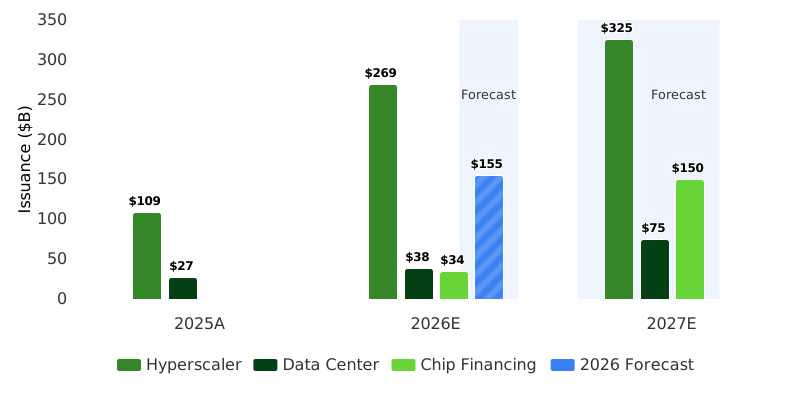
Source: Fidelity Investments, as of 8/14/2026. Note: Issuance group comprises Amazon.com Inc., Alphabet Inc., Meta Platforms Inc., Microsoft Corp., NVIDIA Corp., Oracle Corp., Space Exploration Technologies Corp., hyperscaler-related data center, and investment-grade chip issuance. Specific company names listed are for informational purposes only and are not a recommendation or an offer or solicitation to buy or sell any security.
With the supply included in bond benchmarks, bond portfolios acquire more exposure to the same AI capital cycle that already dominates parts of the equity market. Hyperscaler/AI bonds now represent about 6.2% of the Bloomberg U.S. Corporate Bond Index,3 while their duration-times-spread contribution — a measure of credit risk — exceeds that of the six largest banks.
This creates a less visible form of concentration than what investors see in equity markets. A diversified bond fund may own multiple technology issuers, data center financing, utilities, and capital-goods companies whose credit outcomes all depend on continued AI spending, receptive capital markets, and eventual monetization. As bond spreads and new-issue concessions grow, issuer limits and security selection become increasingly important.
Hyperscaler / AI Names Index Weights
| Bloomberg U.S. Corporate Bond Index | Bloomberg U.S. Aggregate Bond Index | ||||
|---|---|---|---|---|---|
| 2025 | YTD 2026* | 2025 | YTD 2026* | ||
| Amazon | 0.80% | 1.40% | 0.20% | 0.30% | |
| Meta Platforms | 0.80% | 1.00% | 0.20% | 0.20% | |
| Alphabet Inc. | 0.40% | 0.90% | 0.10% | 0.20% | |
| NVIDIA | 0.10% | 0.40% | 0.00% | 0.10% | |
| Microsoft | 0.40% | 0.30% | 0.10% | 0.10% | |
| Oracle | 1.10% | 1.30% | 0.30% | 0.30% | |
| Charter Communications | 0.60% | 0.60% | 0.20% | 0.20% | |
| Space Exploration Technologies | -- | 0.30% | -- | 0.10% | |
| Total | 4.20% | 6.20% | 1.10% | 1.50% | |
Source: Bloomberg L.P., as of 8/31/2026.
AI financing is becoming increasingly interconnected and hard to evaluate. Chipmakers and hyperscalers may invest in AI labs or specialized cloud providers that, in turn, commit to multiyear purchases of chips and computing capacity.
At the same time, data center development is increasingly being outsourced to third-party operators that lease facilities back to technology companies under long-term agreements, sometimes with exit provisions. Because these arrangements are often private, investors may have difficulty identifying unintentional risks, such as how assets are financed, and how much demand is supported by financing within the ecosystem. These arrangements can fuel growth now but may increase downside risk later.
The AI opportunity remains substantial, but the investment debate is moving beyond adoption and market leadership. The next phase will test whether companies can convert heavy upfront spending into returns that exceed their rising cost of capital. In our view, balance sheet quality matters as much as earnings growth.
Two companies may have similar AI exposure but quite different outcomes if one can self-fund investment while the other relies on debt markets and optimistic future cash flows. The key question is not only who wins the AI race, but who can finance the race without impairing shareholders’ or bondholders’ returns. Some key considerations are:
For investors, the opportunity is evolving from AI exposure to AI capital discipline. AI has supported economic growth and market confidence, but the next stress test may occur outside the technology sector. Debt markets will help determine whether the buildout remains a virtuous investment cycle or becomes a source of pressure on yields, credit, and equity valuations.


1. Credit spreads are the extra yield investors demand to own a bond instead of a comparable U.S. Treasury bond.
2. A hurdle rate is the minimum rate of return an investor or company requires before committing capital to an investment or project.
3. The Bloomberg U.S. Corporate Bond Index measures the investment-grade, fixed-rate, taxable corporate bond market. It includes U.S. dollar–denominated securities publicly issued by U.S. and non-U.S. industrial, utility, and financial issuers.
Bloomberg U.S. Aggregate Bond Index is a broad-based flagship benchmark that measures the investment-grade, U.S. dollar–denominated, fixed-rate taxable bond market. The index includes Treasuries, government-related and corporate securities, mortgage-backed securities (agency fixed-rate pass-throughs), asset-backed securities, and collateralized mortgage-backed securities (agency and non-agency).
The information contained herein is general in nature and should not be construed as legal or tax advice. This material is not intended to provide, and should not be relied on for, tax, legal, investment, or accounting advice. Tax laws and regulations are complex and subject to change. You should consult your own tax, legal, investment, and accounting advisors before engaging in any transaction.
Some of this information is forward-looking and is subject to change.
Views expressed are as of the date indicated, based on the information available at that time, and may change based on market and other conditions. Unless otherwise noted, the opinions provided are those of the authors and not necessarily those of Fidelity Investments or its affiliates. Fidelity does not assume any duty to update any of the information.
Investment decisions should be based on an individual’s own goals, time horizon, and tolerance for risk.
These materials are provided for informational purposes only and should not be used or construed as a recommendation of any security, sector, or investment strategy.
In general, the bond market is volatile, and fixed income securities carry interest rate risk.
As interest rates rise, bond prices usually fall, and vice versa. Fixed income securities also carry inflation, credit, and default risks for both issuers and counterparties.
Stock markets, especially foreign markets, are volatile and can decline significantly in response to adverse issuer, political, regulatory, market, or economic developments.