You are on the Investment solutions website for advisors & wealth management firms.
Browse more Fidelity websites here.
The CMSG team believes the economy will accelerate in 2026, and we’ve advocated for a broadening market with expanded asset allocation. We believe U.S. consumers are a durable pillar of this economy—and with a major tax-refund tailwind now approaching, consumers’ bolstered capacity to spend strengthens our belief for the 2026 economic outlook. In related news, the U.S. economy has continued to shrug off lukewarm jobs reports (most recently, Friday’s release was delayed due to last week’s partial government shutdown). It isn’t simple to reach a binary conclusion on whether the eventual jobs data is "bad" or "good" for consumer spending. Job gains have been sideways since April 2025, and the unemployment rate has remained similarly static—yet the economy has accelerated. While job and income gains are important, the relative wealth of consumers is becoming a more significant factor for their propensity to consume.
Consumer spending accounts for 68% of U.S. GDP
Source: Bureau of Economic Analysis, BEA.gov, as of 9/30/25.
Higher-income households remain the primary driver of total spending, a continuation of the K-shaped consumer environment that has defined the post-pandemic cycle. These households have benefited the most from rising asset prices in equities, real estate, and money market holdings–and they continue to spend. This dynamic reinforces a key macro theme: as long as wealthier households continue to experience elevated asset values, aggregate consumer spending retains a durable floor. The top 10% of income earners hold nearly three-quarters of the aggregate U.S. household net worth.1
Even in a benign labor market, the wealth effect remains meaningful. Elevated home equity, strong retirement account balances, and multiyear gains in financial assets all provide consumers with ample support to maintain or increase spending. The combination of wealth stability and easing inflation is likely to strengthen real purchasing power in 2026.
U.S. household net worth has doubled in the past 10 years, growing from $85T in 2015 to $176T in 2025
Source: FRED Federal Reserve Bank of St. Louis, as of 6/30/2025.
The most immediate and powerful near-term boost to consumption is poised to come from significantly larger federal tax refunds, which are expected to reach $517.3 billion, up from $359.3 billion in 2025.2 This may result in one of the largest tax-refund seasons in U.S. history, with refund payments projected to rise approximately $1,000 per filer on average.
Refund size will be directly fed by new provisions such as no tax on tips, overtime, or auto loan interest, along with a higher standard deduction and a major expansion of SALT deductibility. As a result, millions of households will likely see meaningful increases in disposable cash early in Q1 and Q2.
Refund season is historically one of the strongest periods for discretionary consumption—including travel, durable goods, entertainment, home improvement, and financial catch-up behavior (debt paydown and savings). Larger-than-usual refunds could amplify this effect.
While labor income is a disproportionate factor for consumption, it continues to decelerate as wealth accelerates. The wealth effect is becoming a bigger factor in determining consumers’ propensity for consumption.
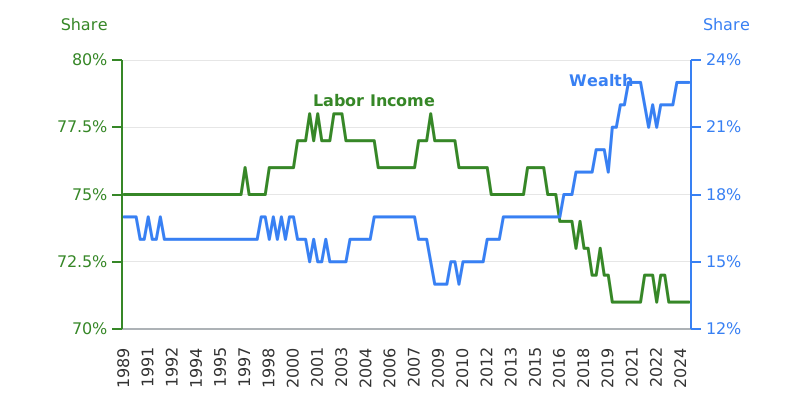
Labor income and wealth do not add up to 100 as the remaining influence on consumption comes from government transfers, which are not shown. Source: Bureau of Economic Analysis, U.S. Federal Reserve, Survey of Consumer Finances, Fidelity Investments (AART), as of 1/31/25.


1. Source: Federal Reserve Bank of Atlanta, Bureau of Labor Statistics, Macrobond, Fidelity Investments (AART), as of 9/30/25.
2. Source: IRS, U.S. House Committee on Ways & Means, as of 1/12/26.
* OBB/OB3 refers to the One Big Beautiful Bill/One Big Beautiful Bill Act.
Views expressed are as of the date indicated, based on the information available at that time, and may change based on market and other conditions. Unless otherwise noted, the opinions provided are those of the authors and not necessarily those of Fidelity Investments or its affiliates. Fidelity does not assume any duty to update any of the information.
Investment decisions should be based on an individual’s own goals, time horizon, and tolerance for risk.
These materials are provided for informational purposes only and should not be used or construed as a recommendation of any security, sector, or investment strategy.
All indices are unmanaged and performance of the indices includes reinvestment of dividends and interest income, unless otherwise noted, are not illustrative of any particular investment, and an investment cannot be made in any index.
This content contains statements that are "forward-looking statements," which are based upon certain assumptions of future events. Actual events are difficult to predict and may differ from those assumed. There can be no assurance that forward-looking statements will materialize, or that actual results will not be materially different from those presented.
S&P 500 index is a market capitalization-weighted index of 500 common stocks chosen for market size, liquidity, and industry group representation to represent U.S. equity performance. S&P 500 is a registered service mark of Standard & Poor's Financial Services LLC.
Sectors and Industries are defined by Global Industry Classification Standards (GICS®), except where noted otherwise. S&P 500 sectors: Consumer Discretionary—companies that tend to be the most sensitive to economic cycles. Consumer Staples—companies whose businesses are less sensitive to economic cycles. Energy—companies whose businesses are dominated by either of the following activities: the construction or provision of oil rigs, drilling equipment, and other energy-related services and equipment; or the exploration, production, marketing, refining, and/or transportation of oil and gas products, coal, and consumable fuels. Financials—companies involved in activities such as banking, consumer finance, investment banking and brokerage, asset management, insurance and investments, and mortgage real estate investment trusts (REITs). Health Care—companies in two main industry groups: health care equipment suppliers, manufacturers, and providers of health care services; and companies involved in research, development, production, and marketing of pharmaceuticals and biotechnology products. Industrials—companies that manufacture and distribute capital goods, provide commercial services and supplies, or provide transportation services. Information Technology—companies in technology software and services and technology hardware and equipment. Materials—companies that engage in a wide range of commodity-related manufacturing. Real Estate—companies in real estate development, operations, and related services, as well as equity REITs. Communication Services—companies that facilitate communication and offer related content through various media. Utilities—companies considered electric, gas, or water utilities, or that operate as independent producers and/or distributors of power.
Stock markets, especially foreign markets, are volatile and can decline significantly in response to adverse issuer, political, regulatory, market, or economic developments. Foreign securities are subject to interest rate, currency exchange rate, economic, and political risks, all of which are magnified in emerging markets.