





Global conflicts and markets
Why global military events have not historically hurt investors over the long term.
- International conflicts make headlines, but have historically had little effect on long-term investment returns.
- At moments like these, it may be wise to resist the urge to "take action" with personal finances.
- Historically, many investors who sought the "safe haven" of cash during perilous times didn't fare as well as those who stuck to their investing plans.
Tensions between the U.S. and other nations have ebbed and flowed over the years. Now, tensions have escalated into military action in the Middle East, where the U.S. and Israel have carried out extensive airstrikes across Iran, and Iran has responded with missile and drone attacks on certain targets across the wider region.
Such events can trigger short-term volatility, particularly when they impact important global commodity markets such as oil. But over longer periods they historically have not generally been major market drivers.
For those concerned, it may help to look at what has happened in the past. “The historical record shows that geopolitical crises have had political and humanitarian consequences, but not long-term economic and financial ones,” says Fidelity's Director of Quantitative Market Strategy Denise Chisholm.
How have stocks fared after past conflicts?
A historical analysis of U.S. stock market performance during times when the U.S. has threatened or used military force abroad shows that there has been little relationship between war and long-term market performance. Generally speaking, the most important driver of stock prices is corporate earnings. Wars have often had little impact on the ability of most companies to earn money.
This has even been true during wars between countries that play significant roles in the global economy. Russia and Ukraine have been locked in conflict since 2022 and both are major exporters of energy, food, and other commodities worldwide. That war is a human tragedy, but it has not hurt the S&P 500, which has risen by more than 60% since that war began. The war has even indirectly benefited stocks in Europe, where many countries have started spending more on investments in defense.
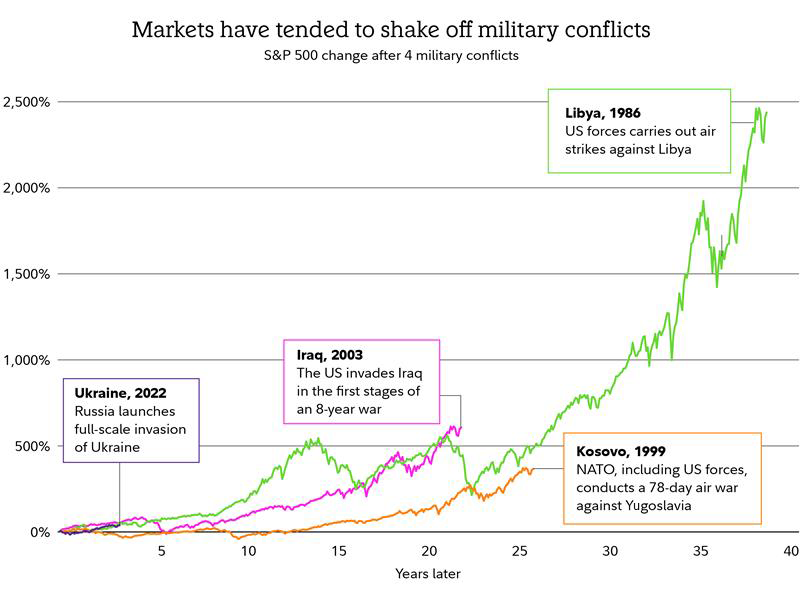
Source: Fidelity Investments, Strategas. Past performance is no guarantee of future results. Indexes are unmanaged. It is not possible to invest directly in an index.
How conflicts may add to bond-market pressures
While military conflicts have had little long-term impact on stocks, they may potentially contribute to bond market volatility. Military conflicts have the potential to exacerbate fiscal pressures over the long term, which can put downward pressures on bond prices. Wars are expensive for governments to fund. Global investors have already expressed concern about the U.S. government’s willingness to manage its debt by selling existing U.S. Treasury bonds and reducing their purchases of newly issued ones.
Bond yields and prices are also impacted by inflation expectations. When military conflict impacts a major oil producer, oil prices can rise—putting upward pressure on inflation and inflation expectations. Investors may then demand higher yields to compensate them for higher expected future inflation, putting further downward pressure on Treasury prices.
What may be worth considering—and what may be worth avoiding
Stock markets reflect investors' expectations of future corporate profits. Bond markets reflect investors' expectations of how likely they are to receive promised payments of interest and principal. Professional investors know this and act on what they know, which includes recognizing that global conflicts have historically had little long-term influence on markets.
Sometimes, though, individual investors may get caught up in the emotions that media coverage of war can bring. Ominous headlines and heart-wrenching images may stimulate a response from investors of “I need to take action.” A strongly felt but inappropriate impulse to “do something” could even prompt an emotional investor to sell stocks and bonds and retreat to cash, which they may hear described as a “safe haven” in times of war.
But history says that would be a mistake. Some of the best days in the stock market have historically occurred during bear markets. "What we've seen historically is that investors who give themselves a time out of the market very rarely come back in at the right time," says Naveen Malwal, institutional portfolio manager with Fidelity’s Strategic Advisers LLC. "Negative headlines can persist for some time. Investors typically wait for good news and by the time that happens, they've often missed some of the strongest days of market performance." Missing out on those big days may make a significant difference in long-term returns. As the chart below shows, a hypothetical investor who missed just the best 5 days in the market since 1988 could have reduced their long-term gains by 37%.
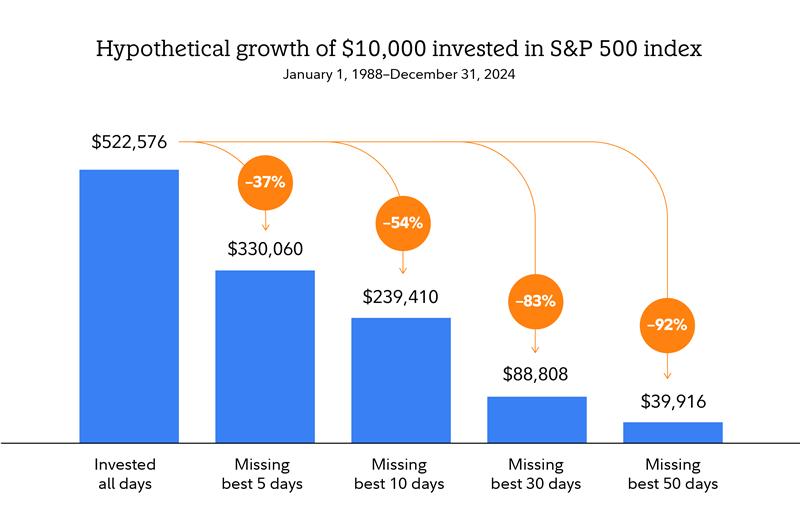
Past performance is no guarantee of future results. Source: Fidelity, Bloomberg as of 12/31/24. This is based on the cumulative percentage return of a hypothetical investment made in the noted index during periods of economic expansions and recessions. Index returns include reinvestment of capital gains and dividends, if any, but do not reflect the impact of taxes, fees, or expenses, which would lower these figures. This return information is not intended to imply any future performance of the investment product. "Best days" were determined by ranking the one-day total returns for the S&P 500® Index within this time period and ranking them from highest to lowest. There is volatility in the market and a sale at any point in time could result in a gain or loss. See disclosures for index definitions. Investment experiences will differ, including the possibility of losing money. It is not possible to invest directly in an index. All indexes are unmanaged. Source: Bloomberg, S&P 500 Index® total return for 12/31/49 to 12/31/24; recession and expansion dates defined by the National Bureau of Economic Research (NBER). The S&P 500 Index was created in 1957; however, returns have been reported since 1926, and the index has been reconstructed for years prior to 1957.
Pursuing peace of mind as an investor
One of the best ways for individual investors to manage the emotions of a volatile news environment is to develop an investing plan that they can live with through a variety of market environments, and then stick with it. A key feature of a well-rounded plan is often broad diversification—meaning owning a wide variety of investments. These can include international stocks as well as those from the U.S. Despite short-term geopolitical risks, Fidelity’s Asset Allocation Research Team expects international stocks to outperform U.S. stocks over the next 20 years. Besides stocks, investors may want to consider short-to-medium maturity bonds and alternative investments, such as precious metals or other real assets, if they are appropriate for your needs and goals.
Fidelity’s professional investment management services may also help manage responses to wars and other bad news while keeping long-term investing goals on track. Malwal explains, “My team holds stocks and bonds across many different regions, countries, sectors, and industries. One result of our diversified approach is that our clients generally have very little direct exposure to areas of conflict. That level of diversification can give investors some peace of mind in the face of events.”
Next steps to consider
Domestic equity
Target your clients' investment needs with our broad lineup of domestic equity solutions.
Learn more
Active equity ETFs
Unlock unique investment opportunities and construct a stronger core with our industry-leading approach to active ETFs.
Learn more
Sector/Industry
Target specific segments of the economy with our full spectrum of sector funds, ETFs, and other solutions.
Learn more
Related insights
View all


This information is intended to be educational and is not tailored to the investment needs of any specific investor.
Views expressed are as of the date indicated, based on the information available at that time, and may change based on market or other conditions. Unless otherwise noted, the opinions provided are those of the speaker or author and not necessarily those of Fidelity Investments or its affiliates. Fidelity does not assume any duty to update any of the information.
Fidelity does not provide legal or tax advice. The information herein is general in nature and should not be considered legal or tax advice. Consult an attorney or tax professional regarding your specific situation. Stock markets are volatile and can fluctuate significantly in response to company, industry, political, regulatory, market, or economic developments. Investing in stock involves risks, including the loss of principal.
Foreign markets can be more volatile than U.S. markets due to increased risks of adverse issuer, political, market, or economic developments, all of which are magnified in emerging markets. These risks are particularly significant for investments that focus on a single country or region.
In general, the bond market is volatile, and fixed income securities carry interest rate risk. (As interest rates rise, bond prices usually fall, and vice versa. This effect is usually more pronounced for longer-term securities). Fixed income securities also carry inflation risk, liquidity risk, call risk and credit and default risks for both issuers and counterparties. Lower-quality fixed income securities involve greater risk of default or price changes due to potential changes in the credit quality of the issuer. Foreign investments involve greater risks than U.S. investments, and can decline significantly in response to adverse issuer, political, regulatory, market, and economic risks. Any fixed-income security sold or redeemed prior to maturity may be subject to loss.
The precious metals market can be significantly affected by international monetary and political developments such as currency devaluations or revaluations, central bank movements, economic and social conditions within a country, trade imbalances, or trade or currency restrictions between countries. Fluctuations in the price of precious metals often dramatically affect the profitability of companies in the precious metals sector. The precious metals market is extremely volatile, and investing directly in physical precious metals may not be appropriate for most investors. Bullion and coin investments in FBS accounts are not covered by either the SIPC or insurance "in excess of SIPC" coverage of FBS or NFS.
The S&P 500 Index is a market capitalization-weighted index of 500 common stocks chosen for market size, liquidity, and industry group representation to represent U.S. equity performance. Strategic Advisers LLC (Strategic Advisers) is a registered investment adviser and a Fidelity Investments company.
As with all your investments through Fidelity, and in connection with your evaluation of the security, you must make your own determination whether an investment in any particular security or securities is consistent with your investment objectives, risk tolerance, and financial situation. Fidelity is not recommending or endorsing this investment by making it available to its customers.
Diversification and asset allocation do not ensure a profit or guarantee against loss.
Fidelity Investments® provides investment products through Fidelity Distributors Company LLC; clearing, custody, or other brokerage services through National Financial Services LLC or Fidelity Brokerage Services LLC; and institutional advisory services through Fidelity Institutional Wealth Adviser LLC.