





Investing Ideas
Invest for income with Fidelity Limited Term Bond ETF (FLTB)
With income-generating investments like the Fidelity Limited Term Bond ETF, investors can generate a reliable income source, build resilience in their portfolio, and help strengthen their overall financial foundation.
Why income is essential
Income is a cornerstone of investment portfolios, offering reliable cash flow to support financial goals now and in the future. Income-generating assets like bonds can provide stability during market downturns, resilience in uncertain times, and a strong foundation for long-term growth.
Historically, bond returns have helped offset stock declines
Bond returns in years when stocks were down, 1926–2025
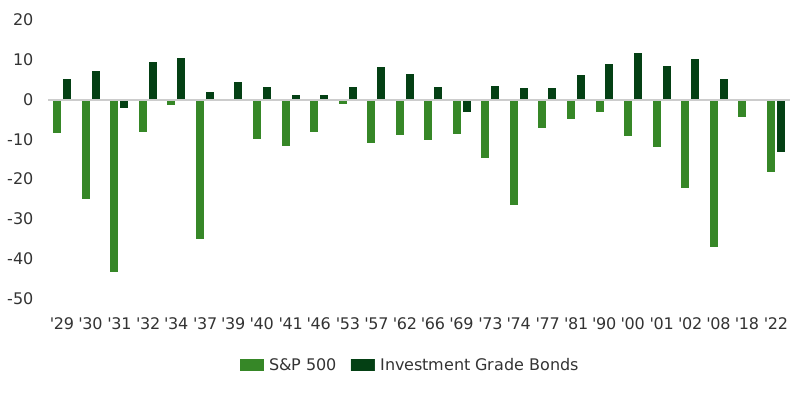
Note: The chart above depicts years in which the calendar year returns for the S&P 500 were negative and how Investment Grade Bonds performed in the corresponding year. Source: Morningstar EnCorr, Fidelity Investments (AART).
It is not possible to invest directly in an index. All indices are unmanaged. Index performance is not meant to represent that of any Fidelity mutual fund. Diversification does not ensure a profit or guarantee against loss. Bond returns represented by the performance of the Bloomberg U.S. Aggregate Bond Index from January 1976 and by a composite of the IA SBBI U.S. Intermediate-Term Government Bond Index (67%) and the IA SBBI U.S. Long-Term Corporate Bond Index (33%) from January 1926 through December 1975. Stock returns represented by the performance of the S&P 500 Index.
Past performance is no guarantee of future results.
Bond returns during various rate environments
Fidelity Limited Term Composite Index (1976–2025)
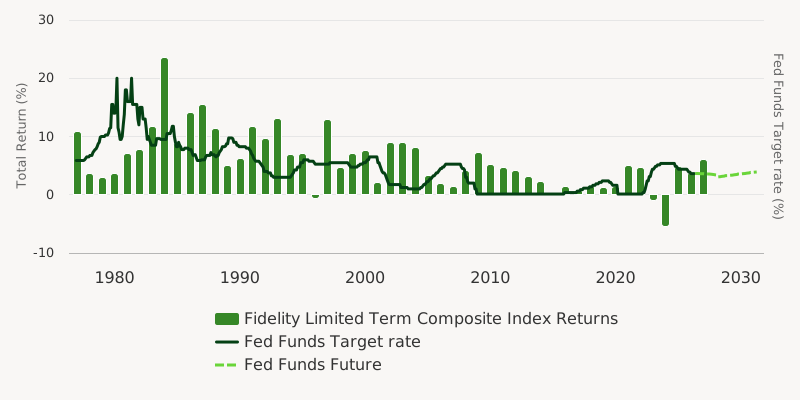
Fidelity Limited Term Composite Index is a customized blend of unmanaged indexes; weighted as follows: Bloomberg U.S. 1-5 Year Credit Bond Index – 70%; Bloomberg U.S. 1-5 Year Government Bond Index – 20%; and ICE BofA 1-5 Year BB-B US Cash Pay High Yield Constrained Index – 10%. The composition differed in periods prior to 2/28/24.
Source: Bloomberg and Fidelity Investments, as of 3/31/26. Past performance is no guarantee of future results. It is not possible to invest directly in an index.
All market indices are unmanaged. Not intended to represent the performance of any Fidelity fund.
Where to go for income
Over the last nearly 50 years, across various interest rate regimes (low, high, rising, falling), limited-term bond strategies have generated positive annual income in all but 3 years or 94% of the time, as illustrated in the graph to the left.
- Focus on high income
- Consistent risk-adjusted return potential
- Comprehensive research provides competitive advantage

Downside protection
Downside protection plays a key role in reducing the impact of market downturns. Learn more about strategies designed to help limit losses and support a more efficient recovery when markets rebound.
Learn more

Capital appreciation
History tells us that companies with strong earnings growth tend to outperform,1 making growth-focused strategies a powerful tool for building a stronger financial future.
Learn more

Outpacing inflation
Whether it's saving for retirement, funding education, or building a legacy, inflation stands in the way of achieving important goals. Choosing the right investments can help outpace inflation and preserve financial stability.
Learn more

Explore more investment products & solutions
1. Source: Fidelity Investments and FactSet, as of December 31, 2025.
In general the bond market is volatile, and fixed income securities carry interest rate risk. (As interest rates rise, bond prices usually fall, and vice versa. This effect is usually more pronounced for longer-term securities.) Fixed income securities also carry inflation, credit, and default risks for both issuers and counterparties. (Unlike individual bonds, most bond funds do not have a maturity date, so holding them until maturity to avoid losses caused by price volatility is not possible.) Lower-quality bonds can be more volatile and have greater risk of default than higher-quality bonds. Foreign securities are subject to interest rate, currency exchange rate, economic, and political risks, all of which may be magnified in emerging markets. Leverage can increase market exposure and magnify investment risk. The fund generally expects to effect its creations and redemptions for cash rather than in-kind securities, and may recognize more capital gains and be less tax-efficient than if it were to redeem in-kind. An ETF may trade at a premium or discount to its Net Asset Value (NAV).
Stock markets, especially foreign markets, are volatile and can decline significantly in response to adverse issuer, political, regulatory, market, or economic developments.
ETFs are subject to market fluctuation and the risks of their underlying investments. ETFs are subject to management fees and other expenses.