





The journey back to fundamentals
Amid flaring tensions in Iran, the market may have reset to its original 2026 playbook.
1. What has changed in the market over the past few weeks?
While the situation in the Middle East remains fluid and vulnerable to periodic flare-ups—including the recent re-escalation of tensions between Iran and the U.S.—recent market behavior suggests investors view the risks of a broader regional conflict as more contained, and are hence assigning lower weight to this source of near-term market uncertainty. In recent months, investors were bracing for higher oil prices, renewed inflation pressure, and the possibility that central banks would need to stay restrictive for longer.
Oil prices have retreated from highs that were driven by the initial unfolding of the conflict with Iran – even though they remain susceptible to ups and downs related to sudden outbreaks of hostilities. In addition, inflation expectations have moderated. Investors appear increasingly willing to look beyond geopolitical headlines and refocus on fundamentals.
Exhibit 1 shows that the headline consumer price index (CPI) may have peaked in May, and, absent a significant conflagration in the Middle East, it may begin to moderate. Still, inflation remains above the Federal Reserve’s 2% target due to sticky services prices. In many ways, markets may be finding themselves back where they started the year.
Exhibit 1: One-year U.S. CPI forecast
(Headline CPI, %year-over-year)
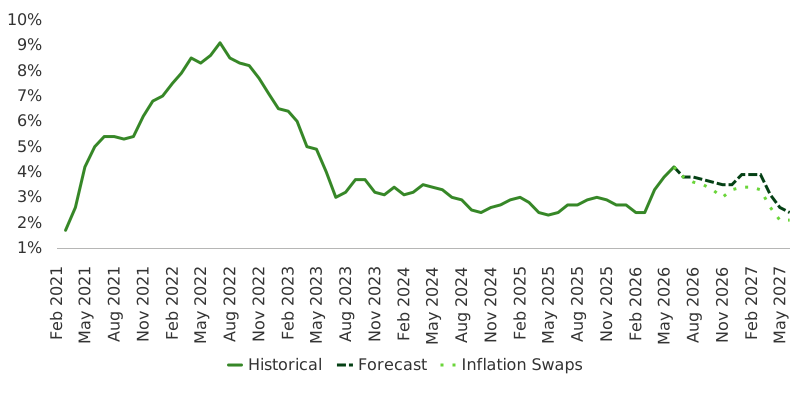
Consumer price index (CPI) is a measure of the average change over time in the prices paid by urban consumers for a market basket of consumer goods and services. Inflation swaps: one-year inflation swaps. A one-year inflation swap rate is a market-based gauge of expected inflation over the next year. Source: Bloomberg L.P., Fidelity Investments, as of 6/30/2026.
Exhibit 2: Leadership has shifted away from a narrow group of large cap U.S. stocks, with emerging markets and small cap equities leading the way
(%, year-to-date price returns)
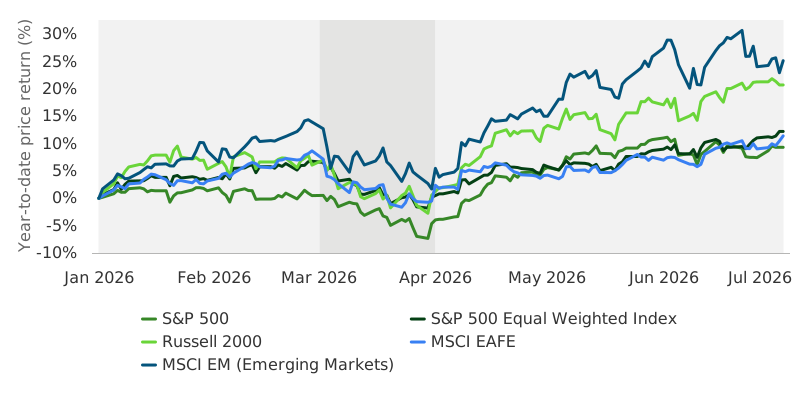
Past performance is no guarantee of future results. S&P 500®. S&P 500 Equal Weighted Index. Russell 2000® Index. MSCI Europe, Australasia, Far East Index (EAFE). MSCI Emerging Markets (EM) Index. Source: FactSet, as of 7/03/26.
4. What factors will influence whether the broadening trend persists?
We continue to monitor several factors that could determine whether this broadening theme gains momentum.
Energy markets: The durability of lower oil prices will be important. A sustained reduction in energy-related inflation risks could relieve pressure on both consumers and policymakers.
Consumer resilience: While some household pressures remain, consumer spending and labor market conditions continue to support economic growth.
Earnings breadth: Strong profit growth extending beyond mega-cap technology would provide important confirmation that market leadership is expanding.
Global growth: Improving conditions outside the United States could support international equity markets and reinforce the benefits of diversification.
5. Investment implications
The market spent much of the second quarter reacting to what could happen if geopolitical risks escalated. Increasingly, investors are slowly shifting back toward evaluating what is actually happening.
If tensions ease, energy markets stabilize and economic fundamentals remain supportive, the investment backdrop could begin to resemble the one investors envisioned at the beginning of the year. That does not eliminate volatility, but it may support a continuation of one of the most important investment themes of 2026: a market that broadens beyond a handful of winners and creates opportunities across a wider opportunity set.
Leadership transitions often occur gradually, but they can create meaningful opportunities for diversified portfolios. If earnings growth expands beyond mega-cap technology and investors become more comfortable taking risks outside the narrowest parts of the market, returns may be supported by a wider set of companies, sectors, and regions.
Related insights


Index Definitions:
MSCI ACWI (All Country World Index) ex USA Index is a market capitalization-weighted index designed to measure investable equity market performance for global investors of large and mid cap stocks in developed and emerging markets, excluding the United States.
Russell 2000® Index is a market capitalization-weighted index designed to measure the performance of the small cap segment of the U.S. equity market. It includes approximately 2,000 of the smallest securities in the Russell 3000 Index.
S&P 500® index index is a market capitalization–weighted index of 500 common stocks chosen for market size, liquidity, and industry group representation to represent U.S. equity performance.
Sectors and Industries are defined by Global Industry Classification Standards (GICS®), except where noted otherwise.
S&P 500 sectors: Consumer Discretionary—companies that tend to be the most sensitive to economic cycles. Consumer Staples—companies whose businesses are less sensitive to economic cycles. Energy—companies whose businesses are dominated by either of the following activities: the construction or provision of oil rigs, drilling equipment, and other energy-related services and equipment; or the exploration, production, marketing, refining, and/or transportation of oil and gas products, coal, and consumable fuels. Financials—companies involved in activities such as banking, consumer finance, investment banking and brokerage, asset management, insurance and investments, and mortgage real estate investment trusts (REITs). Health Care—companies in two main industry groups: health care equipment suppliers, manufacturers, and providers of health care services; and companies involved in research, development, production, and marketing of pharmaceuticals and biotechnology products. Industrials—companies that manufacture and distribute capital goods, provide commercial services and supplies, or provide transportation services. Information Technology—companies in technology software and services and technology hardware and equipment. Materials—companies that engage in a wide range of commodity-related manufacturing. Real Estate—companies in real estate development, operations, and related services, as well as equity REITs. Communication Services—companies that facilitate communication and offer related content through various media. Utilities—companies considered electric, gas, or water utilities, or that operate as independent producers and/or distributors of power.
MSCI Emerging Markets (EM) Index is a market capitalization-weighted index designed to measure the investable equity market performance for global investors in emerging markets.
MSCI Europe, Australasia, Far East (EAFE) Index is a market capitalization-weighted index designed to measure the investable equity market performance for global investors in developed markets, excluding the U.S. and Canada.
DISCLOSURES
The information contained herein is general in nature and should not be construed as legal or tax advice. This material is not intended to provide, and should not be relied on for, tax, legal, investment, or accounting advice. Tax laws and regulations are complex and subject to change. You should consult your own tax, legal, investment, and accounting advisors before engaging in any transaction.
Some of this information is forward-looking and is subject to change.
Views expressed are as of the date indicated, based on the information available at that time, and may change based on market and other conditions. Unless otherwise noted, the opinions provided are those of the authors and not necessarily those of Fidelity Investments or its affiliates. Fidelity does not assume any duty to update any of the information.
Investment decisions should be based on an individual’s own goals, time horizon, and tolerance for risk.
These materials are provided for informational purposes only and should not be used or construed as a recommendation of any security, sector, or investment strategy.
Stock markets, especially foreign markets, are volatile and can decline significantly in response to adverse issuer, political, regulatory, market, or economic developments.
Foreign securities are subject to interest rate, currency exchange rate, economic, and political risks, all of which are magnified in emerging markets.