





Portfolio Construction
Investment portfolio insights
Trends in portfolio construction
Stay ahead of portfolio trends with actionable insights from our Portfolio Construction team, powered by nearly 12,000 advisor portfolio reviews each year.
Your browser doesn’t support video.
Q2 2026 investment landscape
Markets bounced back after a shaky first quarter as geopolitical fears were alleviated and oil prices fell from their peaks. Artificial-intelligence-related capital expenditures broadened corporate earnings growth, while an improving labor market helped alleviate concerns of an economic slowdown. Consumer inflation rose in Q2 after the conflict in Iran triggered shipping disruptions and a spike in energy costs. Higher oil prices also passed through into core inflation, which excludes the more volatile food and energy components. Shelter and service costs are exhibiting signs of reacceleration, adding to tariff and Iran-conflict-related inflation in core goods. Despite a constructive macro backdrop, markets are predisposed to potential bouts of volatility as geopolitical and monetary policy uncertainty, inflation persistence, and elevated asset valuations warrant continued emphasis on portfolio diversification.
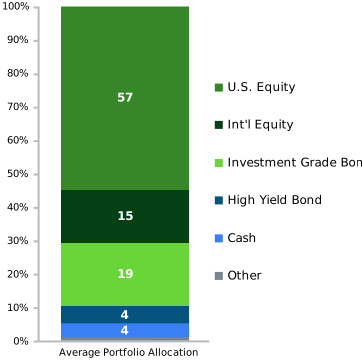
Source: FI Portfolio solutions (2,498 Portfolio Reviews and Portfolio Quick Checks conducted between 4/1/26 and 6/30/26) and Morningstar.
ETF Usage
Sixty-one percent of incoming portfolios in Q2 had some allocation to ETFs—with number keeps growing each quarter. On average, 55% of an advisor’s portfolio is allocated to ETFs which shows the popularity of the investment vehicle. Average expense ratios have fallen from an average of 50bps over the last few quarters to 43bps in Q2. Advisors increasingly prefer low cost index ETFs with 56% having some allocation to the product. The average allocation to index funds was around 30% over the last two years but that rose to 42% in Q2. In Q1, we saw 39% of incoming portfolios with allocation to active ETFs—with an average allocation of 26%, which was higher compared to Q1. To put this in context, this number was 13% in 2022. New active ETF products are being launched across the industry and advisors continue to increase their appetite.
We observed the average portfolio has:
All data points are based on Fidelity portfolio construction reviews and Portfolio Quick Checks (PQC), from 4/1/26 to 6/30/26.
In conclusion
In today’s evolving market environment, maintaining a well-diversified portfolio and staying disciplined are key to achieving long-term investment objectives. Volatility can create meaningful opportunities when approached strategically. Reach out to our Portfolio Construction Guidance team for support in building portfolios designed for today’s markets.
Want to know more?
Check out how Fidelity can give you a scalable, personalized portfolio construction framework for managing portfolios more efficiently and effectively.
Insight and Outlook: Fidelity Market Signals Weekly
Explore weekly insights from the FI Capital Markets Strategy Group covering the latest market trends, economic developments, and key factors shaping investment decisions.

5 big investing ideas now
Ideas for growth, defense, and more, for the rest of the year.

Our tailored portfolio solutions—including model portfolios and separately managed accounts—can allow you to spend more time where it counts: building better client relationships.

Diversification does not ensure a profit or guarantee against a loss.
ETFs are subject to market fluctuation, the risks of their underlying investments, management fees, and other expenses.
Indexes are unmanaged. It is not possible to invest directly in an index.
Stock markets, especially non-U.S. markets, are volatile and can decline significantly in response to adverse issuer, political, regulatory, market, or economic developments. Foreign securities are subject to interest rate, currency exchange rate, economic, and political risks, all of which are magnified in emerging markets. The securities of smaller, less well-known companies can be more volatile than those of larger companies.
Although bonds generally present less short-term risk and volatility than stocks, bonds do contain interest rate risk (as interest rates rise, bond prices usually fall, and vice versa) and the risk of default, or the risk that an issuer will be unable to make income or principal payments.
Additionally, bonds and short-term investments entail greater inflation risk—or the risk that the return of an investment will not keep up with increases in the prices of goods and services—than stocks. Increases in real interest rates can cause the price of inflation-protected debt securities to decrease.
Alternative investments are investment products other than the traditional investments of stocks, bonds, mutual funds, or ETFs. Examples of alternative investments are limited partnerships, limited liability companies, hedge funds, private equity, private debt, commodities, real estate, and promissory notes. Some of the risks associated with alternative investments are: Alternative investments maybe relatively illiquid. It may be difficult to determine the current market value of the asset. There may be limited historical risk and return data. A high degree of investment analysis maybe required before buying. Costs of purchase and sale may be relatively high.
Views expressed are as of the date indicated, based on the information available at that time, and may change based on market and other conditions. Unless otherwise noted, the opinions provided are those of the authors and not necessarily those of Fidelity Investments or its affiliates. Fidelity does not assume any duty to update any of the information.
Fidelity does not provide legal or tax advice. The information herein is general and educational in nature and should not be considered legal or tax advice. Tax laws and regulations are complex and subject to change, which can materially impact investment results. Fidelity cannot guarantee that the information herein is accurate, complete, or timely. Fidelity makes no warranties with regard to such information or results obtained by its use and disclaims any liability arising out of your use of, or any tax position taken in reliance on, such information. Consult an attorney or tax professional regarding your specific situation.