You are on the Investment solutions website for advisors & wealth management firms.
Browse more Fidelity websites here.
Investors have a lot to consider with global shipping at a standstill through the Strait of Hormuz, a U.S. blockade of Iranian ports, and expectations for a second round of U.S./Iran peace talks. While uncertainty remains pervasive, economic data suggest a limited long-term impact on the economy.
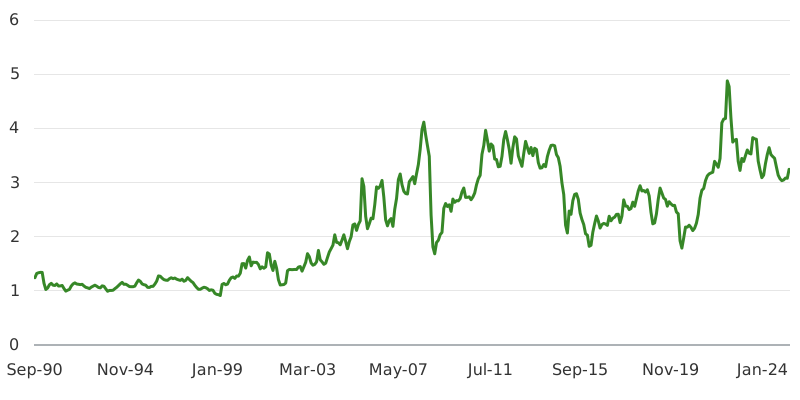
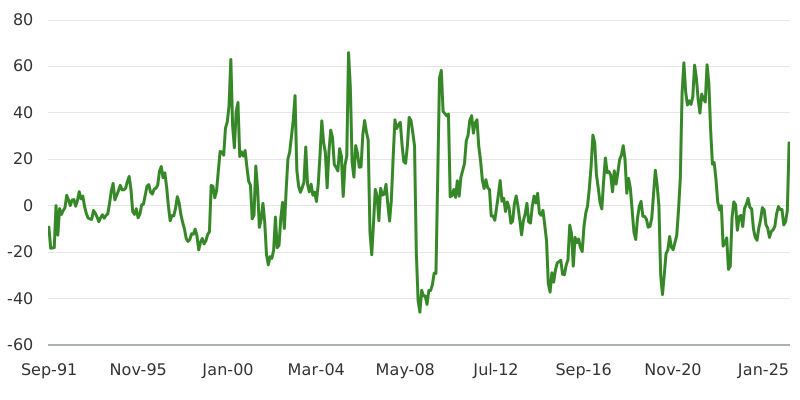
March CPI inflation rose 0.9% month-over-month—annualized to 3.3%. The hike was primarily driven by the sharp rise in energy prices caused by U.S./Iran military action, with WTI oil up 57% year over year, gasoline up 50% and diesel up 55% during the same time. While gasoline prices have spiked due to the disruptions caused by the Middle East conflict, the increase is not likely to derail the U.S. consumer or the economy (Exhibit 1).
Price of Gasoline ($/gallon)
Price of Gasoline YoY% change
Source: Federal Reserve Bank of St. Louis (FRED), U.S. Energy Information Agency (EIA), as of 4/13/26.
History has shown that markets are resilient, even in the face of volatile geopolitical conflict. It isn’t clear whether the hostilities will meaningfully alter the long-term path of markets and the economy. Having said that, if events in the Middle East were to continue over an extended period, an energy-driven inflation hike could have an impact on the broader supply chain, global commodities, and diverse industries from autos to aerospace.
First, one would not simply be experiencing a disruption in energy supplies but also destruction in capacity across the supply chain, which includes infrastructure linked to production, transmission, storage, and transportation. Such a scenario could have a prolonged impact on prices and inflation, the magnitude of which remains uncertain.
Second, this would not just be an energy disruption event but a broad commodity-based event that impacts the entire supply chain of products (chemicals, plastics, fertilizers), all of which use oil and natural gas as feedstock.
Third, other commodities also experiencing supply chain disruption to a significant extent would be aluminum and sulfur. A disruption to aluminum would impact automobiles, packaging, aerospace, and defense. A disruption to sulfur would impact copper refining and helium, which would in turn impact semiconductor manufacturing.
The March payroll report released on April 3 was a mixed bag, with the Establishment Survey reporting that non-farm payrolls grew by 178,000, while the Household Survey recorded a loss of 64,000 jobs.
Further muddying the waters, the unemployment rate fell from 4.4% to 4.3%, but the underemployment rate rose slightly and participation dropped slightly. Possible contributing factors could be a significant drop in the labor force, with declines in the average hourly work week and hourly earnings.
Overall, one could summarize the payroll report as continuing to showcase a “low hire, low fire” environment, with deterioration at the margin and payroll growth very low. However, the boost to capex spending for the artificial intelligence (AI) infrastructure build-out is a counterweight to help support a resilient economy.
We expect the Federal Reserve will continue to consider this energy-related inflation spike as temporary when they next meet on April 28–29, as they have indicated in the past. The Fed tends to focus more on core personal consumption expenditures (PCE), which excludes the volatile food and energy sectors, in its policy decision-making.
We do not expect outcomes to be similar to the inflation crest in 2022, but the risk always exists—that is, the risk of a commodity spike translating into stagflation. (For more on stagflation, please see why a “stagflation-light” scenario may not be that scary; and the latest from AART on inflation and why the team expects inflation to be higher than consensus.)
Note that an energy spike is a combination of magnitude and duration and its cumulative impact on decreasing consumer discretionary spending. We believe investors should consider inflation hedges and volatility smoothing products for their portfolios, as the market risk/return profile looks quite asymmetric at this juncture. AART research has shown that exposure to commodities, real estate, and inflation-aware fixed income (including limited-term bonds and Treasury Inflation-Protected Securities) have performed well in past higher inflation/slower growth environments.
On a similar note, despite the markets being volatile and U.S. large caps underperforming, the theme of broadening markets continues to play out with outperformance from U.S. mid and small caps and international and emerging markets. As we head into Q1 earnings season, we do not expect any significant impact on earnings, but the focus will be more on forward guidance, especially if the conflict were to continue or escalate into Q2.


Views expressed are as of the date indicated, based on the information available at that time, and may change based on market and other conditions. Unless otherwise noted, the opinions provided are those of the authors and not necessarily those of Fidelity Investments or its affiliates. Fidelity does not assume any duty to update any of the information.
Investment decisions should be based on an individual’s own goals, time horizon, and tolerance for risk.
These materials are provided for informational purposes only and should not be used or construed as a recommendation of any security, sector, or investment strategy.
All indices are unmanaged and performance of the indices includes reinvestment of dividends and interest income, unless otherwise noted, are not illustrative of any particular investment, and an investment cannot be made in any index.