You are on the Investment solutions website for advisors & wealth management firms.
Browse more Fidelity websites here.
The Supreme Court’s decision to invalidate the administration’s broad “reciprocal” tariffs removes an important source of immediate trade pressure, but it does not mark an end to tariff risk.
The administration’s swift pivot to a temporary 15% global tariff under Section 122—alongside plans to initiate Section 301 investigations—keeps trade policy uncertainty elevated, even if future measures are likely to be narrower and more procedural than before.
For investors, this suggests continued headline volatility for trade-exposed sectors and multinational margins, modest upside risks to goods inflation at the margin, and a reinforcing case for global diversification as portfolios navigate a more fragmented and less predictable U.S. trade backdrop.
We remain bullish on U.S. markets, largely based on the earnings trends.
While U.S. earnings growth expectations remain robust, global equity market leadership has broadened, with performance increasingly shared across cyclicals, small/mid-caps, and international markets.
International stocks offer diversification, possibly at an opportune time. The broadening we see is not just performance-based. We’re seeing stronger earnings growth in all major global regions. Typically, this has favored non‑U.S. equities, particularly when paired with a softer dollar and easing financial conditions abroad, which is the case in early 2026.
We believe the combination of policy divergence, improving regional fundamentals, and shifting investor preferences is reinforcing the case for global diversification. This is happening as pockets of U.S. equity leadership tied to artificial intelligence (AI) face near‑term scrutiny.
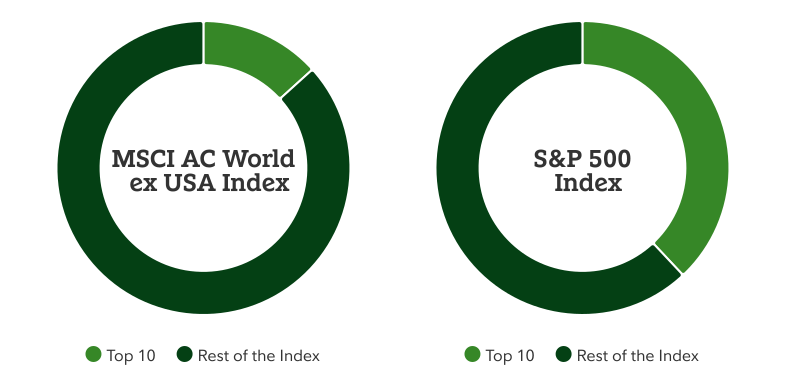
To be clear, tariffs and potential AI growing pains are not the reasons to consider an allocation to international stocks. It’s this: The benchmark MSCI AC World ex USA offers a different set of quality companies and most of the earnings growth of the S&P 500, but at a 30% valuation discount, and almost two-thirds less concentration risk. (Exhibit 1).
|
MSCI AC World ex USA Index
|
S&P 500 Index
|
|
|---|---|---|
| Top-10 Concentration1 | 13% | 38% |
| Valuation (price-to-earnings)2 | 15 | 22 |
| Earnings Growth3 | 16% | 18% |
1) Top-10 Concentration notes the percentage the top 10 represents within each respective index.
Top 10 of the MSCI AC World ex USA = Taiwan Semiconductor, ASML Holding, Samsung Electronics, Tencent Holdings,
Alibaba Group, SK Hynix, Roche Holdings, HSBC Holdings, AstraZeneca, and Novartis. S&P 500 top-10 components
= Nvidia, Apple, Microsoft, Amazon, Alphabet Class A, Alphabet Class C, Broadcom, Meta, Tesla, and Berkshire
Hathaway.
2) Price-earnings value is based on the consensus estimate for the next 12 months.
3) Earnings growth is based on the consensus estimate for the next 12 months.
Source: Bloomberg Finance L.P. and Fidelity Investments, as of 1/31/26.
Market concentration on its own has not been a worrisome issue (see ”Navigating a concentrated equity market”). That said, international investing adds access to a different set of AI investments that may be underappreciated.
International equities do not need to dominate portfolios, but we believe they warrant a strategic role within a well-diversified equity framework, especially as U.S. concentration risk has reentered the conversation. International exposure can complement U.S. holdings, helping to mitigate concentration and broaden sources of return.
U.S. equities have pulled back recently, led by weakness in the Magnificent 7, as investors reassess valuations and competitive dynamics amid rising concerns around AI disruption and returns on capital.
On the other hand, international stocks outperformed U.S. stocks in 2025 and have extended that lead year-to-date in 2026. This has been driven by strength in Japan, Asia ex Japan, and Latin America—where improving earnings momentum, corporate reforms, and more supportive policy backdrops have underpinned broader, less concentrated market leadership.
Active investing works in international—here’s what we found:


Views expressed are as of the date indicated, based on the information available at that time, and may change based on market and other conditions. Unless otherwise noted, the opinions provided are those of the authors and not necessarily those of Fidelity Investments or its affiliates. Fidelity does not assume any duty to update any of the information.
Investment decisions should be based on an individual’s own goals, time horizon, and tolerance for risk.
These materials are provided for informational purposes only and should not be used or construed as a recommendation of any security, sector, or investment strategy.
All indices are unmanaged, and performance of the indices includes reinvestment of dividends and interest income, unless otherwise noted, are not illustrative of any particular investment, and an investment cannot be made in any index.
This content contains statements that are "forward-looking statements," which are based upon certain assumptions of future events. Actual events are difficult to predict and may differ from those assumed. There can be no assurance that forward-looking statements will materialize, or that actual results will not be materially different from those presented.
S&P 500 Index is a market capitalization-weighted index of 500 common stocks chosen for market size, liquidity, and industry group representation to represent U.S. equity performance. S&P 500 is a registered service mark of Standard & Poor's Financial Services LLC.
MSCI AC ex USA World Index is a market capitalization-weighted index that is designed to measure the investable equity market performance for global investors of developed and emerging markets, excluding the United States.
Stock markets, especially foreign markets, are volatile and can decline significantly in response to adverse issuer, political, regulatory, market, or economic developments. Foreign securities are subject to interest rate, currency exchange rate, economic, and political risks, all of which are magnified in emerging markets.
Diversification does not ensure a profit or guarantee against loss.