





Five gut checks for a market that keeps climbing
Markets have shrugged off the U.S.-Iran conflict and recent tariff news and are near all-time highs. Here's how to assess their underlying strength.
Markets have climbed a long way in a short time, which raises a natural question for market participants: Is this rally running on solid fundamentals—or just momentum? The answer likely sits in a handful of signals beneath the index surface that cut across earnings, inflation, the labor market, capital markets, and market leadership. None of these indicators are flashing red today, but together they can help investors separate healthy consolidation from signs that the market’s foundation is beginning to crack.
1. Are good earnings still good enough?
Corporate earnings remain one of the strongest arguments for the market’s resilience. Profits have held up better than many investors expected, margins have broadened, and earnings growth is no longer confined to a narrow group of mega-cap companies. That matters because durable bull markets usually need earnings—not just multiple expansion—to carry the load.
The catch is that expectations have risen too (Exhibit 1). When companies beat estimates but stocks do not react well, it can be a sign that investors have already priced in a lot of good news. The takeaway is simple: Watch not only what companies report, but how the market responds. A rally that rewards quality earnings, cash flow, and disciplined spending is healthier than one that rewards growth at any price.
Exhibit 1: Earnings growth expectations (next 12 months).
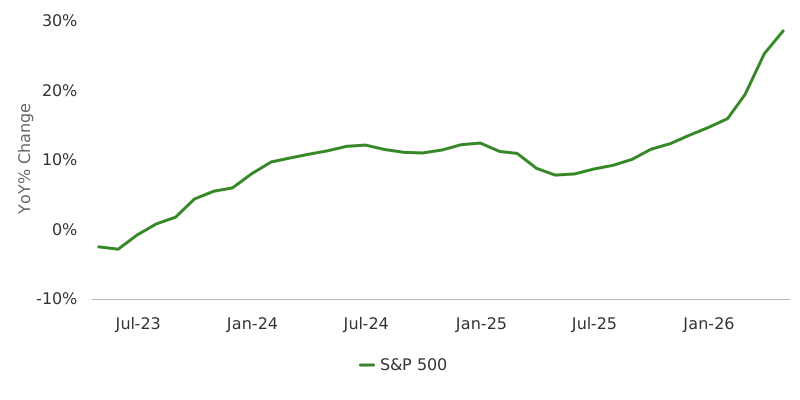
Chart illustrates year-on-year percent change in next 12 months’ EPS expectations. Indexes: S&P 500. Source: FactSet, S&P Global, Fidelity Investments (AART), as of 5/31/26.
2. Is inflation cooling—or just taking a breather?
Recent inflation data have offered investors some relief, but inflation is not yet a solved problem. CPI and PPI trends remain important because they shape the Federal Reserve’s flexibility, the direction of real yields, and the valuation investors are willing to pay for long-duration growth assets. A cooler inflation path would support the soft-landing narrative, while a reacceleration would quickly revive concerns about higher-for-longer rate policy.
The inflation watchlist is broader than the monthly CPI print. Advisors should pay attention to services inflation, wage growth, energy prices, tariff pass-through, housing costs, and input costs tied to AI infrastructure and power demand. If inflation keeps drifting lower while growth stays positive, markets can likely absorb it. If inflation proves sticky while growth slows, the margin for error narrows.
3. Is the labor market cooling in a healthy way?
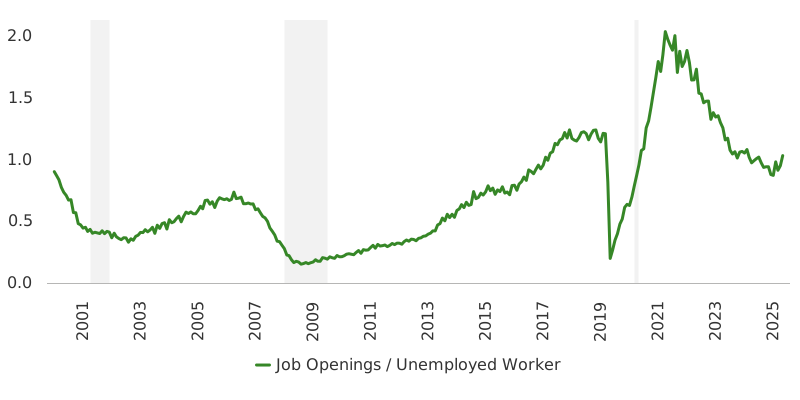
The labor market remains one of the cleanest tests of whether the economy is normalizing or weakening. Job growth has slowed, but unemployment has remained contained, which is generally consistent with a cooling expansion rather than a recessionary downturn (Exhibit 2). That balance is important: Too much labor strength could keep services inflation sticky, while too much weakness would pressure consumer spending and corporate revenues.
For investors, the dashboard should include payrolls, unemployment claims, wage growth, hours worked, and consumer spending trends. A gradual cooling would likely be welcomed by markets because it gives the Fed room to be patient. A faster deterioration would shift the conversation from inflation risk to earnings risk.
Exhibit 2: Job growth has slowed, with contained unemployment, suggesting a cooling expansion rather than a potential recession.
| Metric | 2025 Average | Latest | |
|---|---|---|---|
| Labor Indicators | Unemployment claims Total nonfarm payroll growth Breakeven job growth* Industries increasing hiring |
225K 10K 115K 40% |
208K 92K (YTD) -25 to 35K 80% |
| AI Impact | Labor productivity attributed to AI | 1% |
Shading denotes recessions. Source: Asset Allocation Research Team (AART), Bureau of Labor Statistics, Job Openings and Labor Turnover survey, Macrobond, Fidelity Investments (AART) as of 4/30/26. TABLE: Unemployment claims are a one-month moving average of weekly initial unemployment claims. *Monthly payrolls needed to keep unemployment rate from rising. Breakeven job growth estimates are based on AART proprietary immigration and demographic estimates. Industries increasing hiring shows share of industries from ADP report with positive monthly job growth. Source: U.S. Immigration and Customs Enforcement; U.S. Department of Homeland Security; U.S. Customs and Border Patrol; U.S. Department of Labor; Seyed Mahdi, Hosseini Maasoum and Guy Lichtinger, “Generative AI as Seniority-Biased Technological Change: Evidence from U.S. Résumé and Job Posting Data” (August 31, 2025), available at SSRN: https://ssrn.com/abstract=5425555 or http://dx.doi.org/10.2139/ssrn.5425555; Macrobond, Fidelity Investments (AART) as of 6/30/26. Breakeven job growth and ADP data are as of 5/31/26. Nonfarm payroll data is as of 6/30/26.
4. Are capital markets absorbing the supply?
One of the more underappreciated signs of market health is whether companies can raise capital without disrupting risk appetite. Equity issuance, IPO activity, debt financing, and credit spreads all provide a real-time read on investor confidence. When markets can digest new supply, it usually signals liquidity, risk appetite, and confidence in future growth.
This matters even more in an economy being reshaped by AI investment. Data centers, power generation, grid upgrades, semiconductors, and networking equipment all require enormous funding. So far, markets have been willing to finance that buildout. The signal to watch is whether spreads stay contained and issuance remains orderly—or whether investors begin demanding a much higher risk premium.
5. Is market leadership broadening beyond the obvious winners?
A healthy rally does not need every stock to rise, but it does need more than one narrow theme to do all the work. There are encouraging signs that earnings growth and investor interest are extending beyond the largest technology and AI-linked companies. Select areas of international equities, industrials, financials, health care, and higher-quality small and mid caps may offer opportunities where valuations are less stretched and earnings revisions are improving.
Still, concentration risk remains a key watch item. If index returns depend too heavily on a small group of AI beneficiaries, the market becomes more vulnerable to disappointment in earnings, capex plans, or valuation assumptions. For advisors, the message is not to abandon leadership, but to avoid letting one theme become the whole portfolio. Broadening would be a sign of strength; narrowing would be a reason to reassess risk.
Portfolio implication: how should you think about positioning from here?
The current setup supports a balanced risk-on tilt—favoring quality U.S. large caps, select mid caps, and sectors with earnings durability or cyclical upside such as technology, industrials, financials, and energy—while avoiding the temptation to chase every part of the rally. International exposure can still play an important diversification role, but softer earnings momentum and geopolitical uncertainty argue for selectivity. In fixed income, higher-quality bonds, Treasuries, securitized credit, municipals, and Treasury Inflation-Protected Securities (TIPS) can help anchor portfolios, provide income, and hedge against either slower growth or persistent inflation. With credit spreads already tight, investors may want to be cautious about reaching too far for yield in high yield, bank loans, or emerging-market debt. In short: Participate in the market’s strength, but keep the portfolio built to handle a world where inflation, rates, and earnings reactions can still surprise.
Related insights



S&P 500® is a market capitalization-weighted index of 500 common stocks chosen for market size, liquidity, and industry group representation to represent U.S. equity performance. S&P 500 is a registered service mark of The McGraw-Hill Companies, Inc., and has been licensed for use by Fidelity Distributors Corporation and its affiliates.
Consumer Price Index (CPI) is an inflationary indicator published monthly by the U.S. Bureau of Labor Statistics that measures the change in the cost of a fixed basket of products and services, including housing, electricity, food, and transportation.
Producer Price Index (PPI) tracks price changes of domestic producers.
The information contained herein is general in nature and should not be construed as legal or tax advice. This material is not intended to provide, and should not be relied on for, tax, legal, investment, or accounting advice. Tax laws and regulations are complex and subject to change. You should consult your own tax, legal, investment, and accounting advisors before engaging in any transaction.
Some of this information is forward-looking and is subject to change.
Views expressed are as of the date indicated, based on the information available at that time, and may change based on market and other conditions. Unless otherwise noted, the opinions provided are those of the authors and not necessarily those of Fidelity Investments or its affiliates. Fidelity does not assume any duty to update any of the information.
Investment decisions should be based on an individual’s own goals, time horizon, and tolerance for risk.
These materials are provided for informational purposes only and should not be used or construed as a recommendation of any security, sector, or investment strategy.
Stock markets, especially foreign markets, are volatile and can decline significantly in response to adverse issuer, political, regulatory, market, or economic developments.
Foreign securities are subject to interest rate, currency exchange rate, economic, and political risks, all of which are magnified in emerging markets.