You are on the Investment solutions website for advisors & wealth management firms.
Browse more Fidelity websites here.
U.S. manufacturing recovery has accelerated meaningfully, with the most notable signal coming from the Institute for Supply Management’s purchasing managers index (PMI), a key economic indicator of the sector’s health. A PMI reading above 50 indicates manufacturing is expanding, while a reading below 50 suggests contraction. Activity jumped to 52.6 in January, the highest in more than three years, compared with 47.9 in December.1 The decisive move marked the first reading above 50 in nearly a year, ending one of the longest contractionary stretches on record.
Among the key underlying metrics in the PMI, new orders posted their largest one-month increase since 2001; output strengthened, and although employment remained in contraction, the pace of decline eased. A slightly higher prices index reinforces the view that inflation pressures remain sticky but not destabilizing. Broader strength among the sub-indexes suggests a more durable return to expansion.
Manufacturing contributes approximately 10% to the value-added output of the U.S. economy while services make up approximately 80%. However, manufacturing companies are responsible for 51.8% of all private‑sector research and development (R&D) spending.2 The 100% depreciation provision in the One Big Beautiful Bill Act incentivizes manufacturing companies to invest more in R&D, which could translate into higher corporate profitability.
The delayed January jobs report from the Bureau of Labor Statistics showed the economy added 130,000 jobs, with the unemployment rate ticking lower to 4.3%.3 These numbers were an “upside surprise,” as economists had projected 65,000 jobs and an unemployment rate of 4.4%. While health care and social assistance drove most of the job gains, manufacturing also added some workers, a modest but encouraging signal for the sector.
Most manufacturing firms in the United States are relatively small. In 2022, only 1.75% of these companies had more than 500 employees.4 If the upturn in manufacturing activity holds, we could see the sector’s employment stabilize, further providing another tailwind for consumer spending.
The improvement in manufacturing aligns with our ongoing thesis that market breadth is likely to broaden beyond mega-cap stocks. Better PMIs, combined with steady AI-related capital expenditure, are incrementally supportive of cyclical sectors, small caps, and beneficiaries of industrial spending. Although tech earnings have remained resilient, momentum could face headwinds after the rapid run up in key tech sectors. Stronger manufacturing trends provide a counterbalance, in our view. This should support a gradual rotation toward cyclicals as their earnings trajectories align more closely with improving macro conditions.
Research by Denise Chisholm, Fidelity’s Director of Quantitative Market Strategy, has posited that one of the most useful ways to analyze PMI is over rolling one-year periods, as opposed to more volatile month-to-month analysis. Framed in this way, PMI tends to fall into four distinct regimes: expansionary and rising, expansionary and falling, contractionary and rising, and contractionary and falling (see Exhibit 1).
A PMI reading of above 50 and rising has historically delivered the strongest industrial production growth and some of the most favorable environments for equity earnings—particularly within industrials and some other cyclicals. Machinery, transportation, and other cyclical industrial subsectors have shown the highest odds of outperformance during this phase.
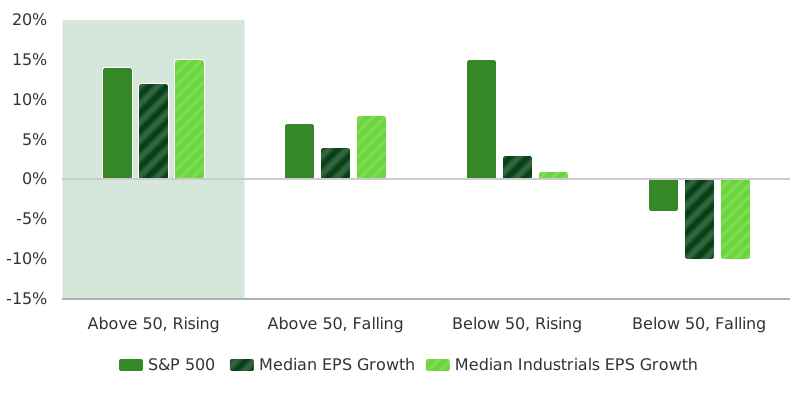
Past performance is no guarantee of future results. Analysis is based on the S&P 500 index. EPS: Earnings per share. Data analyzed monthly from January 1990 through January 2026. Sources: Haver Analytics, FactSet, Fidelity Investments, as of 1/31/26.


1. Institute for Supply Management. ISM® Manufacturing PMI® Report, February 2026. https://www.ismworld.org/supply-management-news-and-reports/reports/ism-pmi-reports/pmi/january/
2. U.S. Bureau of Economic Analysis, as of December 2024. https://www.bea.gov/
3. U.S. Bureau of Labor Statistics. “Employment Situation Summary,” February 2026. https://www.bls.gov/news.release/empsit.nr0.htm#
4. U.S. Census Bureau, Statistics of U.S. Businesses, as of 2022. https://www.census.gov/programs-surveys/susb.html
Views expressed are as of the date indicated, based on the information available at that time, and may change based on market and other conditions. Unless otherwise noted, the opinions provided are those of the authors and not necessarily those of Fidelity Investments or its affiliates. Fidelity does not assume any duty to update any of the information.
Investment decisions should be based on an individual’s own goals, time horizon, and tolerance for risk.
These materials are provided for informational purposes only and should not be used or construed as a recommendation of any security, sector, or investment strategy.
All indices are unmanaged and performance of the indices includes reinvestment of dividends and interest income, unless otherwise noted, are not illustrative of any particular investment, and an investment cannot be made in any index.
This content contains statements that are "forward-looking statements," which are based upon certain assumptions of future events. Actual events are difficult to predict and may differ from those assumed. There can be no assurance that forward-looking statements will materialize, or that actual results will not be materially different from those presented.
S&P 500 index is a market capitalization-weighted index of 500 common stocks chosen for market size, liquidity, and industry group representation to represent U.S. equity performance. S&P 500 is a registered service mark of Standard & Poor's Financial Services LLC.
Sectors and Industries are defined by Global Industry Classification Standards (GICS®), except where noted otherwise. S&P 500 sectors: Industrials—companies that manufacture and distribute capital goods, provide commercial services and supplies, or provide transportation services.
Stock markets, especially foreign markets, are volatile and can decline significantly in response to adverse issuer, political, regulatory, market, or economic developments. Foreign securities are subject to interest rate, currency exchange rate, economic, and political risks, all of which are magnified in emerging markets.