You are on the Investment solutions website for advisors & wealth management firms.
Browse more Fidelity websites here.
The Fed kept policy rates steady at its policy meeting last week. While the Statement of Economic Projections (SEP) still implies eventual easing, higher services inflation, stable unemployment, higher projected economic growth, and war driven uncertainty give the Fed cover to wait.
Headline risks—and the implications for energy and equities—have intensified. Yet several fear metrics we track—10-year U.S. Treasury yields and the 10-year breakeven inflation rate among them—have barely budged.
Meanwhile, the economy looks sound. While recognizing that many of these measures can lag the markets, corporate earnings look strong. Consumer spending appears resilient. Consumer confidence may be cautiously improving. Wage growth is topping inflation, and inflation is lower than past peaks. The job market is cooling but without triggering broader economic stress.
Advisors will likely start hearing even more about stagflation in the coming weeks. But how big a concern is it, really?
Stagflation is often framed by the Misery Index (unemployment + inflation). Exhibit 1 shows the history of this index and how miserable we are today (2.4% headline Inflation, plus 4.4% unemployment). Historically speaking, we’re very mildly miserable and nowhere near peak misery in the 1970s.
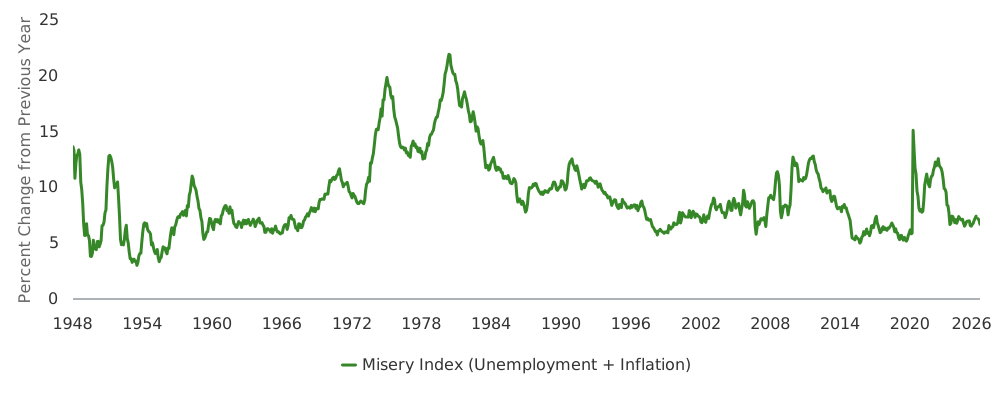
Unemployment rate plus Inflation for All Urban Consumers. Source: U.S. Bureau of Labor Statistics, Federal Reserve Bank of St. Louis (FRED), as of 2/1/26.
This is the main reason the CMSG team is still sanguine on the markets, even as we’re watching the headlines, energy, and inflation for possible changes.
Investor Implication: Stay balanced. Participate in risk assets while preserving defensive positions, including inflation-aware fixed income and real assets. Stay the course and avoid overreacting to the headlines.
Investor Implication: Diversification becomes even more critical. Inflation-aware fixed income— potentially including floating-rate securities and limited-term bonds—play an even larger role. Real asset exposure, possibly including precious metals and alternative strategies, may further enhance resilience.
Investor Implication: Energy moves from being “headline noise” to a true macro constraint. Portfolio priorities skew toward maximum diversification, ample liquidity, and high-quality assets.
Scenario analysis isn’t about predicting the outcome. It’s about preparing for multiple potentialities. The optimistic scenario may prevail, but prudence demands readiness for repricing and escalation.
The appropriate response is time-tested: Stay diversified, avoid anchoring on a single narrative, remain disciplined, and rebalance purposefully—without overreacting to headlines.
Subscribe now to our weekly commentary


Views expressed are as of the date indicated, based on the information available at that time, and may change based on market and other conditions. Unless otherwise noted, the opinions provided are those of the authors and not necessarily those of Fidelity Investments or its affiliates. Fidelity does not assume any duty to update any of the information.
Investment decisions should be based on an individual’s own goals, time horizon, and tolerance for risk.
These materials are provided for informational purposes only and should not be used or construed as a recommendation of any security, sector, or investment strategy.
Sectors and Industries are defined by Global Industry Classification Standards (GICS®), except where noted otherwise. S&P 500 sectors: Consumer Discretionary—companies that tend to be the most sensitive to economic cycles. Consumer Staples—companies whose businesses are less sensitive to economic cycles. Energy—companies whose businesses are dominated by either of the following activities: the construction or provision of oil rigs, drilling equipment, and other energy-related services and equipment; or the exploration, production, marketing, refining, and/or transportation of oil and gas products, coal, and consumable fuels. Financials—companies involved in activities such as banking, consumer finance, investment banking and brokerage, asset management, insurance and investments, and mortgage real estate investment trusts (REITs). Health Care—companies in two main industry groups: health care equipment suppliers, manufacturers, and providers of health care services; and companies involved in research, development, production, and marketing of pharmaceuticals and biotechnology products. Industrials—companies that manufacture and distribute capital goods, provide commercial services and supplies, or provide transportation services. Information Technology—companies in technology software and services and technology hardware and equipment. Materials—companies that engage in a wide range of commodity-related manufacturing. Real Estate—companies in real estate development, operations, and related services, as well as equity REITs. Communication Services—companies that facilitate communication and offer related content through various media. Utilities—companies considered electric, gas, or water utilities, or that operate as independent producers and/or distributors of power.
Stock markets, especially foreign markets, are volatile and can decline significantly in response to adverse issuer, political, regulatory, market, or economic developments. Foreign securities are subject to interest rate, currency exchange rate, economic, and political risks, all of which are magnified in emerging markets.