You are on the Investment solutions website for advisors & wealth management firms.
Browse more Fidelity websites here.
The conflict in Iran continues, but market reaction so far has not reflected a material change in urgency, mindset, or decision-making. The market in recent days has had an orderly tone to it—not one of panic. Jobs data has softened, but energy and inflation remain the bigger watchpoints.
The software sell-off reflects markets adapting to a faster AI future—not capitulating. Volatility is the cost of that adjustment, and selectivity is the opportunity. Markets continue to navigate a shifting narrative around artificial intelligence (AI), with recent volatility highlighting a growing divide between perceived winners and losers. Over the past six months, investors have rotated aggressively within technology, selling long-duration software stocks while favoring areas tied more directly to AI infrastructure, hardware, and industrial demand. This reallocation reflects structural questions about business models—not a deterioration in economic fundamentals.
Investors are concerned that rapid advances in generative and agentic AI may introduce uncertainty around traditional software pricing, moats, and long-term profitability, rather than enhance growth. This has led investors to question terminal values for many software companies, even where near-term fundamentals remain solid (Exhibit 1).
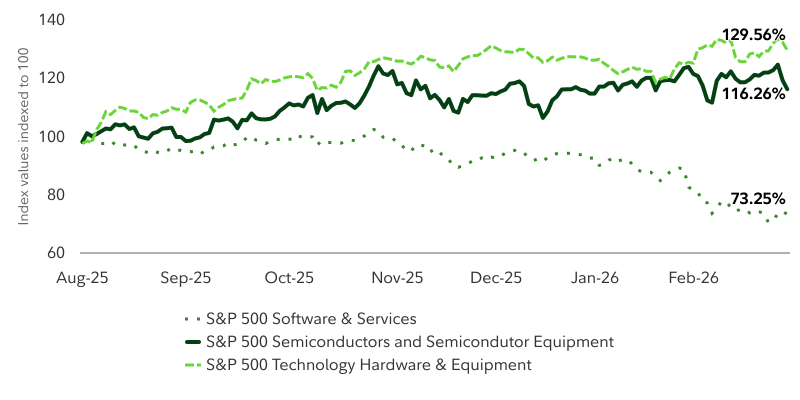
Past performance is no guarantee of future results. It is not possible to invest in an index. S&P 500 sector performance indexed to 100 on 7/31/25. Data from 8/1/25 through 2/28/26. Source: FactSet.
Heavy derisking, crowded positioning, and forced selling acted as accelerants in the sell-off. Software has experienced one of the largest non-recessionary drawdowns in decades, with investors rotating away from software toward AI-linked infrastructure and semiconductors, and sectors such as energy, materials, and consumer staples.
The Atlanta Fed is currently estimating real GDP growth of 3.1% for the first quarter of 2026. Based on our business cycle model, the U.S. economy remains in the expansion phase of the business cycle. The Fed has cut interest rates by 1.75%, and while the yield curve is now upward sloping, rates are not very restrictive by historical measures and financial conditions remain accommodative. The S&P 500 is currently estimated to grow earnings by 14.5% in 2026. Thus, this is a valuation and duration reset, not a sell-off caused by economic or earnings concerns.
The sell-off reflects long-term uncertainty, not collapsing revenues or margins. Technology earnings overall remain strong, but software-specific forward expectations are weakening as investors reassess durability under AI competition.
Recent earnings announcements show that current and expected revenue and earnings growth remain strong and management teams are broadly constructive. However, investors have turned cautious and are no longer willing to pay the multiples that software stocks once commanded. The S&P 500 Software & Services Index is currently trading at a multiple of 24 times next 12-month earnings versus its post-COVID peak of 33 times in August 2021. This reflects growing consensus that AI introduces longer-term margin and competitive risks.
Importantly, the current environment reflects differentiation rather than broad risk aversion. Investors are not abandoning AI; they are sorting through which companies can adapt and which may struggle. Software companies with proprietary data, mission-critical workflows, and deep customer relationships are better positioned to evolve and potentially thrive. Meanwhile, as the valuations of longer-duration software stocks are repriced for lower terminal values, investors are shifting down the AI stack, favoring infrastructure and semiconductors over application-layer software.
At the same time, this repricing is occurring against a backdrop of improving cyclical momentum. Manufacturing activity has turned positive, reinforcing the view that the economy remains on stable footing and that parts of the market tied to real activity may benefit. Historically, periods of rising efficiency—driven by general-purpose technologies like AI—have supported both the producers of the technology and the users of it. As AI investment continues to drive demand for chips, data centers, power infrastructure, and industrial capacity, the case for cyclicals and infrastructure remains intact.
Once positioning stabilizes, valuation dispersion could create attractive entry points in companies with clear data advantages, essential systems, or defensible architectures. The focus remains on selectivity rather than wholesale exits.
Fears of structural cracks caused by AI in long-duration business models are leading to a rotation in market leadership, even as economic conditions and corporate earnings remain supportive. Manufacturing momentum turning positive adds a tailwind for select cyclicals, while AI continues to reshape leadership within technology. Ongoing AI innovation means continued reassessment of these long-duration assets. Volatility is likely to persist, but it is also creating opportunity for disciplined, active investors focused on durability, pricing power, and real-economy exposure.


Views expressed are as of the date indicated, based on the information available at that time, and may change based on market and other conditions. Unless otherwise noted, the opinions provided are those of the authors and not necessarily those of Fidelity Investments or its affiliates. Fidelity does not assume any duty to update any of the information.
Investment decisions should be based on an individual’s own goals, time horizon, and tolerance for risk.
These materials are provided for informational purposes only and should not be used or construed as a recommendation of any security, sector, or investment strategy.
All indices are unmanaged and performance of the indices includes reinvestment of dividends and interest income, unless otherwise noted, are not illustrative of any particular investment, and an investment cannot be made in any index.
The S&P 500 index is a market capitalization-weighted index of 500 common stocks chosen for market size, liquidity, and industry group representation to represent U.S. equity performance. S&P 500 is a registered service mark of Standard & Poor's Financial Services LLC.
Sectors and Industries are defined by Global Industry Classification Standards (GICS®), except where noted otherwise. S&P 500 sectors: Consumer Discretionary—companies that tend to be the most sensitive to economic cycles. Consumer Staples—companies whose businesses are less sensitive to economic cycles. Energy—companies whose businesses are dominated by either of the following activities: the construction or provision of oil rigs, drilling equipment, and other energy-related services and equipment; or the exploration, production, marketing, refining, and/or transportation of oil and gas products, coal, and consumable fuels. Financials—companies involved in activities such as banking, consumer finance, investment banking and brokerage, asset management, insurance and investments, and mortgage real estate investment trusts (REITs). Health Care—companies in two main industry groups: health care equipment suppliers, manufacturers, and providers of health care services; and companies involved in research, development, production, and marketing of pharmaceuticals and biotechnology products. Industrials—companies that manufacture and distribute capital goods, provide commercial services and supplies, or provide transportation services. Information Technology—companies in technology software and services and technology hardware and equipment. Materials—companies that engage in a wide range of commodity-related manufacturing. Real Estate—companies in real estate development, operations, and related services, as well as equity REITs. Communication Services—companies that facilitate communication and offer related content through various media. Utilities—companies considered electric, gas, or water utilities, or that operate as independent producers and/or distributors of power.
Stock markets, especially foreign markets, are volatile and can decline significantly in response to adverse issuer, political, regulatory, market, or economic developments. Foreign securities are subject to interest rate, currency exchange rate, economic, and political risks, all of which are magnified in emerging markets.