





Revisiting the changing investor landscape
Women are growing their wealth faster than men. Multigenerational households are now putting down roots via right-sized homes and ADUs. And gray divorce rates have remained steadfast for over a decade. Yet all these groups remain underserved by our financial system.
This article is an adaptation of a report by the Fidelity Center of Applied Technology, “Revisiting the changing investor landscape.”
The Fidelity Center for Applied Technology (FCAT®) serves as an innovation catalyst for Fidelity Investments, delivering transformative solutions through cutting-edge research, experimentation, and product development. FCAT experts explore new frontiers, analyze societal shifts, and test emerging technologies to help redefine what's next for financial services and beyond.
The investor landscape is continuing to evolve in ways that matter far beyond demographics alone. Changes in who holds wealth, how households are structured, and when major life transitions occur are reshaping the context in which financial decisions get made. For wealth managers, these shifts are not just social trends to monitor. They can signal where client expectations are changing and where firms may need to adapt their engagement model to stay relevant.
This article looks at three structural shifts with growing implications for advice relationships:
- Women’s rising share of wealth
- The persistence of multigenerational households
- The continued normalization of divorce later in life
Each of these trends points to a broader theme: investors increasingly want guidance that reflects the realities of their lives, families, and goals—not just their portfolios.
Women’s wealth: Gaining ground among the UHNW
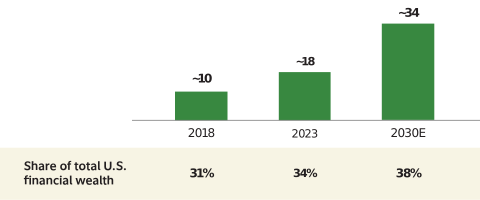
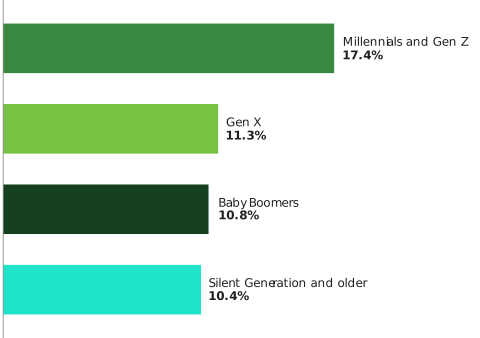
Between 2018 and 2023, global female wealth increased 51% compared with 43% overall.1 In the U.S., women are expected to control 38% of financial assets by 2030, up from 31% in 2018 (Figure 1). This growth is also happening at higher levels of wealth. In total, women only account for 12% of global ultra-high net worth (UHNW) investors ($30M+), yet among the youngest generations they account for 17% (Figure 2).2 And at the highest echelon—that of billionaires—thanks largely to inheritance and divorce settlements, as well as a growing number of self-made billionaires, the average wealth of female billionaires has risen faster than males each year since 2022.3
U.S. financial wealth controlled by women, $T
Figure 1. Women’s assets are growing as a share of total wealth in the U.S.
Source: McKinsey.2
Women’s financial power has staying power. A confluence of economic, demographic, and sociocultural trends bolster women’s financial rise. Since 1995, women have outpaced men in college degrees4 and now represent 58% of all workers in professional occupations.5 And because women are marrying later—or not at all—there are more single women managing their finances on their own. In fact, single women make up 21% of all U.S. homebuyers and 25% of first-time buyers, compared with 9% and 10% of single men, respectively.6 Finally, the combination of wealth concentration among Baby Boomers and women’s longer average lifespans means that Baby Boomer women are set to receive $40T in "horizontal" wealth transfer over the next 20 years.7
Share of global UHNW investors that are women, by generation
Figure 2. Female representation among UHNW.
Source: Altrata, 2026.8
Why it matters for wealth managers. Women may be accumulating wealth faster than men, but they still fall short in financial confidence and access. Increasing the share of women’s assets that are advisor-managed to the same share as for men will represent a $10T opportunity by 2030.9 But it’ll take work. Studies have shown that a significant share of female investors prefer to work with a female advisor or at least have one on the team.10 Yet the share of female financial advisors continues to hover around 20%–25%. Women also tend to wait until they are older to engage with a financial advisor, potentially missing out on years of influential financial decisions that could strengthen a longer-term relationship.11 Women also have different priorities for their wealth, which they’ll want reflected in the advice they receive. For example, 60% of UHNW women indicate philanthropy as their top interest compared with 35% of UHNW men (for them, sports is #1).12
Signal to watch: Younger generations closing the wealth gap. Younger women are gaining ground in retirement preparedness. A TIAA survey found that Gen Z women outnumber men when it comes to saving through a 401(k).13 Young women are also gaining financial influence. Two of the three most popular finfluencers are women, providing a more inclusive range of financial content in a space historically dominated by men.14 Whereas male finfluencers typically focus on the quantitative aspects of finance, women more often use narratives and personal stories to connect financial decisions to life goals and personal well-being.15 These finfluencers are setting new expectations around communication style, transparency, and relatability that may come to shape what younger women seek from advisors in years to come.
Multigenerational households: By need and by choice
Roughly 60 million Americans—or 20% of the U.S. population—live in a home with two or more adult generations. This is a stark departure from the 1990s and 2000s, when that share was closer to 10%.16 Older Americans living with their adult children; young adults residing with their parents; and a growing number of foreign-born, Asian, Black, and Hispanic Americans who are more likely to live in multigen households explain this rise. Beyond cultural forces, cost pressures drive much of the growth. One-third of young adults 18 to 34 live with their parents, with especially high rates in coastal areas of the U.S. where housing can be prohibitively expensive.17 At the other end of the age spectrum, though we hear a lot about “aging in place,” both the practical and financial needs of caregiving explain why 20% of Americans 65+ live in a multigen household.
Multigen living is not a temporary arrangement. While cost savings may initially have spurred the move to a multigenerational household, residents recognize the benefits and are putting down roots. Buoyed by improved finances, health, caregiving, educational attainment, and familial relationships, 7 in 10 people living in a multigen household want to do so long term.18 Buying patterns reflect this. In 2024, 17% of all homebuyers bought a multigenerational home, up from 14% the previous year, including 21% of Gen X homebuyers.19 The three biggest U.S. home builders—D.R. Horton, Lennar, and Pulte—offer homes with multigen features like kitchenettes, separate entrances, secondary bedroom suites, and bonus living rooms. Since 2023, 13 states have passed accessory dwelling unit laws to make it easier for homeowners to accommodate more people by adding on to their existing homes, often in the form of “in-law” suites.20
Why it matters for wealth managers: Pay attention to the underlying financial dynamics. Multigen households have more complex cost-sharing arrangements but often lack the financial tools to manage them. For example, some 50% to 60% of adult children in multigen households chip in to their parents’ housing or household expenses,21 most likely in disparate ways involving a lot of money movement and resource pooling. In other households, expect parents to have to contribute to their children’s finances for longer, potentially impacting their own budgeting and retirement savings. But these sharing arrangements could also have positive secondary impacts. With the money saved from living at home, young adults can invest earlier and many do: Gen Z is investing earlier than previous generations, with over a third doing so before even entering the workforce.22
Signal to watch: Cultural acceptance of living at home grows. Young adults living at home is often seen as a financial choice—surely when they can afford to move out, they will. But the cultural tide may be changing. Boston University psychology professor Catherine L. Caldwell-Harris says that in the last decade it’s become more acceptable for young adults to live with their parents.23 The “stay-at-home sons” moniker reflects the new reality of many young men, some financially independent and working but others not, who set up shop in their parents' basement. And they’re in no hurry to leave. Perhaps the American ideal of raising autonomous, independent children who move out and strike out on their own is changing.
As shared living arrangements become more culturally accepted, they may also become a more important driver of planning complexity. This may result in a greater need for advisors to support clients through family-centered decisions involving housing, caregiving, resource sharing, and generational expectations.
Gray divorce: The new face of splitting up
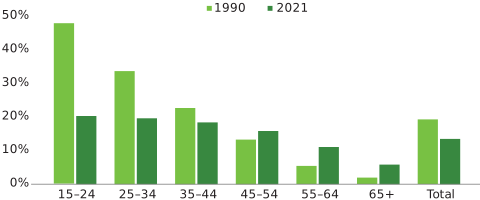
Divorcing after age 50 used to be a rare phenomenon. But between 1990 and 2010, the divorce rate for U.S. adults over 50 doubled (and for those 65+ it tripled), and it has since stabilized. This pattern flies in the face of divorce overall, with Americans under 45 splitting up at lower rates than in 1990 (Figure 3). As a result, gray divorces now comprise 36% of all divorces, more than four times their share in 1990.24
Who’s splitting up?
Figure 3. As divorce rates have declined among younger groups, split-ups among older Americans have risen.
Source: National Center for Family & Marriage Research.
Building up the infrastructure around gray divorce. Given these trends, divorce services need a facelift. While divorce proceedings have typically focused on child custody and division of shared property, they now more often include the divvying up of retirement assets and securing health insurance coverage.25 Financial advisors have adapted, too. There are now 3,500 certified divorce financial analysts, up 40% in the past decade, trained to help primarily older couples establish post-divorce budgets, assess tax implications, divide retirement accounts, and forecast housing costs.26
Why it matters for wealth managers: Divorce puts financial assets at risk. While men over 50 see a 21% drop in their standard of living post-divorce, women on average experience a 45% drop, and both persist over time.27 Re-partnering can recoup one’s standard of living, and Americans are more likely to sign a prenup in subsequent marriages.28 But only 22% of women and 37% of men re-partner or remarry following a gray divorce.29 This creates precarity at the same moment that financial flexibility is shrinking, with fewer income-earning years in one’s future. And divorcees aren’t always getting the financial help they need. For example, divorced UK women most often seek financial advice from lawyers (26%) and friends and family (13%), with only 9% getting help from financial experts, even among HNW/UHNW women.30
Signal to watch: Are we in for a post-Baby Boomer gray divorce reversal? While the gray divorce rate has held steady at higher-than-historical averages over the past 15 years, we should be on the lookout for signals that it could drop, alongside the overall divorce rate. Sociologist Susan Brown says she is “increasingly confident this gray divorce revolution is being driven by Baby Boomers and is likely to be a phenomenon largely unique to them.”31 Baby Boomers married earlier and at higher rates than subsequent generations—so as people wait longer to marry or choose not to all, look for a related decline in divorce. Further, diminished stigma around divorce is a relatively recent thing, making divorce a more palatable option for Boomers only later in life—younger generations may not hesitate to divorce sooner. While services for gray divorce will remain relevant for a while considering the size and increasing longevity of Boomers, look for signs that demand will eventually decline.
Gray divorce is a reminder that major life transitions do not stop at retirement. Firms that can guide clients through these later-life changes with both planning rigor and relationship sensitivity may be better positioned to create lasting value.
Conclusion
For wealth management firms, the strategic question is not simply which trends will grow next, but how the business can evolve to meet the needs emerging now. Firms that strengthen family engagement, tailor advice to a wider range of investor experiences, and align their service model to more holistic client expectations may be better positioned to create durable value—for both their clients and their firms.
Next steps to consider
Practice management
Discover how to transform your firm into a future-ready practice by leveraging our proprietary research, proven frameworks, and industry-leading insights.
Learn more
Client Insight Tool
Go beyond traditional client segmentation to understand where your revenue is coming from with our tailored insights.
Learn more
Investment solutions
See how Fidelity's award-winning financial investment solutions can help you meet your clients' evolving needs.
Learn more
Related insights
View all


1. Excerpted from “The new face of wealth: The rise of the female investor”, May 2025, McKinsey & Company, www.mckinsey.com. Copyright (c) 2026 McKinsey & Company. All rights reserved. Reprinted by permission.
2. Ibid
3. UBS, UBS Billionaire Ambitions Report 2025
4. Pew Research, U.S. women are outpacing men in college completion... (2024)
5. Pew Research, Women are a rising share of U.S. managers and professionals (2025)
6. Copyright ©2026 “Profile of Home Buyers and Sellers.” NATIONAL ASSOCIATION OF REALTORS®. All rights reserved. Reprinted with permission. August 31, 2026, https://www.nar.realtor/research-and-statistics/research-reports/highlights-from-the-profile-of-home-buyers-and-sellers.
7. Cerulli, High-Net-Worth and Ultra-High-Net-Worth Markets (2024)
8. Altrata, World Ultra Wealth Report 2025
9. Excerpted from “The new face of wealth: The rise of the female investor”, May 2025, McKinsey & Company, www.mckinsey.com. Copyright (c) 2026 McKinsey & Company. All rights reserved. Reprinted by permission.
10. New York Life Investments, Inspiring Women by Participating in Their Financial Growth (2024)
11. Excerpted from “The new face of wealth: The rise of the female investor”, May 2025, McKinsey & Company, www.mckinsey.com. Copyright (c) 2026 McKinsey & Company. All rights reserved. Reprinted by permission.
12. Altrata, The Defining Characteristics of Ultra Wealthy Women (2023)
13. TIAA Institute, From gap years to golden years: A comprehensive look at Gen Z’s current thinking about retirement, 2024.
14. International Accounting Bulletin, Finfluencers: The most popular influencers in finance (2023)
15. The Gendered Language of Financial Advice: Finfluencers, Framing, and Subconscious Preferences (2024)
16. Pew Research, The demographics of multigenerational households (2022)
17. National Association of Home Builders, Affordability Impacts: Young Adults Are Once Again Moving Back Home (2025)
18. Generations United, New Study Reveals Multigenerational Living Nearly Quadrupled... (2021)
19. Copyright ©2026 “Multigenerational Homes Are On the Rise — Here's Why” NATIONAL ASSOCIATION OF REALTORS®. All rights reserved. Reprinted with permission. August 31, 2026, https://www.nar.realtor/press-releases/in-the-news/multigenerational-homes-are-on-the-rise-heres-why-good-housekeeping.
20. Mercatus Center, A Taxonomy of State Accessory Dwelling Unit Laws 2025
21. Pew Research, The experiences of adults in multigenerational households (2022)
22. World Economic Forum, 2024 Global Retail Investor Outlook (2025)
23. The Global Observer, Leaving the parental home... (2023)
24. The Journals of Gerontology, The Gray of Divorce: A Half Century of Change (2022)
25. Attorney At Law Magazine, The Rise of Gray Divorce is Reshaping Family Law (2025)
26. Bloomberg, Divorce After 50? There’s a Special Financial Adviser for That (2025)
27. The Journals of Gerontology, The Economic Consequences of Gray Divorce for Women and Men (2020)
28. Law Depot, 2024 Prenup Report (2025)
29. Demography, Repartnering Following Gray Divorce (2019)
30. Mishcon de Reya, Beyond the Break: The truth about divorce in midlife for women (2025). The report was published by Mishcon and wealth advisors Julius Baer, in partnership with NOON.
31. AARP, Divorce Skyrocketing Among Aging Boomers (2023)