





ALTERNATIVES
Private credit
Private credit strategies may provide opportunities for higher income and/or total returns versus public credit markets by investing in privately negotiated loans, bonds, or other debt instruments.
Explore what Fidelity's private credit advantage may do for your clients' portfolios.
Private credit generally refers to investments that are originated or negotiated privately and are not traded on public markets. The category is often composed of higher-yielding securities, helping to deliver higher income and returns relative to traditional credit. Examples of private credit strategies include direct lending, distressed debt, collateralized loan obligations, mezzanine debt, and opportunistic credit.
This asset class presents a larger investible market than ever before, thanks to rising investor demand for private credit and its significant growth over the past several decades.

Enhanced income and returns
Potential for enhanced income and higher risk-adjusted returns through illiquidity premiums and deal complexity.

Downside protection
May offer downside protection through various structural protections, from strong covenants to collateral and/or senior secured positioning.

Diversification
Can help hedge against inflation and rate fluctuations while offering diversification beyond traditional credit markets.
Fidelity's private credit advantage is driven by 40+ years of continued innovation and a ~$130B credit platform.
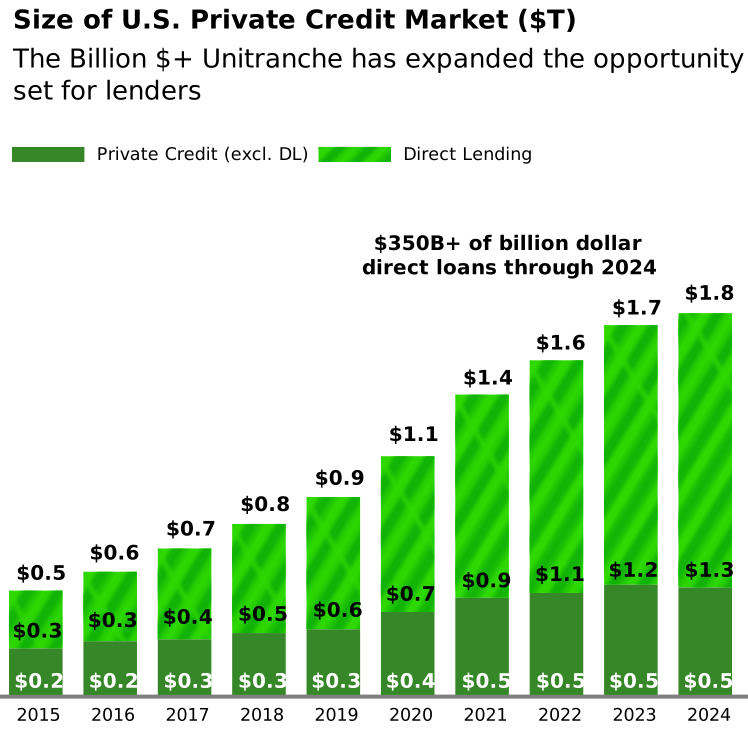
As of 12/31/2025.
Chart source: Pitchbook, Preqin, Cliffwater, Bloomberg, Fidelity Direct Lending Estimates as of 12/31/2024.
Knowledge & expertise
Our strength lies in our expertise in sourcing deals across the capital structure and taking an active role to help improve returns for investors.
Experienced investors
Fidelity's private credit team combines deep industry knowledge with a fully integrated team of portfolio managers, analysts, research, and investment professionals.
Favorable outcomes
Our large asset base, established platform, and experienced team help to maximize returns for investors.
Want to know more about our private credit offerings?
Contact us or register for investment professional website access.
Research & insights
View all


Private equity
Seeks to provide enhanced long-term capital appreciation by investing in the equity of private, non-traded companies and helping them optimize operations to drive future growth.
Learn more
Digital assets
Seeks to provide growth and diversification by investing in digital assets, such as cryptocurrencies like bitcoin and ether.
Learn more
Real assets
Seeks to provide attractive total returns, diversification from traditional investments, and income through exposure to physical assets, such as real estate, infrastructure, and agriculture.
Learn more
Liquid alternatives
Seeks to diversify and manage risk by generating less correlated returns using a combination of stocks, bonds, commodities, currencies, leverage, and derivatives.
Learn more
Explore more investment products & solutions
Alternative investments are investment products other than the traditional investments of stocks, bond, mutual funds, or ETFs. Alternative investment strategies may not be suitable for all investors and are not intended to be a complete investment program for any investor. Examples of alternative investments are limited partnerships, limited liability companies, hedge funds, private equity, private debt, commodities, real estate, and promissory notes. Some of the risks associated with alternative investments are: Alternative investments may be relatively illiquid. It may be difficult to determine the current market value of the asset. There may be limited historical risk and return data. A high degree of investment analysis may be required before buying. Costs of purchase and sale may be relatively high.
Commodity interest trading involves substantial risk of loss.
Digital assets are speculative and highly volatile, and their market movements are very difficult to predict. Investors also face other risks, including significant and negative price swings, flash crashes, and fraud and cybersecurity risks. Digital assets may also be more susceptible to market manipulation than securities. They can become illiquid at any time and are for investors with a high-risk tolerance. Investors in digital assets could lose the entire value of their investment.
Fidelity Diversifying Solutions LLC (“FDS”) is a U.S. registered investment adviser, and CFTC registered commodity pool operator and registered commodity trading advisor. FDS is an indirect, wholly owned subsidiary of FMR LLC. Products and services may be presented by Fidelity Distributors Company LLC (FDC), a non-exclusive financial intermediary affiliated with FDS and compensated for such services.