You are on the Investment solutions website for advisors & wealth management firms.
Browse more Fidelity websites here.
As we enter week six of the Iran conflict, the Strait of Hormuz problem remains the primary economic overhang.
The big questions we’re answering for clients right now: Will this closure drive a permanent spike in inflation? Is a global growth slowdown inevitable? And ultimately, are we looking at a legitimate risk of stagflation?"
Here’s the answer you likely haven’t heard: A slower-growth, higher-inflation environment might not be as bad as you think—and could even lead to specific opportunities.
It’s true, the current inflation picture isn’t great. Just a few days ago, Fidelity’s Asset Allocation Research team made the case that inflation is more likely to run higher than the current market consensus. Reasons include (1) past energy supply shocks having been multi-month events, (2) secondary waves of inflation following a peak (like the one in 2022) have been common, and (3) the team issuing an increased number of inflationary signals.
The team thinks CPI inflation could rise toward 4% over the next 9 to 12 months. In comparison, market expectations based on inflation swaps call for an inflation rate closer to 3% over the same period (Exhibit 1).
Year-over-year expectations as of 12/31/25
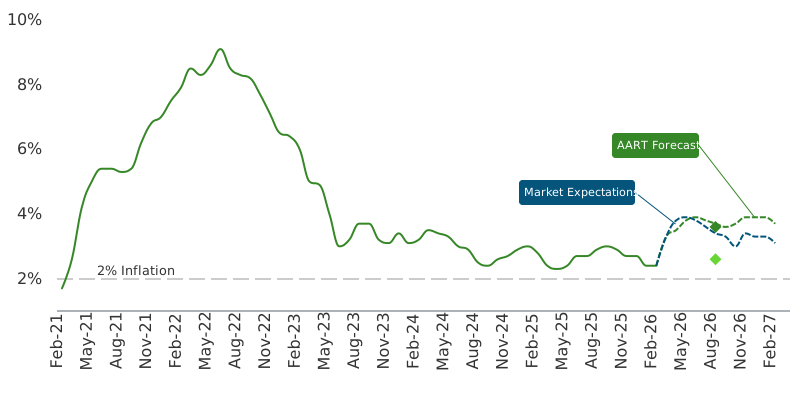
Expected annual impact of $100 oil on U.S. CPI
|
Core
|
Headline
|
|---|---|
| +0.7% | +1.3% |
CPI: Consumer Price Index. Market expectations based on pricing of inflation swaps. Source: Bureau of Labor Statistics, Bloomberg, Macrobond, Fidelity Investments (AART), as of 2/28/26. TABLE: AART estimates as of 3/31/26.
Sounds bad, right? Does this mean we are going to see a repeat of the 1970s all over again? If so, what does that mean for bonds?
Our base case is that bonds continue to offer income diversification benefits for equity investors, driven by attractive yields and valuations roughly in line with long-term averages.
Could we be wrong? It would be problematic if the Fed were forced to raise rates this year, or if 10-year U.S. Treasury yields broke out solidly above 4.5%.
Yet we don’t see either as a base case.
In this environment, it’s all about getting rewarded for taking risks. Considerations, therefore, include investments at the shorter end of the yield curve and several unique bond asset classes.
Advisors cannot forget about the importance of clients maintaining exposure to fixed income, even in a slower-growth, higher-inflation environment.
While inflation needs to be monitored, market pricing suggests inflation expectations could stay contained. Meanwhile, bond valuations are best described as “OK.”
Positioning emphasizes being selective and intentional, favoring areas of the bond market where investors are more clearly compensated for risk—particularly at the shorter end of the curve and in asset classes with structural or technical support.
This approach allows portfolios to remain resilient, even if growth and inflation dynamics in the future are not ideal.



Views expressed are as of the date indicated, based on the information available at that time, and may change based on market and other conditions. Unless otherwise noted, the opinions provided are those of the authors and not necessarily those of Fidelity Investments or its affiliates. Fidelity does not assume any duty to update any of the information.
Investment decisions should be based on an individual’s own goals, time horizon, and tolerance for risk.
These materials are provided for informational purposes only and should not be used or construed as a recommendation of any security, sector, or investment strategy.
All indices are unmanaged and performance of the indices includes reinvestment of dividends and interest income, unless otherwise noted, are not illustrative of any particular investment, and an investment cannot be made in any index.
In general, the bond market is volatile, and fixed income securities carry interest rate risk. (As interest rates rise, bond prices usually fall, and vice versa. This effect is usually more pronounced for longer-term securities.) Fixed income securities also carry inflation risk, liquidity risk, call risk and credit and default risks for both issuers and counterparties. Unlike individual bonds, most bond funds do not have a maturity date, so avoiding losses caused by price volatility by holding them until maturity is not possible. Lower-quality bonds can be more volatile and have greater risk of default than higher-quality bonds. Foreign securities are subject to interest rate, currency exchange rate, economic, and political risks, all of which are magnified in emerging markets. Leverage can increase market exposure and magnify investment risk.
CLO ETFs invest significantly in collateralized loan obligations (CLOs) which are associated with a number of risks including liquidity, interest-rate, credit, event, and call risk as well as the risk of default of the underlying assets. While these funds invest principally in CLO tranches that are rated AAA, such ratings do not constitute a guarantee of credit quality and may be downgraded. To the extent that these funds invest in CLO tranches rated below AAA, the risks of investing in CLOs will be greater. The CLOs are managed by investment advisers independent of the Advisers running the funds and may be subject to conflicts of interests, including managing the assets of other clients or other investment vehicles, or receiving fees that incentivize maximizing the yield, and indirectly the risk, of a CLO. Fixed income securities carry interest rate risk (As interest rates rise, bond prices usually fall, and vice versa. This effect is usually more pronounced for longer-term securities.). Fixed income securities also carry inflation risk, liquidity risk, call risk and credit and default risks for both issuers and counterparties. Unlike individual bonds, most bond funds do not have a maturity date, so avoiding losses caused by price volatility by holding them until maturity is not possible. Floating rate loans may not be fully collateralized and therefore may decline significantly in value. Foreign markets can be more volatile than the U.S. market due to increased risks of adverse issuer, political, regulatory, market, or economic developments and can perform differently from the U.S. market. Leverage can increase market exposure, magnify investment risks, and cause losses to be realized more quickly. Unlike certain ETFs, the fund may effect some or all creations and redemptions using cash, rather than in-kind securities. As a result, an investment in the fund may be less tax-efficient than an investment in an ETF that distributes portfolio securities entirely in-kind. The fund may have additional volatility because it can invest a significant portion of assets in securities of a small number of individual issuers. An ETF may trade at a premium or discount to its Net Asset Value (NAV).