You are on the Investment solutions website for advisors & wealth management firms.
Browse more Fidelity websites here.
SERIES
Introducing new weekly insights from Fidelity Institutional's (FI) Capital Markets Strategy Group covering the latest market trends, economic developments, and key factors shaping investment decisions—all to help you and your clients navigate the markets with confidence.
What was behind the post-midterm sell-off in semiconductors and data-center infrastructure? We believe the sell-off is best read as a repricing of how fast the AI buildout proceeds, not a verdict on whether the demand exists. Given that much of 2027's data center capacity is largely under construction, capex spending is still rising, and semiconductor fundamentals are near historic highs, we see speed bumps, not roadblocks. The market sold the AI complex as one trade, creating potential for widening dispersion that will favor selectivity and active management.
The move after midterm elections was violent and indiscriminate. On Nov. 5, the Philadelphia Semiconductor Index fell roughly 10%, its worst session since March 2020, and the Nasdaq Composite dropped about 5.5%, confirming a correction from its Oct. 6 high. Hyperscalers, chipmakers, equipment suppliers, and neoclouds were sold in unison.
The trigger was the election results, not fundamentals. Democrats won control of both chambers of Congress, and governor races in Texas, Ohio, and Georgia went to candidates who campaigned on restricting data-center construction. Voters sided against data centers in 40 of 41 local ballot measures. Texas alone accounts for roughly a quarter of planned U.S. data-center capacity, and its governor-elect has pledged a moratorium on new projects. Projects already authorized are expected to continue.
The bear case has quietly changed shape. Through the summer, the worry was overbuilding of data centers. Now it is whether demand arrives fast enough to justify the spend at a slower, costlier pace. Note the irony: Constraint on new supply is the natural remedy for a potential overbuild.
We don’t believe the election changed the demand outlook. Three points argue that the data-center story is bent but not broken.
Price and fundamentals have rarely been this far apart. Semiconductor industry revenue has compounded at roughly 33% annually over the past three years, a pace in the 94th percentile of all three-year periods since 1970. Over the same stretch, the sector’s multiple has compressed to below that of the broader market. That combination has historically been constructive.
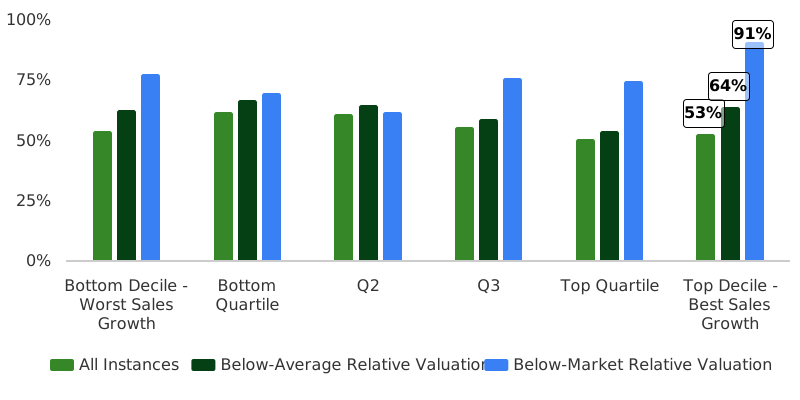
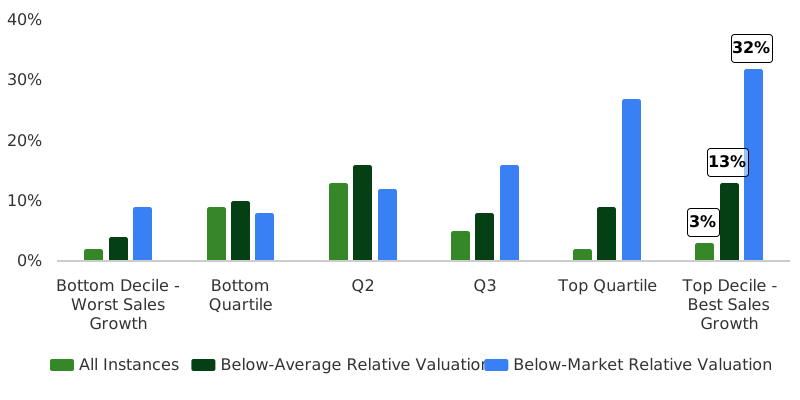
When elevated sales growth has been paired with a below-market multiple, semiconductors have outperformed over the following 12 months about 91% of the time since 1970, by an average of 32% (Exhibit 1). We don’t read this as a reason to buy the index wholesale. Base rates are not guarantees, and the historical sample does not include a politically driven supply shock of this kind. But it does suggest the market is pricing a deeper earnings disappointment than the revenue trend supports.
NTM Odds of semiconductor outperformance across sales growth
Regimes, Under different valuation starting points
1970-Present
NTM Average semiconductor relative performance across sales growth
Regimes, Under different valuation starting points
1970-Present
Past performance is no guarantee of future results. Views are subject to change and are not intended to be investment advice or a recommendation. Data reflected is based on a proprietary Fidelity index. NTM = Next 12 Months. Sources: FactSet, Haver Analytics, Fidelity Investments, Denise Chisholm, Bloomberg. Data as of Oct. 28, 2026.
Last week tested the idea of a multilayered AI stack, and the notion that the AI trade was broadening. High correlations on the way down are typically when dispersion increases on the way back up.
The pressure points are specific. The names most exposed to a slower, costlier buildout are debt-funded neoclouds, a Texas-heavy population of data-center developers, power, cooling, and electrical equipment suppliers, semiconductors and equipment, and the application software and IT services. Holding up relatively well are hyperscalers, infrastructure software and cybersecurity, health care and biotech, and non-AI sectors such as energy, staples, and utilities.
Similar to the recent path of consumer spending, AI market performance may be K-shaped. The indiscriminate rally that defined the first half of 2026 appears to be giving way to a market that is increasingly rewarding fundamentals. That differentiation is arguably healthy. Selectivity matters across both stocks and bonds. We favor companies that can fund growth without relying on favorable financing conditions or tax incentives, a filter that applies as much to data-center credit exposure as it does to equities.
Data-center skepticism is bipartisan; so is the AI race. Texas’s Republican governor paused new large-load grid approvals months before the election, and local opposition has crossed party lines nationwide. At the same time, policymakers in both parties share an interest in keeping the U.S. competitive in an increasingly global race for AI leadership. That tension tends to resolve through negotiation rather than prohibition: community-benefit agreements, local investment commitments, and rules requiring data centers to cover their own grid costs, which over time could even ease pressure on household electric bills. We believe the debate is about the terms of the buildout, not whether it happens.
Capex guidance is the cleanest signal. An explicit pullback from a major hyperscaler would be the clearest evidence that demand, not politics, is the binding constraint. So far, guidance is still moving up.
Fiscal policy is the sleeper risk. A potential debt-ceiling negotiation early next year could put 100% bonus depreciation for data centers on the table, a plan favored by the Trump administration that would allow more immediate, more favorable tax treatment. Recent Senate proposals would deny full expensing to certain new AI data centers, which would raise the after-tax cost of the buildout and weigh most on marginal, debt-funded builders.
The midterm elections introduced speed bumps, not roadblocks. Data centers are still moving forward, at a slower and possibly healthier pace, and the fundamentals underneath the AI complex are stronger than the recent price action suggests. The opportunity lies in separating short-term sentiment from long-term fundamentals, which is where active management can add value. We view the policy debate as a question of global competitiveness rather than red versus blue, acknowledge the genuine uncertainty around 2028 capacity, and resist the conclusion that the AI trade is over. It is simply no longer a trade where everything wins together.

Concentration risk may merit investors reviewing their allocation to stocks tied to artificial intelligence.
The headline S&P 500 has remained close to its highs, but the calm at the index level masks turbulence underneath.




The FI Capital Markets Strategy Group synthesizes economic analysis and market outlooks from across Fidelity to provide timely, actionable perspectives for financial advisors and institutional investors.






The information contained herein is general in nature and should not be construed as legal or tax advice. This material is not intended to provide, and should not be relied on for, tax, legal, investment, or accounting advice. Tax laws and regulations are complex and subject to change. You should consult your own tax, legal, investment, and accounting advisors before engaging in any transaction.
Some of this information is forward-looking and is subject to change.
Stock markets, especially foreign markets, are volatile and can decline significantly in response to adverse issuer, political, regulatory, market, or economic developments.
The technology industries can be significantly affected by obsolescence of existing technology, short product cycles, falling prices and profits, competition from new market entrants, and general economic conditions. Foreign securities are subject to interest rate, currency exchange rate, economic, and political risks.
Views expressed are as of the date indicated, based on the information available at that time, and may change based on market and other conditions. Unless otherwise noted, the opinions provided are those of the authors and not necessarily those of Fidelity Investments or its affiliates. Fidelity does not assume any duty to update any of the information. Diversification does not ensure a profit or guarantee against a loss. Investment decisions should be based on an individual’s own goals, time horizon, and tolerance for risk. These materials are provided for informational purposes only and should not be used or construed as a recommendation of any security, sector, or investment strategy. Stock markets, especially foreign markets, are volatile and can decline significantly in response to adverse issuer, political, regulatory, market, or economic developments.