You are on the Investment solutions website for advisors & wealth management firms.
Browse more Fidelity websites here.
Ben Shuleva is portfolio manager of Fidelity Advisor® Consumer Staples Fund.
Consumer staples stocks struggled to gain ground in 2025, widely underperforming the broad-based S&P 500® index year to date. The lagging result for the defensive-oriented sector reflects investors’ strong preference for AI-driven growth stocks, as well as shifting consumer spending trends and concern that GLP-1 weight-loss drugs may reduce consumption of certain foods and beverages. Nonetheless, I believe 2026 could bring a more favorable environment for the sector—which comprises companies that produce and sell a wide variety of essential goods and services—supported by fiscal stimulus and easing sector-specific pressure, potentially boosting product demand and stock valuations.
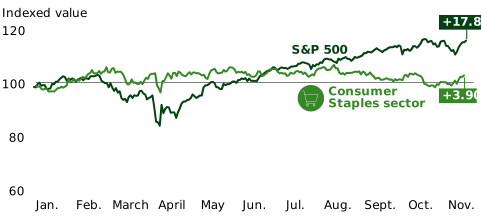
Past performance is no guarantee of future results. Consumer staples sector performance is represented by the MSCI US IMI Consumer Staples 25/50 index. Data as of November 30, 2025. Source: S&P Dow Jones Indices, a division of S&P Global, and MSCI.
Investors’ fascination with all things AI has left the consumer staples sector on the back shelf in 2025, with only a modest advance that is notably lower than its long-term historical average. The sector is among the smallest in the S&P 500® index and includes producers of everyday essentials, such as packaged foods, toothpaste and household cleaners. It’s considered defensive because demand for these goods tends to remain stable, even during an economic downturn, and because many companies in the sector are mature, dividend-paying businesses.
This defensive profile was out of sync with investors’ appetite for risk in 2025, as they favored growth-oriented sectors and stocks that dominated the broader market’s performance. Volume growth within staples has been sluggish, weighed down by headwinds such as the impact of GLP-1 medications, evolving alcohol consumption, and shifting purchasing behavior among lower-income consumers grappling with high inflation and slowing wage growth. Valuations for stocks in the sector have fallen in 2025, with investors increasingly questioning whether the weakness is cyclical or structural.
Looking ahead, I believe the sector is poised to benefit from an improved investment environment, driven by lower interest rates and the normalization of recent headwinds. A key development will be the impact of the One Big Beautiful Bill Act, a massive tax and spending package that passed in July, which I expect to deliver a significant income boost to middle-income consumers and potentially translate into stronger discretionary spending.
In addition, several sector-specific challenges appear to be stabilizing. For example, I believe the alcohol-consumption reset among certain segments of the population—partly due to immigration-related fears and policy shifts—has largely played out, reducing the likelihood of further downside in the sector’s industries related to alcohol. Similarly, I expect deceleration in the rapid adoption of GLP-1 drugs, which has been a headwind for certain food and beverage segments. In my view, these factors suggest a more balanced operating backdrop for consumer staples companies in 2026, with fewer disruptive dynamics and improved consumer spending.
Valuations for stocks in the sector remain compelling, based on my analysis, especially relative to segments that are heavily exposed to AI. While the sector’s performance in 2026 hinges on broader market dynamics, I believe the risk-reward picture within staples appears more attractive heading into the new year.
I am particularly bullish about the distillers & vintners subindustry, which faced meaningful headwinds in 2025, ranging from declining consumption among younger consumers to the impact of GLP-1 drugs and economic pressure on low- and middle-income households. While some of these challenges are structural, I believe investors have overstated their duration. With this in mind, I see opportunity in companies with strong brand equity and international exposure, such as Constellation Brands and Diageo, both of which are sizable positions in the fund.
I expect consumer spending to broaden in 2026, moving away from the hyper-value focus that has dominated the past few years. I believe this shift has the potential to benefit shares of Target, a top fund holding that has lost significant ground in 2025 because consumers concentrated their spending at value leaders Walmart and Costco Wholesale.
I continue to be optimistic about stocks that I consider undervalued because investors have overreacted to company-specific challenges. For example, Mondelez International, a large fund holding, was pressured by the rising cost of cocoa in 2025, but I foresee the potential for profit-margin recovery now that costs for the multinational snack maker have eased and its international footprint has helped to offset the impact of GLP-1 drugs.
Other value-oriented stocks I like include Keurig Dr Pepper. A sizable portfolio holding, the stock sunk in late August on news the company would acquire JDE Peet’s. While I don’t love the deal, I believe investors overly punished the stock, potentially making it more attractive. Battery maker Energizer Holdings is another deep-value stock and meaningful portfolio position that I think is mispriced. Kenvue, maker of Tylenol, has faced a headwind in recent product safety claims. The stock is extremely cheap, based on my estimate, and with Kimberly-Clark recently announcing it plans to acquire the company, I see a clear path to improved performance in 2026. Kenvue is among the fund’s top holdings.
The stocks noted have been left behind as the sector derated in 2025, but if fundamentals improve and valuation spreads begin to narrow, I believe the consumer staples sector is well-positioned to benefit from mean reversion and renewed investor interest.
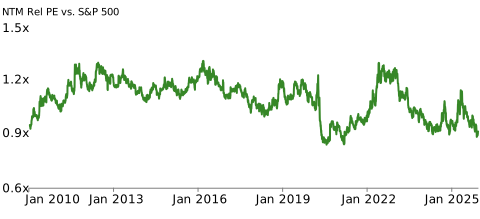
NTM = next 12 months price-to-earnings multiple. P/E: Consumer staples price to earnings multiple. Source: Bloomberg, as of Oct. 29, 2025.
In 2026, I see a more constructive backdrop for consumer staples stocks, with support from fiscal stimulus, easing headwinds and compelling valuations. With the sector offering rich opportunities for stock selection, I’m focused on undervalued names and turnaround stories, especially those with stabilizing business fundamentals and high potential for mean reversion.
Seeks capital appreciation.

Our latest investing takes and practice management tips, in an easy audio format.












All stocks mentioned in this article as fund holdings were held as of November 30, 2025.
Diversification does not ensure a profit or guarantee against loss.
It is not possible to invest directly in an index. All market indices are unmanaged. Index performance is not meant to represent that of any Fidelity mutual fund.
The MSCI US IMI Consumer Staples 25/50 Index represents the performance of the MSCI US IM Consumer Staples 25/50 Index since January 1, 2010, and the MSCI US Investable Market Consumer Staples Index prior to that date. The S&P 500® index is a market capitalization–weighted index of 500 common stocks chosen for market size, liquidity, and industry group representation to represent U.S. equity performance.
Information presented herein is for discussion and illustrative purposes only and is not a recommendation or an offer or solicitation to buy or sell any securities. Views expressed are as of the date indicated, based on the information available at that time, and may change based on market and other conditions. Unless otherwise noted, the opinions provided are those of the author and not necessarily those of Fidelity Investments or its affiliates. Fidelity does not assume any duty to update any of the information.
References to specific securities or investment themes are for illustrative purposes only and should not be construed as recommendations or investment advice. This information must not be relied upon in making any investment decision. Fidelity cannot be held responsible for any type of loss incurred by applying any of the information presented. These views must not be relied upon as an indication of trading intent of any Fidelity fund or Fidelity advisor. Investment decisions should be based on an individual's own goals, time horizon, and tolerance for risk. This piece may contain assumptions that are "forward-looking statements," which are based on certain assumptions of future events. Actual events are difficult to predict and may differ from those assumed. There can be no assurance that forward-looking statements will materialize or that actual returns or results will not be materially different from those described here. Investing involves risk, including risk of loss.
Stock markets are volatile and can decline significantly in response to adverse issuer, political, regulatory, market, or economic developments. Because of its narrow focus, sector investing tends to be more volatile than investments that diversify across many sectors and companies. The consumer discretionary industries can be significantly affected by the performance of the overall economy, interest rates, competition, consumer confidence and spending, and changes in demographics and consumer tastes. Sector investing is also subject to the additional risks associated with its particular industry.
Before investing, consider the funds' investment objectives, risks, charges, and expenses. Contact your investment professional or visit i.fidelity.com for a prospectus or, if available, a summary prospectus containing this information. Read it carefully.