





Health care sector
Despite lingering U.S. government policy uncertainty, innovation among drug therapies and other health care products supports attractively valued growth in the sector.
Eddie Yoon is a portfolio manager of Fidelity Advisor® Health Care Fund.
- Health care stocks largely tracked the broader equity market in 2025 despite mounting U.S. government policy and macroeconomic uncertainty.
- Market volatility among health care stocks is likely to remain elevated until the current presidential administration’s health care agenda is clarified and through the midterm U.S. elections.
- Product innovation is poised to remain the sector’s key growth driver in 2026, with upcoming clinical readouts from several biotech firms setting the stage for potential breakthroughs.
- Bioprocessing stocks are another source of potential growth, given they could benefit from several recent trends and policies, including nearshoring and finally getting through pandemic-era excesses.
Health care stocks climbed higher in 2025, roughly in line with the broader U.S. equity market. Enthusiasm over all things tied to artificial intelligence (AI) fueled gains in areas of the market with clearer AI exposure, and some sector-specific volatility provided headwinds, while other parts of the sector saw the beginning of a reemergence, following years of underperformance. U.S. government policy uncertainty, rising health care costs and weak quarterly financial reports from some industry leaders weighed heavily on the sector. A pick-up in mergers and acquisitions (M&A) and capital markets activity, in conjunction with more favorable monetary policy, provided some tailwinds to the sector, most notably in the biotech industry, though we saw notable Initial Public Offering (IPO) activity in other areas in the sector as well, including in the medical technology industry.
Investors continue to value innovation in the health care space. Even amid macroeconomic uncertainty, investors are rewarding companies with breakthrough clinical results and large companies are putting capital to work through acquisitions. Incremental progress is also emerging in areas such as bioprocessing—a trend I see likely to build in 2026.
Year-to-date price return
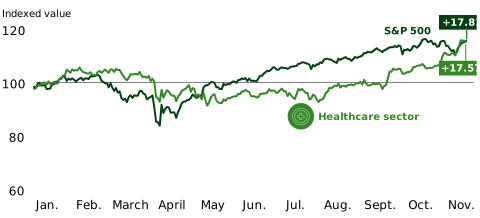
Past performance is no guarantee of future results. Health care sector performance is represented by the MSCI US IMI Health Care 25/50 Index. Data as of November 30, 2025. Source: S&P Dow Jones Indices, a division of S&P Global, MSCI.
2025: Policy uncertainty amid strong clinical trial data
Unclear U.S. government policy direction clouded the health care sector’s outlook in 2025. Health insurers were hit particularly hard as the trend of costs outpacing pricing that we’ve seen over the past few years continued, leading to significant profit margin pressure in the industry. Toward the end of the year, additional volatility hit the sector, as investors considered the fate of the enhanced premium for Affordable Care Act marketplace plans. The subsidies, first introduced under the American Rescue Plan Act of 2021 and later extended through 2025 in the Inflation Reduction Act of 2022, reduced consumer premiums. However, without another extension, enrollees could face sharply higher premiums in 2026.
In addition to rising costs, tariff and trade concerns and the Trump administration’s targeted cuts to National Institutes of Health (NIH) research funding also proved to be headwinds for some industries. The Supreme Court allowed the administration to end funding to some areas, even as Congress preserved the NIH’s $48 billion budget. The White House’s new upfront policy could reduce the number of projects funded. Finally, drug pricing was back in the news in May, when the president pushed to tie U.S. prices to those of other countries that follow the World Trade Organization's "Most Favored Nation (MFN)" rule.
M&A volume (# of deals)
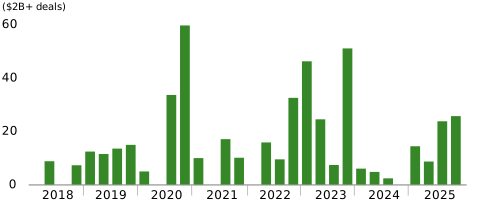
Source: FactSet, as of September 30, 2025.
Amid the uncertainty, there were some bright spots in the sector. Biotech stocks, up about 36% year to date through November 30, 2025, according to the MSCI IMI Biotechnology 25/50 Index, benefited from strong clinical data for multiple drug candidates and a policy interest rate cut by the Federal Reserve that eased funding conditions. The biotech industry and health care technology industry both benefitted from increased capital market activity, with M&A and IPO activity picking up toward the second half of the year. Meanwhile, site-of-care shifts—from hospitals to ambulatory and urgent care centers—benefited some health care facilities.
2026: Innovation and progress lead the way
Despite the macro uncertainties, innovation remains a key market driver for the sector in 2026 and beyond. In the biotech industry, we’re seeing higher rates of positive clinical data—with clinical trial success rates jumping during the year. I believe this is because many of the more speculative companies have been weeded out of the industry. Positive clinical data has been rewarded with a corresponding increase in valuations during the year. In a sign of a return to more level heads in the space, companies with negative data aren’t being funded and some are continuing to go out of business. I believe this rightsizing continues to be positive for the industry. In addition, we’ve seen more companies pursuing M&A this year, a trend I expect to continue, as large cap biopharma companies look to fill therapeutic pipelines in the face of significant patent cliffs expected between now and 2030.
Conviction in bioprocessing and biotech stocks
Bioprocessing companies manufacture the tools—bioreactors, fuel bags and cell-culture media, for example—needed to make complex drugs, including monoclonal antibodies, cell and gene therapies, as well as vaccines. Demand surged during the pandemic for these tools, which are critical components in the creation of vaccines, treatments, and diagnostics, and as the biotech industry swelled in size. But this boom led to a bust in subsequent years when sales fell as biopharma firms worked through outsized inventory, and cut their spending when funding was sapped by rising interest rates and a drying up of capital markets to the industry.
Recently, though, we’ve seen early signs of a recovery for bioprocessing companies, as companies have worked through inventories, and the beginnings of a recovery in the biopharma space. The bioprocessing industry has seen an uptick in orders that I expect will continue through 2026. Bioprocessing firms also stand to benefit from increased capital spending, nearshoring trends and policies like the MFN rule. Among the largest holdings in this industry are Danaher and Repligen—two companies I favor for their stable business models, exposure to secular growth trends and regulatory barriers that limit new competitors.
Biotech is another industry regaining momentum after a challenging period. In recent years, the group was hurt by high interest rates, regulatory and policy unease, and the poor performance of speculative companies that went public during the pandemic. But with several crucial data readouts expected into 2026, key breakthroughs are a real possibility.
Over the years, research and development in the highly personalized gene therapy space has surged, while the cost of gene sequencing has dropped. Moreover, merger and acquisition activity is poised for a comeback, with blockbuster drugs set to lose exclusivity at a faster-than-average pace over the next five years and major players looking to strike deals to refill their pipelines. In my view, specialty firms Argenx and Alnylam Pharmaceuticals appear particularly well positioned, as both companies are turning profitable on the back of successful commercial drug launches. In addition, these firms leverage innovative antibody and RNAi platforms to address significant unmet medical needs. RNAi is a biological process where RNA molecules are used to silence specific genes. For therapeutic purposes, this process can target and treat diseases by silencing the genes responsible for them. Each is among the fund’s largest holdings as of November 30.
A potential opening for long-term investors
Across the sector, lower stock valuations and a period of multiyear underperformance relative to the broader U.S. equity market may offer an appealing entry point for investors seeking exposure to powerful long-term trends—most notably an aging U.S. population with unmet medical needs.
The sector also encompasses a broad and diverse range of industries, offering a unique mix of defense and growth characteristics that may be attractive across a variety of market scenarios.

Fidelity Advisor Health Care Fund (FHCIX)
Seeks to provide capital appreciation.

Fidelity Disruptive Medicine ETF (FMED)
Seeks capital appreciation.

Insight & Outlook Special Edition
Our latest investing takes and practice management tips, in an easy audio format.
Explore the 11 equity sector outlooks











All stocks mentioned in this article as fund holdings were held as of November 30, 2025.
Diversification does not ensure a profit or guarantee against loss.
It is not possible to invest directly in an index. All market indices are unmanaged. Index performance is not meant to represent that of any Fidelity mutual fund. The S&P 500® index is a market capitalization-weighted index of 500 common stocks chosen for market size, liquidity, and industry group representation to represent U.S. equity performance. The MSCI US IMI Health Care 25-50 Index is a modified market capitalization-weighted index of stocks designed to measure the performance of Health Care companies in the MSCI US Investable Market 2500 Index. The MSCI US Investable Market 2500 Index is the aggregation of the MSCI US Large Cap 300, Mid Cap 450, and Small Cap 1750 Indices. The MSCI US IMI Biotechnology 25-50 Index is a modified market capitalization-weighted index of stocks designed to measure the performance of Biotechnology companies in the MSCI US Investable Market 2500 Index.
Information presented herein is for discussion and illustrative purposes only and is not a recommendation or an offer or solicitation to buy or sell any securities. Views expressed are as of the date indicated, based on the information available at that time, and may change based on market and other conditions. Unless otherwise noted, the opinions provided are those of the author and not necessarily those of Fidelity Investments or its affiliates. Fidelity does not assume any duty to update any of the information.
References to specific securities or investment themes are for illustrative purposes only and should not be construed as recommendations or investment advice. This information must not be relied upon in making any investment decision. Fidelity cannot be held responsible for any type of loss incurred by applying any of the information presented. These views must not be relied upon as an indication of trading intent of any Fidelity fund or Fidelity advisor. Investment decisions should be based on an individual's own goals, time horizon, and tolerance for risk. This piece may contain assumptions that are "forward-looking statements," which are based on certain assumptions of future events. Actual events are difficult to predict and may differ from those assumed. There can be no assurance that forward-looking statements will materialize or that actual returns or results will not be materially different from those described here. Investing involves risk, including risk of loss.
Stock markets are volatile and can decline significantly in response to adverse issuer, political, regulatory, market, or economic developments. Because of its narrow focus, sector investing tends to be more volatile than investments that diversify across many sectors and companies. The health care industries are subject to government regulation and reimbursement rates, as well as government approval of products and services, which could have a significant effect on price and availability, and can be significantly affected by rapid obsolescence and patent expirations. Sector investing is also subject to the additional risks associated with its particular industry.