





Real estate sector
Favorable conditions for many real estate groups, including senior housing REITs, provide optimism for 2026.
Steve Buller is a portfolio manager of Fidelity Advisor® Real Estate Investment Portfolio.
- The stocks of real estate investment trusts underperformed the broader U.S. equity market in 2025, as growth-oriented stocks, particularly those connected to artificial intelligence applications, led the way.
- A combination of solid supply-and-demand conditions, improved capital costs and more attractive valuations are reasons to be optimistic about REITs in 2026.
- Senior housing REITs offer a particularly attractive investment opportunity, given constrained supply and robust demand, driven by the demographic tailwind of an aging baby boomer population.
Investors in real estate investment trusts might be forgiven for feeling left behind once again in 2025, following yet another robust year for high-growth, technology-focused stocks. Despite REITs’ underperformance this past year, however, I’m feeling relatively optimistic about the prospects for real estate securities in 2026. My optimism reflects solid industry fundamentals, better capital costs and more attractive valuations, particularly relative to the broader U.S. equity market. I see particularly compelling investment potential among senior housing REITs, which I believe are positioned well due to a highly favorable supply-and-demand balance in the industry.
2025: More subdued gains for REITs
The past 12 months were a challenging environment for the performance of real estate stocks compared with the broader U.S. equity market. Not surprisingly, REITs, a relatively slow-moving, income-oriented asset class, tend to lag the broader stock market when growth-oriented stocks are thriving. This was indeed the situation investors encountered for most of 2025, as technology-related companies tied to the burgeoning growth of artificial intelligence applications continued to soar.
Year-to-date price return
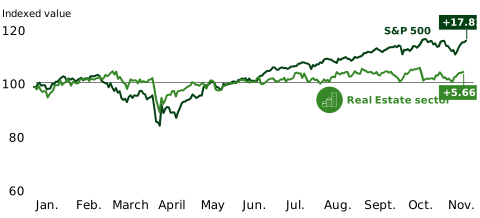
Past performance is no guarantee of future results. Real estate sector performance is represented by the MSCI US IMI Real Estate 25/50 Index. Data as of November 30, 2025. Source: S&P Dow Jones Indices, a division of S&P Global, MSCI.
Within the REIT market, meanwhile, industry performance was mixed. Health care REITs were notably strong performers, benefiting from strong supply-and-demand conditions. Industrial REITs also fared very well, reflecting continued strength in e-commerce and demand for logistics facilities.
In contrast, single-family rental stocks meaningfully struggled, as did apartment REIT stocks, hampered by stubbornly high supply that dragged down rental income. Lodging and resort REITs also were weak in 2025, hurt by profit-margin pressure amid higher costs and decreasing RevPAR, or revenue per available room, a common measure of hotels’ financial performance.
2026: Reasons for optimism
My outlook for real estate securities is constructive for the coming year. When evaluating REITs’ prospects, we consider the asset class through three lenses: fundamentals, capital factors and valuations.
From a fundamental standpoint, the supply-and-demand balance remains favorable across many areas of the REIT market, putting upward pressure on rents. Although certain areas of the REIT market are experiencing an excess of supply—Sunbelt apartments come to mind—most areas currently strike me as well-positioned.
On the capital side, market participants are now anticipating several additional cuts to short-term interest rates. These rate cuts should be a positive factor for REITs if they also lead to lower long-term rates and, as a result, the cost of capital. Because REITs depend on the affordability and availability of capital for long-term growth, more-attractive capital costs can provide a tailwind for the asset class.
Finally, in terms of valuations, REITs have become much more attractively priced in recent years relative to the broader equity market, given the latter’s rapid growth due largely to investors’ excitement about all things related to AI.
Conviction in senior housing REITs
One area with a particularly strong supply-and-demand profile is in the senior housing industry, where I anticipate strong potential for the coming year. I’m currently seeing a large gap between the supply of properties and the demand for them, driven by the demographic tailwind of a large and aging baby boomer population.
The supply of senior housing facilities is constrained because the economics aren’t currently supporting the construction of new properties. This partly stems from oversupply a decade ago, followed by the COVID-19 pandemic, which resulted in many older people delaying their moves into group housing. Meanwhile, higher interest rates and building costs made the economics of creating more supply less compelling.
Addressing this supply shortfall might take years, given that the permitting and construction process often takes a long time to complete. Yet demand has returned to the industry as the first baby boomers are about to turn 80 years old—an age at which many seniors start needing additional care.
Thus, the combination of strong and growing demand with the limited available supply and the lack of visible new properties on the horizon could lead the industry to be in a supply/demand imbalance for years to come, in my opinion.
Among publicly traded health care REITs, the senior housing industry consists of two primary property owners: Ventas (VTR) and Welltower (WELL), both of which are meaningful fund holdings. Of the two, we appreciate Welltower for its compelling portfolio of properties and the upside of the company’s potentially better pricing power. Meanwhile, I find Ventas attractive because it trades at a valuation multiple similar to the overall REIT average, even as it offers well-above-average earnings growth potential.
Monitoring economic conditions
In short, I’m relatively optimistic about REITs for the coming year, particularly in those areas of the market experiencing a tailwind from favorable supply-and-demand factors—senior housing REITs chief among them.
All told, I’m going to continue to pay close attention to the broader economic context in which the fund operates, while maintaining my attention on bottom-up, company-by-company stockpicking.
Fidelity Advisor Real Estate Fund (FRVHX)
Seeks above-average income and long-term capital growth, consistent with reasonable investment risk. The fund seeks to provide a yield that exceeds the composite yield of the S&P 500 Index.

Insight & Outlook Special Edition
Our latest investing takes and practice management tips, in an easy audio format.

Explore the 11 equity sector outlooks











All stocks mentioned in this article as fund holdings were held as of November 30, 2025.
Diversification does not ensure a profit or guarantee against loss.
It is not possible to invest directly in an index. All market indices are unmanaged. Index performance is not meant to represent that of any Fidelity mutual fund.
The S&P 500® index is a market capitalization-weighted index of 500 common stocks chosen for market size, liquidity, and industry group representation to represent U.S. equity performance. The MSCI US IMI Real Estate 25/50 Index is a modified market capitalization-weighted index of stocks designed to measure the performance of real estate companies in the MSCI US Investable Market 2500 Index.
Information presented herein is for discussion and illustrative purposes only and is not a recommendation or an offer or solicitation to buy or sell any securities. Views expressed are as of the date indicated, based on the information available at that time, and may change based on market and other conditions. Unless otherwise noted, the opinions provided are those of the author and not necessarily those of Fidelity Investments or its affiliates. Fidelity does not assume any duty to update any of the information.
References to specific securities or investment themes are for illustrative purposes only and should not be construed as recommendations or investment advice. This information must not be relied upon in making any investment decision. Fidelity cannot be held responsible for any type of loss incurred by applying any of the information presented. These views must not be relied upon as an indication of trading intent of any Fidelity fund or Fidelity advisor. Investment decisions should be based on an individual's own goals, time horizon, and tolerance for risk. This piece may contain assumptions that are "forward-looking statements," which are based on certain assumptions of future events. Actual events are difficult to predict and may differ from those assumed. There can be no assurance that forward-looking statements will materialize or that actual returns or results will not be materially different from those described here. Investing involves risk, including risk of loss.
Stock markets are volatile and can decline significantly in response to adverse issuer, political, regulatory, market, or economic developments. Because of its narrow focus, sector investing tends to be more volatile than investments that diversify across many sectors and companies. The real estate industries can be significantly affected by changes in real estate values or economic downturns. Sector investing is also subject to the additional risks associated with its particular industry.