





Utilities sector
An expected rise in electric power demand, driven in part by the rapid development of AI technology, has the potential to super-charge growth for utilities stocks in 2026 and beyond.
Pranay Kirpalani is portfolio manager of Fidelity Advisor® Utilities Fund.
- Following a surge in the second half of 2024, the utilities sector delivered an outsized gain in 2025, propelled by growing demand for electric power in the United States.
- After nearly two decades of stagnant growth, the utilities sector is potentially undergoing a once-in-a-generation structural shift—one that could yield a multiyear up-cycle of growth, driven by the electrification of many consumer and industrial products, increasing efforts by U.S. firms to onshore manufacturing, and a proliferation of data-center building to power artificial intelligence applications.
- This shift is projected to accelerate growth for certain areas within the sector over the next 5 to 10 years, most notably among electric utilities and independent power producers—the segments with the most exposure to these trends.
- AI’s impact could have a long tail, as adoption of the technology may require massive investment in power generation, transmission and distribution, all of which could stoke earnings and revenue growth for the most well-positioned electric utilities.
AI investment contributes to surging power demand
Utilities outperformed the broader U.S. equity market in 2025, fueled by enthusiasm around increased demand for power that was driven by the electrification of the U.S. power grid, increased onshoring of manufacturing by U.S. firms, and, most importantly, the boom in artificial intelligence and the build-out of power-hungry data centers.
After nearly two decades of stagnant growth, power demand is projected to grow 38% between 2020 and 2040. The proliferation of AI is one of the most important and influential trends stoking this growth, since power is the essential “feedstock” for AI servers. To satisfy this growing demand, significant investment in the domestic power grid and new power generation may be required, putting utilities at the center of the AI boom.
Sector tailwinds persisted in 2025
Equity market volatility spiked in the early months of 2025, largely due to a dramatic shift in U.S. trade policy, including the imposition of new tariffs, by the incoming Trump administration. Amid this uncertain environment, utilities were an attractive investment for many investors. Year to date through November 30, 2025, utilities sector stocks advanced about 23%, as measured by the MSCI IMI Utilities 25/50 Index. By comparison, the broad-market S&P 500® index gained approximately 18%.
Historically, utilities have displayed the least economic sensitivity among the 11 equity market sectors, as well as having low beta—meaning the sector’s volatility compared with the broader market. For investors, one of the most attractive features of utility companies is their typically steady and predictable cash flows, which can become a source of income for shareholders through dividend payments.
This year, we began to see utility firms strategically invest to expand their power infrastructure and establish lucrative multiyear deals with hyperscalers—that is, large scale cloud computing providers, many of which are developing frontier LLMs—to deliver that power. This exposure to AI, the most powerful trend driving the equity market over the past two to three years, gave utilities—in particular, electric utilities and independent power producers—a performance edge during the past year.
Year-to-date price return
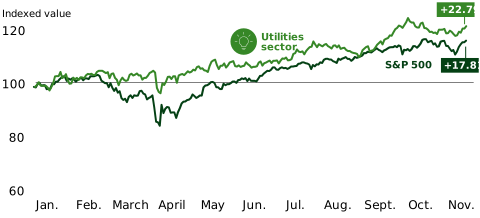
Past performance is no guarantee of future results. Utilities sector performance is represented by the MSCI US IMI Utilities 25/50 Index. Data as of November 30, 2025. Source: S&P Dow Jones Indices, a division of S&P Global, MSCI.
Outlook for 2026: More growth projected
I am optimistic about continued growth in utilities in 2026, given the expected growing demand for power. Hyperscalers are working quickly to secure long-term deals with power producers to fuel their data centers and feed power-hungry chips as demand for AI applications grows. These contracts can provide long-term visibility on earnings and growth for corporate leaders in the utilities sector.
Going forward, the build-out of infrastructure to satisfy surging power demand could require massive investment in power generation, transmission, and distribution across the sector. I believe this infrastructure expansion is likely to be a multiyear endeavor.
Given the urgency to provide high-quality, consistent power, the energy mix to expand and improve the power grid will continue to evolve. While the use of fossil fuels, such as coal and natural gas, may continue to incrementally decline, renewable energy could be a key area of growth to bridge this supply and demand power gap. According to the International Energy Agency, renewable sources, including wind and solar, are forecasted to grow from approximately 30% of energy generation in 2023 to 46% in 2030, with much of the growth centered in China. Nuclear energy is also emerging as an important alternative source, and the Trump administration’s recent executive orders could spur new U.S. investment.
AI presents strong investment opportunities—and some risks
Artificial intelligence remains the most important influence within the utilities sector. Compared with more traditional internet use cases, AI applications are much more computationally intensive. A generative AI query (for example, on ChatGPT) requires 10 times more computing power compared with an average Google search. As AI becomes more ubiquitous and far-reaching in our daily lives, increased power capacity across the U.S. will become vital.
As such, utility companies with the most exposure to powering the AI boom are poised to be among the sector’s biggest winners in the near term and over a longer-term horizon, in my opinion. Specifically, independent power producers such as Constellation Energy, and large, well-placed regional providers such as NextEra Energy and NRG Energy, are positioned to continue expanding their diversified energy footprints and engaging in partnerships with hyperscalers. As of November 30, NextEra, Constellation, and NRG are among the top holdings in Fidelity Advisor® Utilities Fund.
While we are enthusiastic about opportunities in the sector, there are also risks we are closely monitoring. Firstly, capital must be deployed effectively. Utilities need to ensure they are not overbuilding and creating stranded assets. Secondly, retail customer affordability must remain top of mind for regulated utilities. If customer bills rise appreciably, higher capital expenditures by utilities firms could become a political hot-button issue. Lastly, utilities need to make sure that large AI and industrial customers are paying their fair share, and that retail customers are not forced to subsidize these larger power consumers.
Spiking demand for power signals a dramatic shift
As power demand increases from further electrification of the U.S. power grid, efforts to onshore manufacturing and, especially, the proliferation of AI, utilities companies could experience a once-in-a-generation period of growth. From my perspective, the dramatic shift in power demand is likely to be a multiyear trend that will drive utilities sector growth for years to come.
Fidelity Advisor Utilities Fund (FFUIX)
Seeks capital appreciation.
Insight & Outlook Special Edition
Our latest investing takes and practice management tips, in an easy audio format.

Explore the 11 equity sector outlooks











All stocks mentioned in this article as fund holdings were held as of November 30, 2025.
Diversification does not ensure a profit or guarantee against loss.
It is not possible to invest directly in an index. All market indices are unmanaged. Index performance is not meant to represent that of any Fidelity mutual fund.
The S&P 500® index is a market capitalization-weighted index of 500 common stocks chosen for market size, liquidity, and industry group representation to represent U.S. equity performance. The MSCI US IMI Utilities 25/50 is a customized blend of the following unmanaged indices: MSCI US IM Utilities 25/50 Index - 100%. The composition differed in periods prior to January 01 2010.
Information presented herein is for discussion and illustrative purposes only and is not a recommendation or an offer or solicitation to buy or sell any securities. Views expressed are as of the date indicated, based on the information available at that time, and may change based on market and other conditions. Unless otherwise noted, the opinions provided are those of the author and not necessarily those of Fidelity Investments or its affiliates. Fidelity does not assume any duty to update any of the information.
References to specific securities or investment themes are for illustrative purposes only and should not be construed as recommendations or investment advice. This information must not be relied upon in making any investment decision. Fidelity cannot be held responsible for any type of loss incurred by applying any of the information presented. These views must not be relied upon as an indication of trading intent of any Fidelity fund or Fidelity advisor. Investment decisions should be based on an individual's own goals, time horizon, and tolerance for risk. This piece may contain assumptions that are "forward-looking statements," which are based on certain assumptions of future events. Actual events are difficult to predict and may differ from those assumed. There can be no assurance that forward-looking statements will materialize or that actual returns or results will not be materially different from those described here. Investing involves risk, including risk of loss.
Stock markets are volatile and can decline significantly in response to adverse issuer, political, regulatory, market, or economic developments. Because of its narrow focus, sector investing tends to be more volatile than investments that diversify across many sectors and companies. The utilities industries can be significantly affected by government regulation, financing difficulties, supply and demand for services or fuel, and natural resource conservation. Sector investing is also subject to the additional risks associated with its particular industry.