





Industrials sector
Robust fundamentals in electrical power equipment and commercial aerospace highlight investment opportunities in the sector.
Clayton Pfannenstiel is co-portfolio manager of Fidelity Advisor® Industrials Fund.
- Certain parts of the sector have benefited from structural supply constraint in 2025, which is a key feature I look for when investing in industrials.
- One industry subject to significant supply constraint near year-end is electrical power capacity, driven by soaring demand from data centers to support generative artificial intelligence.
- I have also seen major supply constraint in the production of commercial jets, which I believe has the potential to aid the growth of both original equipment manufacturers and aftermarket players in 2026 and beyond.
The industrials sector is on track to deliver a strong gain in 2025, roughly keeping pace with the broad-based S&P 500® index and topping its long-term historical average in a “risk-on” environment.
For 2026, I foresee a supportive environment for the parts of the sector supported by solid business drivers, especially structural supply constraint. With that said, U.S. manufacturing continued to reflect a slowing in activity as of the fourth quarter of 2025. Moreover, a sluggish domestic housing market could dampen the prospects for building products, and questions persist about the health of the labor market, raising the possibility of further cyclical weakness.
2025: Industrials nearing year-end about in line with the S&P 500
Industrials had a strong first half of 2025, as investors favored the group amid concern about the outlook for other growth-oriented sectors, such as information technology, given worries about the potential impact of tariffs on tech firms. However, as the tariff-related sell-off reversed on April 9, some investors shifted their attention away from industrials and back to technology. Still, the compelling supply/demand situation supporting power equipment and aerospace firms continued to lift the sector into November.
Year-to-date price return
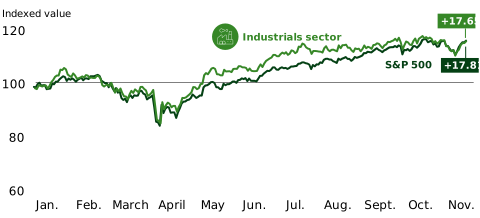
Past performance is no guarantee of future results. Industrials sector performance is represented by the MSCI US IMI Industrials 25/50 Linked Index. Data as of November 30, 2025. Source: S&P Dow Jones Indices, a division of S&P Global, MSCI.
2026: Highlighting electrical power
In the new year, the strongest reshoring opportunities I see are shaping up to be in the market for heavy electrical equipment—think large gas turbines that can supply enough electricity to power a data center. The U.S. has underinvested in power production for at least several decades, as demand flatlined for long periods amid conservation efforts and technological advances. As of late 2025, though, demand for power has skyrocketed, with data centers being planned and built both here and abroad to keep up with rapidly evolving advancement in AI.
I believe gas-fired turbines will play a key role in meeting this surging demand. Nuclear power, while appealing in many ways, takes years to bring online, and alternative power sources, such as solar and wind, are not cost-competitive or scalable enough to carry the load at this point. This leaves natural gas as the mostly likely fuel source to power data centers. Moreover, this appears to be a multiyear trend, as the rest of the world is in a similar state of limited power capacity to meet exploding demand for AI.
Against this backdrop, GE Vernova is a company that should benefit, based on my analysis. Vernova is a power-generation business spun off from General Electric in April 2024 that has fared well as a stand-alone entity. The firm’s largest division makes gas turbines for generating electricity. The stock has rallied considerably since the spin-off, and its price-earnings ratio in late 2025 is in the mid-double digits, so I am cognizant of the high expectations embedded in the stock at recent levels. But business fundamentals look solid for the foreseeable future, in my view, thus GE Vernova is a sizable holding and overweight position for the fund versus its sector benchmark.
Conviction in commercial aerospace
Commercial aerospace is another area where constrained supply appears “baked in the cake"—in other words, it’s structural in nature. The industry is divided into two segments: 1) original equipment, which includes companies that derive most of their earnings from building new planes; and 2) aftermarket businesses, which generate most of their earnings from maintaining existing aircraft.
With steadily firming air traffic, original equipment has struggled to catch up with demand after a series of production halts and COVID-related disruption. This supply disruption has created an elongated cycle of demand for aftermarket companies. The production shortfall has forced airlines to keep planes longer than anticipated: The average age of the in-service fleet near the end of 2025 stood at 12.6 years, versus 10.7 in 2017. About 80% of the in-service fleet is now out of warranty, and older aircraft traditionally require more maintenance.
Passenger airline demand: Above pre-COVID peak
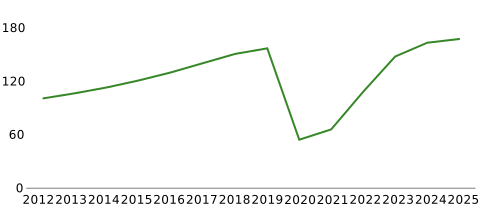
Data shows global revenue passenger kilometers, indexed to 100, year over year data. Source: International Air Transport Association, as of November 2025.
Airline industry supply: Seat capacity only, near 2013 level
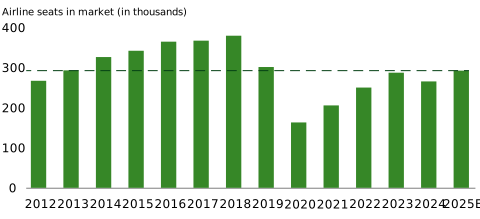
Data shows global revenue passenger kilometers, indexed to 100, year-over-year data. E = estimate. Source: International Air Transport Association, as of November 2025.
Howmet Aerospace has exposure to both the original equipment and aftermarket segments, with a high profit margin in both. The company specializes in forgings and castings, which are components of the metal parts of the plane—turbine blades, for example. Further, forgings and castings are a structural bottleneck for the industry, as manufacturing them is a challenging business requiring highly proprietary expertise in materials engineering. As with GE Vernova, while the stock has done well in the recent 2025 market rally, the company’s long-term fundamentals continue to appear strong to me. It is a top holding and overweight position for the fund.
Potential opportunity and risk in 2026
The past few years have been challenging for U.S. manufacturing, and housing activity remained extremely muted. If a recession develops in the U.S. in 2026, I believe industrial stocks would likely feel that pain, especially those with a stretched valuation. With that said, it seems reasonable to me that cyclical factors will improve at some point, after such a long period of weakness. In a broad cyclical recovery, segments of the industrial sector such as building products, air freight & logistics, and a number of others should benefit, in my view, while segments bolstered by structural supply constraint could continue to be aided by that backdrop.
Fidelity Advisor Industrials Fund (FCLIX)
Seeks capital appreciation.

Fidelity Disruptive Automation ETF (FBOT)
The fund seeks long-term growth of capital by primarily investing in securities of disruptive automation companies.

Insight & Outlook Special Edition
Our latest investing takes and practice management tips, in an easy audio format.

Explore the 11 equity sector outlooks











All stocks mentioned in this article as fund holdings were held as of November 30, 2025.
Diversification does not ensure a profit or guarantee against loss.
It is not possible to invest directly in an index. All market indices are unmanaged. Index performance is not meant to represent that of any Fidelity mutual fund.
The S&P 500® index is a market capitalization-weighted index of 500 common stocks chosen for market size, liquidity, and industry group representation to represent U.S. equity performance.
The MSCI US IMI Industrials 25-50 Index is a modified market capitalization-weighted index of stocks designed to measure the performance of Industrials companies in the MSCI US Investable Market 2500 Index. The MSCI US Investable Market 2500 Index is the aggregation of the MSCI US Large Cap 300, Mid Cap 450, and Small Cap 1750 Indices.
Information presented herein is for discussion and illustrative purposes only and is not a recommendation or an offer or solicitation to buy or sell any securities. Views expressed are as of the date indicated, based on the information available at that time, and may change based on market and other conditions. Unless otherwise noted, the opinions provided are those of the author and not necessarily those of Fidelity Investments or its affiliates. Fidelity does not assume any duty to update any of the information.
References to specific securities or investment themes are for illustrative purposes only and should not be construed as recommendations or investment advice. This information must not be relied upon in making any investment decision. Fidelity cannot be held responsible for any type of loss incurred by applying any of the information presented. These views must not be relied upon as an indication of trading intent of any Fidelity fund or Fidelity advisor. Investment decisions should be based on an individual's own goals, time horizon, and tolerance for risk. This piece may contain assumptions that are "forward-looking statements," which are based on certain assumptions of future events. Actual events are difficult to predict and may differ from those assumed. There can be no assurance that forward-looking statements will materialize or that actual returns or results will not be materially different from those described here. Investing involves risk, including risk of loss.
Stock markets are volatile and can decline significantly in response to adverse issuer, political, regulatory, market, or economic developments. Because of its narrow focus, sector investing tends to be more volatile than investments that diversify across many sectors and companies. The utilities industries can be significantly affected by government regulation, financing difficulties, supply and demand for services or fuel, and natural resource conservation. Sector investing is also subject to the additional risks associated with its particular industry.
Before investing, consider the funds' investment objectives, risks, charges, and expenses. Contact your investment professional or visit i.fidelity.com for a prospectus or, if available, a summary prospectus containing this information. Read it carefully.
Before investing, consider the exchange traded product's, investment objectives, risks, charges, and expenses. Contact Fidelity or visit i.fidelity.com for a prospectus or, if available, a summary prospectus containing this information. Read it carefully.