Billy Dietze: For our next article, we're digging into a topic that a lot of advisors are thinking about right now: how to actually reach, retain and service ultra high net worth clients. So, we're talking about folks with tens of millions in investable assets, not necessarily a huge group, but an incredibly important one when it comes to where wealth is concentrated today.
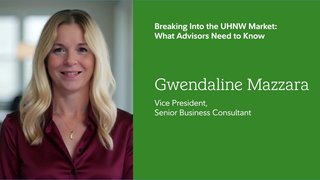
To help us unpack this, I'm joined by Gwendaline Mazzara, Vice President Senior Business consultant, who has deep expertise in this space. Gwendaline, great to have you.
Gwendaline Mazzara: It's nice to be here, Billy. Thank you.
Billy Dietze: So, let's start with an anchoring point. Can you just help us define what an ultra high net worth client is? How much money are we talking about here?
Gwendaline Mazzara: Sure. So, the ultra high net worth designation is really used for the wealthiest individuals and families. But there's some nuance in terms of what point one becomes wealthiest. So most often we see this threshold defined at $30M in investable assets. For example, Cirulli often cites that number in their reports, but there's no real broad consensus. So, it's a bit nuanced. And we'll have to think through what the ultra high net worth individual is really about. Right. And we'll talk about some of the personas later on.
Billy Dietze: Why are we hearing so much about ultra high net worth clients right now? What might be driving that focus?
Gwendaline Mazzara: Yeah. So, there's really a confluence of factors. The first is that this cohort continues to accumulate assets. So again, according to Cirulli, the assets held by this group grew 173% from 2019 to 2023.
Billy Dietze: Wow!
Gwendaline Mazzara: So, yeah, they represent only 0.2% of U.S. households, but are 19% of overall share of assets, so rather concentrated. The other factor is that wealthy families have been branching out of the traditional private bank and trust company service model into the RIA channel. And this is supported by the success of what we call multi-family offices. And then I would say last but not least, is something that I think is top of mind for all of your listeners, is this impending $124T generational wealth transfer that's happening over the next 20-ish years. But I highlight here that this is only part of the story, as it doesn't guarantee that every individual getting that transfer is going to have a large windfall.
Billy Dietze: One thing I want to circle back to is how you said that being defined as ultra high net worth isn't necessarily a number. There might be more to it than that. And I think what you're sort of getting at is there are different ways that people become wealthy, and that can kind of set them into that next tier of ultra high net worth. Can you expand on the source of wealth and how that might affect how people feel about their money and what they might expect from an advisor?
Gwendaline Mazzara: Yeah, sure. And so really, when we think about our clients or end investors, they're not monolithic, right? Whether they have a few hundred thousand dollars or again in this ultra high net worth cohort, we have to think about them beyond their investable assets. And that goes into the psychographic, right? So how do they think about money? How do they spend money, etc.
So back to the wealth origin story. There's a variety of different ways that wealth can originate. Uh, first is from entrepreneurship, right? Um, you started a company and you built a business and, uh, now it's been quite successful. The other way is perhaps, uh, you are inheriting that wealth based on somebody's, uh, previous wealth before you. And, uh, so you are an inheritor. And then again, third and last but not least is very successful executives, right? Long time employees who have accumulated wealth through equity compensation, retirement, saving a whole host of, of ways. But those are some examples.
Billy Dietze: Totally. And I can kind of see, yeah, how the source of your wealth would dictate the expectations that you put on your investment advisor. For example, if you're the first person in your family to come into a large amount of money versus, like, the fifth-generation inheritor, you probably think about your wealth very differently. Would you say that’s correct?
Gwendaline Mazzara: Yeah, absolutely. Right. In certain cases, for entrepreneurs, right, no one else in their family was an entrepreneur. Or again, they didn't come from wealth themselves, and all of a sudden, they have a lot of people calling on them. They have accumulated this large sum of cash and they need to put it to work.
They also don't necessarily have a network, right? They don't know about estate planning. They don't have a lawyer, perhaps, that can help them, again, think about their personal wealth. They might not have an advisor, right, to help guide them, on not only just their financial plan, but their wealth plan going forward.
So, that is a different set of needs perhaps, than an inheritor who over time there has been a family wealth advisor, right? So, perhaps the inheritor is G4, they know the family's advisors. They also know the family's lawyer, right? They know the family's foundation, the board of directors, right. They have, also friends - they have a cohort of their friends that are in the same investible asset class as they are. So, there's a bunch of variables that we need to think through.
Billy Dietze: I think that makes it a little tricky. Like, as an advisor, if you have a host of clients who got wealthy from different ways, who have different expectations and needs for their wealth, that almost feels a little overwhelming. Do you think maybe another strategy could be finding a lane and sticking to it versus trying to be everything to everybody?
Gwendaline Mazzara: Sure. We see that actually with multifamily offices, right? They really do, uh, double down on a niche offering first, right? Of course, you can always expand over time. And for those who are also working with business owners probably have witnessed that as well, right? The business owner has a particular area of expertise, product expertise, and then perhaps over time introduces other products. So, I think what's really important is for, again, for your listeners to think about what do we do exceptionally well today for our existing client base? And what are some of the capabilities that we have that actually may be something that the ultra high net worth cohort can benefit from already?
For example, let's just say you are working with business owners and you've noticed that you're really, really good at servicing, um, a certain type of business owner. They have a business that's, I don't know, maybe thirty to fifty million dollars in top line revenue. You know, it's a professional services business and, um, you really have got to learn about their industry over time. And so that's maybe someplace you want to start. Same thing with tech entrepreneurs. You've been working with them for quite some time, maybe continue to do that as you expand and think about expanding your business.
Billy Dietze: No, that that makes a lot of sense. I could imagine how an advisor in the Bay area has a different set of clients than maybe an advisor in South Florida. So, let's shift and move over to pricing because I know that is another hot button, you know, topic when it comes to servicing extremely wealthy individuals. Can you still get away charging, say one hundred basis points?
Gwendaline Mazzara: So pricing, pricing, discipline and analysis is, is very important to, uh, all of the practices that are looking to build their business again, whether it be for ultra high net worth or mass market now on the ultra high net worth because of the investable assets. Sure. We, we start to see a difference in in pricing tiers. So for example, clients that are in the one to three million dollar range, perhaps we're seeing things around 80-100 Bips, etc.. And then when you get to clients over that $50M investable asset threshold, sure. It tends to be closer to, again, that 45-50 Bips.
Now, the takeaway here though, isn't the exact numbers, right? Because ultimately the practices, the businesses, the advisory practices are going to define that themselves, right? Based on their business needs and, um, revenue targets. It's really around what does the pricing represent for the service we're offering to this end client. Right. So ,with the ultra high net worth, it's broader than just investments.
There's a lot of planning estate coordination. Again, family governance is very important at that level. And it almost becomes more consulting, right. And so how do we make sure as a business, we are getting compensated for the time that we're spending with our families, our ultra high net worth families and the real intellectual capital we're, we're bringing to this conversation and helping them think through a decision matrix for their generation and generation four, five, six, and beyond. So what we often see in these asset thresholds is a variety of pricing structure, right?
So, sure, we'll still be doing assets under management, right? We'll think about capturing that pricing, but we'll also introduce things like retainers, right? For ongoing planning or project based fees, right? For specific events that are happening in, in the ultra high net worth life. Again, it's, it's a way to Separate fees for those non-investment services like also bill pay is in this category, right? Tax prep. And, uh, philanthropic administration, the point that there's some real flexibility here in how you price.
Billy Dietze: I appreciate that. Yeah, that that's some interesting ways of thinking about, you know, how to still maintain the profitability of your own business while you help these families with, with their own complex lives.
As we wrap up here, Gwen, I want to make sure that we leave the advisors listening to this conversation with some practical advice. And I want to circle back to something you mentioned a few moments ago about auditing your own capabilities first. Can you expand on that and leave our audience with some practical things to take away?
Gwendaline Mazzara: Sure. So first, it's always important to just really understand the business itself and the competitive landscape, right? So, what's going on in this cohort and how has the service offering evolved? Then I would really take a look at your own business.
And as I mentioned before, do you have clients that are maybe on the cusp of this threshold? Right. So, what are some capabilities that that have been mentioned today that maybe you can expand upon because you actually already have a pretty good understanding of some of these areas?
And then also think about, perhaps, relationships or partnerships within your own ecosystem that you can lean on to outsource, right? Instead of going all in. Uh, perhaps you just want to again, test the waters. And that's, and that's common, right? To see, maybe we're just going to service one or two families and we're going to think about outsourcing. And then you can evolve it over time.
And we've actually developed a framework around this at Fidelity, right? It's called the Ultra High Net Worth Framework to really start thinking about when it comes to planning, for example, right? What is the scope of offering you have around wealth, growth and protection? What do you offer there, right? Capital preservation, complex cash management, uh, as it relates to holistic family support. How are you helping families think through family cohesion, right? Or personal security. And last but not least is getting around the client experience. Is it a white glove client experience? Do you have an integrated team supporting these families? Just some examples there.
Billy Dietze: No, that's all great advice. Thank you. And I think that's a great place for us to wrap. Gwendaline, I really appreciate you joining us today.
Gwendaline Mazzara: Thank you for having me.
Billy Dietze: If you'd like to learn more about servicing the ultra high net worth segment, we've provided additional resources and readings at the bottom of this page. Thanks for listening.