





Materials sector
Copper and precious metals equities may be positioned for continued growth in 2026, along with chemicals firms supporting the massive artificial intelligence build-out.
Ashley Fernandes is portfolio manager of Fidelity Advisor® Materials Fund.
- The materials sector underperformed the broad-based U.S. equity market in 2025.
- During the past year, metals- and construction-related stocks fared best, whereas the chemicals industry was plagued by stagnant demand and overcapacity.
- Looking ahead, I think copper and precious metals equities are positioned for continued growth in 2026, and chemicals firms supporting the massive artificial intelligence build-out could continue to show strength.
Stocks in the materials sector advanced in 2025 but notably lagged the broad-based S&P 500® index. The sector’s sluggish relative performance was due to both broad macroeconomic and sector-specific factors. Materials is a highly cyclical sector—that is, its performance tends to track closely with that of the larger economy. It is also among the most sensitive to the interest-rate environment. In early 2025, materials stocks were held back by uncertainty about shifting U.S. trade policy and persistently high consumer inflation, along with the U.S. Federal Reserve’s decision to pause its monetary easing campaign for much of the year after cutting rates three times in 2024. The sector gained some momentum by late spring and summer as concerns about a potential trade war subsided and the Fed signaled that it might resume cutting its policy interest rate later in the year, which it eventually did.
Year-to-date price return
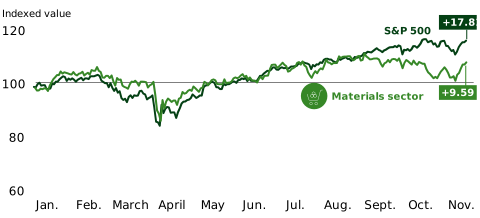
Past performance is no guarantee of future results. It is not possible to invest directly in an index. All market indices are unmanaged. Index performance is not meant to represent that of any Fidelity mutual fund. Materials sector performance is represented MSCI US IMI Materials 25/50 Linked index. Data as of November 30, 2025. Source: S&P Dow Jones Indices, a division of S&P Global, MSCI.
Apart from these developments, supply and demand vary widely for different materials markets and often are the primary driver of investment outcomes. Let’s look at how those dynamics influenced performance in 2025, and what they may mean for the sector in 2026.
2025: Wide disparity among industry segments
The materials sector encompasses industries such as chemical producers (including makers of fertilizer and industrial chemicals), metals producers (including gold and copper miners, and steel manufacturers), makers of construction materials (such as cement, bricks, glass, and gravel), and producers of wood-based goods (such as lumber and paper packaging).
The environment for metals and construction stocks in 2025 has been constructive, whereas chemical producers have been plagued by stagnant demand and overcapacity. Among the latter, specialty chemicals and industrial gases—the two largest segments, at about 24% and 21% of total assets, respectively, in the sector benchmark, the MSCI U.S. IMI Materials 25/50 Index—have lost modest ground year to date, while the smaller commodity chemicals group has been especially hard hit, hurt by high inventory amid weakening industrial activity.
In contrast, precious metals such as gold and silver have led all other materials segments. Building-related metals such as steel and copper have also meaningfully advanced, as have construction materials, which was helped by the improving interest-rate backdrop in the second half of 2025.
Industry performance in the materials sector
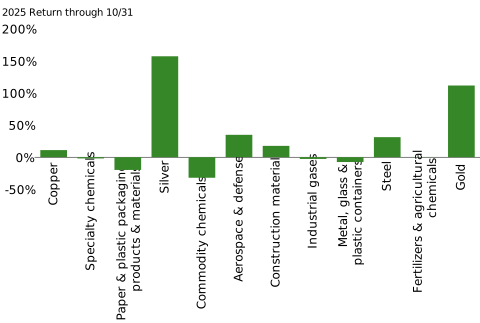
Past performance is no guarantee of future results. It is not possible to invest directly in an index. All market indices are unmanaged. Index performance is not meant to represent that of any Fidelity mutual fund. Source: MSCI U.S. IMI Materials 25/50 Index and Fidelity Investments, as of October 31, 2025.
2026: Stock and industry selection will be key
The U.S. macroeconomic outlook for 2026 remains uncertain, with positive indicators, including strong corporate earnings and consumer spending, set against less-positive signals, mainly persistently high inflation and a softening job market.
Though the macro picture is cloudy, I believe several materials subindustries are well-positioned for growth. I continue to be bullish on the long-term prospects for copper, an industry where supply is increasingly constrained while demand continues to grow. Among copper-intensive segments, electric-vehicle growth has slowed in the U.S. but accelerated in China; growth for renewable energy sources has continued, albeit at a slower pace than I expected; and the build-out of electric-power capacity for AI-capable data centers is a significant new source of demand. The copper market is often subject to near-term volatility, but I believe the long-term trend is inexorably upward.
Elsewhere, I think some recently beleaguered chemicals stocks could be in line for a rebound. Specifically, investors have begun to recognize the growth potential for certain specialty chemicals firms that are supporting the massive effort to build AI-related hardware and infrastructure as quickly as possible. In addition, I think valuations for commodity chemicals equities have fallen to a point where there is the potential for recovery as market dynamics change. In each of these areas, careful stock selection will be key to success.
Among precious metals, I am somewhat cautious about gold—as I believe the huge recent growth may be unsustainable—but I think silver could have some more room to run. The latter has made a slow transition to being viewed more like gold as a store of value, while at the same time, industrial demand for the metal has risen. Silver is a very small sector component, but its profile is rising and merits consideration as a modest portfolio position.
Conviction in select copper, specialty chemical and gold producers
Among copper producers, the largest position in Fidelity Advisor® Materials Fund is Canada-headquartered First Quantum Minerals. The stock has rebounded strongly since Panama’s government unexpectedly shut down the company’s top copper-mining operation in late 2023. First Quantum has increased production at its other copper facilities, and has been helped by high prices for gold, which it mines at its site in Zambia. Though the stock’s valuation has become a bit high, I think if the company continues to grow production and improve its financial position, it could do very well in a supply-constrained copper market.
Within specialty chemicals, Florida-based Element Solutions, another fund holding, is one of the firms that has established a strong place in the AI-development chain. The company’s electronics division recently posted its sixth consecutive quarter of organic growth, driven by demand from data centers and semiconductor manufacturers, and the firm’s financial guidance reflects confidence for sustained growth in this area.
Lastly, for exposure to gold and other precious metals, I favor the model offered by certain streaming and royalty firms. Though several mining companies have had a strong run the past couple of years, gold mining remains a difficult and expensive enterprise. Royalty companies, in contrast, provide upfront financing to mining firms and then purchase the mined metals at a predetermined price. With this model, they are able to exert an enviable amount of control over operating risk and revenue. Notable fund holdings in this area include Wheaton Precious Metals and Altius Minerals.
A sharp focus on supply and demand
While the economic backdrop will always play a role in the trajectory of stocks in the materials sector, in managing the fund I am focused squarely on supply and demand for the individual commodities that are represented in the sector. Then, I choose companies that, in my view, have a strong balance sheet and low political risk. This approach remains consistent through all broad-market conditions.
Fidelity Advisor Materials Fund (FMFEX)
Seeks capital appreciation.

Insight & Outlook Special Edition
Our latest investing takes and practice management tips, in an easy audio format.

Explore the 11 equity sector outlooks










All stocks mentioned in this article as fund holdings were held as of November 30, 2025.
Diversification does not ensure a profit or guarantee against loss.
The S&P 500® index is a market capitalization-weighted index of 500 common stocks chosen for market size, liquidity, and industry group representation to represent U.S. equity performance. The MSCI US IMI Materials 25-50 Index is a modified market capitalization-weighted index of stocks designed to measure the performance of Materials companies in the MSCI US Investable Market 2500 Index. The MSCI US Investable Market 2500 Index is the aggregation of the MSCI US Large Cap 300, Mid Cap 450, and Small Cap 1750 Indices.
Information presented herein is for discussion and illustrative purposes only and is not a recommendation or an offer or a solicitation to buy or sell any securities. Views expressed are as of the date indicated, based on the information available at that time, and may change based on market and other conditions. Unless otherwise noted, the opinions provided are those of the author and not necessarily those of Fidelity Investments or its affiliates. Fidelity does not assume any duty to update any of the information.
References to specific securities or investment themes are for illustrative purposes only and should not be construed as recommendations or investment advice. This information must not be relied upon in making any investment decision. Fidelity cannot be held responsible for any type of loss incurred by applying any of the information presented. These views must not be relied upon as an indication of trading intent of any Fidelity fund or Fidelity advisor. Investment decisions should be based on an individual's own goals, time horizon, and tolerance for risk. This piece may contain assumptions that are "forward-looking statements," which are based on certain assumptions of future events. Actual events are difficult to predict and may differ from those assumed. There can be no assurance that forward-looking statements will materialize or that actual returns or results will not be materially different from those described here. Investing involves risk, including risk of loss.
Stock markets are volatile and can decline significantly in response to adverse issuer, political, regulatory, market, or economic developments. Because of its narrow focus, sector investing tends to be more volatile than investments that diversify across many sectors and companies. The materials industries can be significantly affected by the level and volatility of commodity prices, the exchange value of the dollar, import controls, worldwide competition, liability for environmental damage, depletion of resources, and mandated expenditures for safety and pollution control. Sector investing is also subject to the additional risks associated with its particular industry.