





Energy sector
A focus on companies with lower costs, a contracted business model, and exposure to higher demand for power amid an outlook for range-bound oil prices.
Kristen Dougherty is portfolio manager of Fidelity Advisor® Energy Fund
- The price of crude oil is likely to remain range-bound in 2026, as phased output increases from the Organization of the Petroleum Exporting Countries are gradually absorbed by steady global demand.
- Spare oil capacity should decline through 2026, which combined with a decade of under-investment in exploration, should sow the seeds for the next up cycle in oil prices.
- Companies with a low cost structure or that have a contracted business model are well-positioned to succeed in this environment.
- Rising power demand, largely driven by the build-out of AI-related data centers, could create compelling tailwinds for certain areas in the sector, including power producers and some energy services companies in the years to come.
Energy stocks have achieved solid gains so far in 2025, but lagged the strength of the broad-based S&P 500® index, due largely to headwinds from weaker crude oil prices and volatile natural gas prices. Crude-oil prices have fallen in spite of healthy global demand and ongoing elevated geopolitical risk because producers in the Organization of the Petroleum Exporting Countries (OPEC) have increased supply more quickly than the market expected. However, by increasing that supply, OPEC is eating away at the last and largest source of global spare capacity in oil production, which I believe will set the sector up for a more durable next up cycle in oil prices over the intermediate term. Natural gas prices have been volatile in 2025, as U.S. production has held up better than I expected, given the reduction in drilling of new wells. Going forward, I expect new demand for liquid natural gas (LNG) exports to provide a larger global market for this U.S. production, and longer-term demand is likely to be driven by the build-out of data centers to power artificial intelligence capabilities.
2025: Energy stocks fared well, but lag the broader market
The broad U.S. stock market performed well in 2025, as measured by the S&P 500® index, driven in large part by investor enthusiasm for the growth in AI capabilities and infrastructure among companies in many industries, including the potential for productivity improvement and the required spending on data centers to support it. While this trend can boost energy companies, they are not the primary beneficiaries. As a result, the energy sector lagged the strong outcome of the S&P 500® index in 2025.
Year-to-date price return
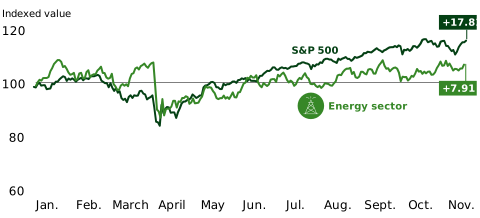
Past performance is no guarantee of future results. Energy sector performance is represented by the MSCI US IMI Energy 25/50 Index. Data as of November 30, 2025. Source: S&P Dow Jones Indices, a division of S&P Global, MSCI.
Energy sector dynamics: More U.S. policy balance, production efficiency and a foundation for growth
In 2025, an intense focus on climate change and the resulting push toward renewables abated, allowing for a more balanced approach by U.S. policymakers, one that is based on energy diversity, security, and affordability. The tone has shifted from when the industry will experience peak demand for oil, to whether the industry will experience it. This has implications across the value chain in the energy sector, giving upstream producers more confidence to plan long-term projects, and midstream companies more visibility to support those projects with infrastructure. In 2026, I expect more offshore projects to be sanctioned, and more pipeline routes to be proposed, with a greater degree of policy support than the industry has experienced in the recent past.
The energy-supply mix has been fundamentally changed by the addition of U.S. shale, which has evolved from an emerging-growth technology play into a very mature, repeatable manufacturing process. U.S. oil and gas producers have become much more efficient in how they drill and complete shale wells, and they are now able to produce at a notably higher level using a much smaller base of equipment. In 2026, I expect production efficiency to further improve, but the magnitude of the improvement to moderate, as best-in-class operators start to see diminishing returns and smaller operators exhaust their highest-quality inventory.
U.S. crude & natural gas production vs. rig count
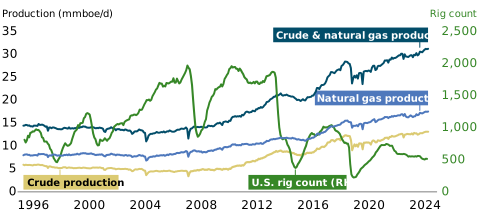
MMboe/d stands for million barrels of oil equivalent per day, which is a unit of measurement used to express the amount of energy produced.
Source: U.S. Energy Information Administration
The marginal cost of discovering, producing, and transporting a barrel of crude oil has been falling in recent years, thanks largely to the addition of U.S. shale sources and success driving efficiencies from them, but that falling cost has created a headwind for the per-barrel price of oil. In the long term, oil is a highly liquid global commodity. Lower per-barrel prices limit producers’ investment in short-cycle resources, bringing down supply and ultimately balancing the market, until there is once again a tailwind for the price per barrel.
In 2026, I expect this cycle to start to turn, and the marginal cost of oil to start rising again, as low-cost producers in OPEC work through their spare capacity, U.S. shale producers see efficiency moderate and acreage-quality erode, and global integrated energy companies see the need to invest more heavily in early-stage exploration, which is expensive. I believe these developments provide a foundation for the next up cycle in the price of oil, which is a key factor in corporate profitability in the sector. Companies with a low cost structure or that have a contracted business model are well-positioned to succeed in this environment, in my view.
Investment theme: Exposure to growth in AI and power demand
Looking ahead, one key question for the energy complex is how and when the rising demand for power to support data centers used intensively by AI will drive cash flows across the value chain in energy. In many cases, market expectations have differed from where I expect to see the cash flow benefit. Within the upstream segment, higher use of data centers will drive higher demand for natural gas, but that demand will grow over time as the data center build-out evolves. In the near term, demand for natural gas will be influenced by winter weather much more than by data centers. Within the midstream segment, the growth of data centers will require significant infrastructure build-out, but these are multiyear projects, only some of which will come to fruition even with a more supportive policy environment at the federal level. Within oilfield services, many companies are looking to adapt their business model from providing mobile power to a remote oilfield to providing it to a data center, but the terminal value of that business model is unclear when grid-supplied power remains more efficient.
Vistra and Baker Hughes are two portfolio holdings I think will benefit from the growth of AI and the rising demand for power more than the market expects. As an independent power producer, Vistra is on the front lines of generating the power that will be required, and the stock’s valuation does not yet fully reflect the higher power prices that I expect in its markets. I consider Vistra, an out-of-benchmark fund holding, to be well-positioned to benefit from growing demand for power in its markets and difficulty adding supply, given the constraints of accessing utility-scale gas turbines.
As an oilfield services provider, Baker Hughes has bolstered the industrial side of its business and, in my view, is well-positioned to provide equipment linked to the growth of natural gas for use in power generation. Its equipment ranges from smaller-scale gas turbines to gas processing and compression equipment that forms the backbone of gas infrastructure. While I don’t know which specific pipeline route will survive permitting, I believe natural gas distribution infrastructure broadly will require refreshed investment to support growth in demand for power, and the equipment provided by Baker Hughes will be in significant demand.
The long-term outlook is shaping up to be attractive
While I believe global oil prices are likely to remain range-bound in 2026 due to phased-out OPEC increases and steady global demand, I think the energy sector can continue to make progress developing long-term projects with attractive economics, eking out short-term efficiencies, returning capital to shareholders, and setting the stage for the next up cycle. I plan to continue to focus on companies that I believe can ride out short-term volatility and that can build a differentiated business model even in a commodity-linked industry. As of year-end, I see many energy companies that are well-positioned to achieve a strong through-cycle return on capital and that trade at a modest valuation, and I will continue to invest in them.
Fidelity Advisor Energy Fund (FFNWX)
Seeks capital appreciation.

Insight & Outlook Special Edition
Our latest investing takes and practice management tips, in an easy audio format.

Explore the 11 equity sector outlooks









All stocks mentioned in this article as fund holdings were held as of November 30, 2025.
It is not possible to invest directly in an index. All market indices are unmanaged. Index performance is not meant to represent that of any Fidelity mutual fund.
Diversification does not ensure a profit or guarantee against loss.
The S&P 500® index is a market capitalization-weighted index of 500 common stocks chosen for market size, liquidity, and industry group representation to represent U.S. equity performance. The MSCI U.S. IMI Energy 25-50 Index is a modified market capitalization-weighted index of stocks designed to measure the performance of Energy companies in the MSCI U.S. Investable Market 2500 Index. The MSCI U.S. Investable Market 2500 Index is the aggregation of the MSCI U.S. Large Cap 300, Mid Cap 450, and Small Cap 1750 Indices.
Information presented herein is for discussion and illustrative purposes only and is not a recommendation or an offer or solicitation to buy or sell any securities. Views expressed are as of the date indicated, based on the information available at that time, and may change based on market and other conditions. Unless otherwise noted, the opinions provided are those of the author and not necessarily those of Fidelity Investments or its affiliates. Fidelity does not assume any duty to update any of the information.
References to specific securities or investment themes are for illustrative purposes only and should not be construed as recommendations or investment advice. This information must not be relied upon in making any investment decision. Fidelity cannot be held responsible for any type of loss incurred by applying any of the information presented. These views must not be relied upon as an indication of trading intent of any Fidelity fund or Fidelity advisor. Investment decisions should be based on an individual's own goals, time horizon, and tolerance for risk. This piece may contain assumptions that are "forward-looking statements," which are based on certain assumptions of future events. Actual events are difficult to predict and may differ from those assumed. There can be no assurance that forward-looking statements will materialize or that actual returns or results will not be materially different from those described here. Investing involves risk, including risk of loss.
Stock markets are volatile and can decline significantly in response to adverse issuer, political, regulatory, market, or economic developments. Because of its narrow focus, sector investing tends to be more volatile than investments that diversify across many sectors and companies. The energy industries can be significantly affected by fluctuations in energy prices and supply and demand of energy fuels, energy conservation, the success of exploration projects, and tax and other government regulations. Sector investing is also subject to the additional risks associated with its particular industry.