





Consumer discretionary sector
Housing-related stocks and discount retailers offer growth potential, even as macroeconomic uncertainty squeezes some consumers.
Jordan Michaels is a portfolio manager of Fidelity Advisor® Consumer Discretionary Fund.
- Consumer discretionary stocks lagged the broader U.S. equity market well into the fourth quarter of 2025 amid elevated inflation and interest rates, policy uncertainty and government program disruptions.
- Although these macro drivers continue to warrant some caution for 2026, interest rate cuts could ease the burden among some consumer categories and many domestic retailers are adapting to higher tariffs.
- Cyclical tailwinds and the possibility of lower interest rates could fuel growth for home improvement and home furnishing retailers in 2026.
- Persistent inflation and economic uncertainty could drive value-focused consumers to off-price and discount retailers.
Consumer discretionary stocks rose in 2025 but lagged the broader U.S. market as the consumer backdrop stayed choppy. Tariff shifts under the Trump administration, cuts to some government support programs, stubborn inflation, and a softening job market hit lower-income households hardest, while wealthier consumers benefited from rising capital markets and home prices. Meanwhile, investor attention largely gravitated toward AI-linked sectors, leaving many consumer discretionary stocks struggling to keep up.
While the macro backdrop may be unpredictable, consumer discretionary is a diverse sector that typically offers investment opportunities in any environment. In 2026, some industries may even be set up for a cyclical lift. For example, home-improvement retailers and furnishings companies could get a further boost if lower interest rates revive housing, while discount retailers stand to gain as shoppers hunt for value amid rising prices.
2025: Spending persists as pressures build
Still-high inflation and concerns over Trump administration actions, including shifting tariff policies and government program disruptions, weighed on consumer sentiment in 2025. Spending held up overall, but shoppers became more discerning, as spending on fast-casual dining and big-ticket items like homes, autos and high-end appliances softened.
2025 saw slower growth amid federal government funding cuts, layoffs and macro uncertainty. And although the Federal Reserve cut its benchmark rate by 25 basis points in both September and October to support the labor market, consumer borrowing rates on credit cards and mortgages remained stubbornly elevated.
Amid this backdrop, industry performance within the sector was mixed. The stocks of luxury and footwear retailers struggled with tariff uncertainty, customer resistance to higher prices and heightened competition, while fast-casual restaurants felt the pinch from elevated inflation and other pressures on lower-income consumers. On the positive side, auto parts & equipment and auto retailers surged in 2025, helped by attractive starting valuations and growing demand for replacement parts as consumers held onto their existing vehicles for longer. These groups also weathered the negative impact of higher tariffs better than expected.
Year-to-date price return
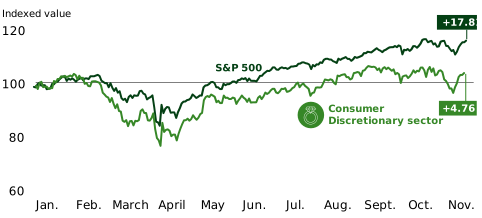
Past performance is no guarantee of future results. Consumer discretionary sector performance is represented by the MSCI US IMI Consumer Discretionary 25/50. Data as of November 30, 2025. Source: S&P Dow Jones Indices, a division of S&P Global, MSCI.
2026: Pockets of opportunity in a shaky market
There are several reasons to remain cautious in the near term, particularly with tariff effects working their way through supply chains. Consumer sentiment recently softened and inventories in key markets—including certain durable goods and areas of manufacturing—returned to pre-pandemic levels, chipping away at pricing power. Inflation and borrowing costs remain high and big-ticket categories continue to feel the squeeze.
There are bright spots, though. Further interest rate cuts—which are expected in 2026—could ease pressure on housing and durables, and the broader U.S. economy has remained resilient. Higher-income households have benefited from strong capital markets and home prices, and some consumer categories are holding up far better than others. Additionally, many companies—especially some retailors—are showing surprising agility in sourcing away from imports and toward domestic alternatives.
Although it’s important to monitor the macro backdrop, my investment approach is grounded in fundamental research and company-specific analysis. I’m focused on owning competitively advantaged consumer discretionary firms—specifically, businesses across a variety of industries with strong market positioning and clear differentiators that can perform well across a range of scenarios.
Conviction in home-related names and discount retailers
Home improvement retailing is highly interest-rate sensitive and, in my view, stands to benefit from lower interest rates, including on mortgages and home equity loan lines of credit, which could spark refinancing activity. With U.S. homes near record prices, housing stock has continued to grow and age, necessitating greater maintenance. Most home improvement activity has focused on upkeep rather than large discretionary projects, which have been depressed and may be poised for a rebound. Severe weather is also driving increased repair across the country. Lowe’s is a standout as the second-largest home improvement retailer in the country. The company made significant strides in operational efficiency and recently has been growing earnings faster than its main competitor, Home Depot. At the same time, I believe Floor & Decor Holding, a specialty flooring retailer, offers a unique value proposition to customers, including a wide product selection, ample on-hand inventory and competitive pricing. Both Lowe’s and Floor & Decor are outsized fund holdings relative to the fund’s sector index.
Existing home sales
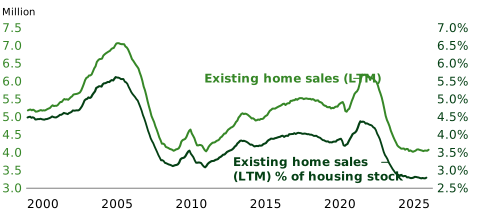
Source: National Association of Realtors, U.S. Census, Fidelity Investments, as of September 30, 2025.
I also see opportunity among home furnishing names, including bedding manufacturer Somnigroup International, another outsized fund position. Bedding remains a depressed category, though signs of stabilization are emerging. Somnigroup is the clear industry leader, gaining significant market share as competitors struggle. Williams-Sonoma is another potential standout. The company continues to win share with its on-trend home goods and small appliances, bolstered by a supply chain and sourcing strategy that resonates with customers. Williams-Sonoma is a top-20 fund position.
I believe value-focused retailers are another compelling opportunity in 2026. Off-price leaders like TJX, Ross Stores and Ollie’s Bargain Outlet capitalize on excess and cancelled inventory from full-price retailers, buying it at steep discounts and passing those savings on to increasingly bargain-conscious customers. Similarly, persistent inflation and economic uncertainty are boosting traffic for Dollar Tree and other discount chains. Importantly, these business models tend to be less economically sensitive than many specialty retailers, which may offer some added resilience if the recent bumpy market environment persists. All these companies are notable fund positions.
Disciplined investing in an uncertain market
Entering 2026, the consumer and economic pictures still come with near-term risks. But while I stay mindful of the macro landscape, my approach is driven by bottom-up, company-by-company research and a clear view of each firm’s business fundamentals.
The consumer discretionary sector is broad, and even in uncertain markets it can offer compelling pockets of value. With Fidelity’s deep research resources, I aim to identify those companies with strong risk-reward profiles and durable long-term growth potential.
Fidelity Advisor Consumer Discretionary Fund (FFNQX)
Seeks capital appreciation.

Insight & Outlook Special Edition
Our latest investing takes and practice management tips, in an easy audio format.

Explore the 11 equity sector outlooks











All stocks mentioned in this article as fund holdings were held as of November 30, 2025.
Diversification does not ensure a profit or guarantee against loss.
It is not possible to invest directly in an index. All market indices are unmanaged. Index performance is not meant to represent that of any Fidelity mutual fund.
LTM represents last twelve months, often used in financial metrics.
The MSCI US IMI Consumer Discretionary 25/50 Index represents the performance of the MSCI US IM Consumer Discretionary 25/50 Index since January 1, 2010, and the MSCI US Investable Market Consumer Discretionary Index prior to that date. The S&P 500® index is a market capitalization–weighted index of 500 common stocks chosen for market size, liquidity, and industry group representation to represent U.S. equity performance.
Information presented herein is for discussion and illustrative purposes only and is not a recommendation or an offer or solicitation to buy or sell any securities. Views expressed are as of the date indicated, based on the information available at that time, and may change based on market and other conditions. Unless otherwise noted, the opinions provided are those of the author and not necessarily those of Fidelity Investments or its affiliates. Fidelity does not assume any duty to update any of the information.
References to specific securities or investment themes are for illustrative purposes only and should not be construed as recommendations or investment advice. This information must not be relied upon in making any investment decision. Fidelity cannot be held responsible for any type of loss incurred by applying any of the information presented. These views must not be relied upon as an indication of trading intent of any Fidelity fund or Fidelity advisor. Investment decisions should be based on an individual's own goals, time horizon, and tolerance for risk. This piece may contain assumptions that are "forward-looking statements," which are based on certain assumptions of future events. Actual events are difficult to predict and may differ from those assumed. There can be no assurance that forward-looking statements will materialize or that actual returns or results will not be materially different from those described here. Investing involves risk, including risk of loss.
Stock markets are volatile and can decline significantly in response to adverse issuer, political, regulatory, market, or economic developments. Because of its narrow focus, sector investing tends to be more volatile than investments that diversify across many sectors and companies. The consumer discretionary industries can be significantly affected by the performance of the overall economy, interest rates, competition, consumer confidence and spending, and changes in demographics and consumer tastes. Sector investing is also subject to the additional risks associated with its particular industry.
Before investing, consider the funds' investment objectives, risks, charges, and expenses. Contact your investment professional or visit i.fidelity.com for a prospectus or, if available, a summary prospectus containing this information. Read it carefully.